Facts
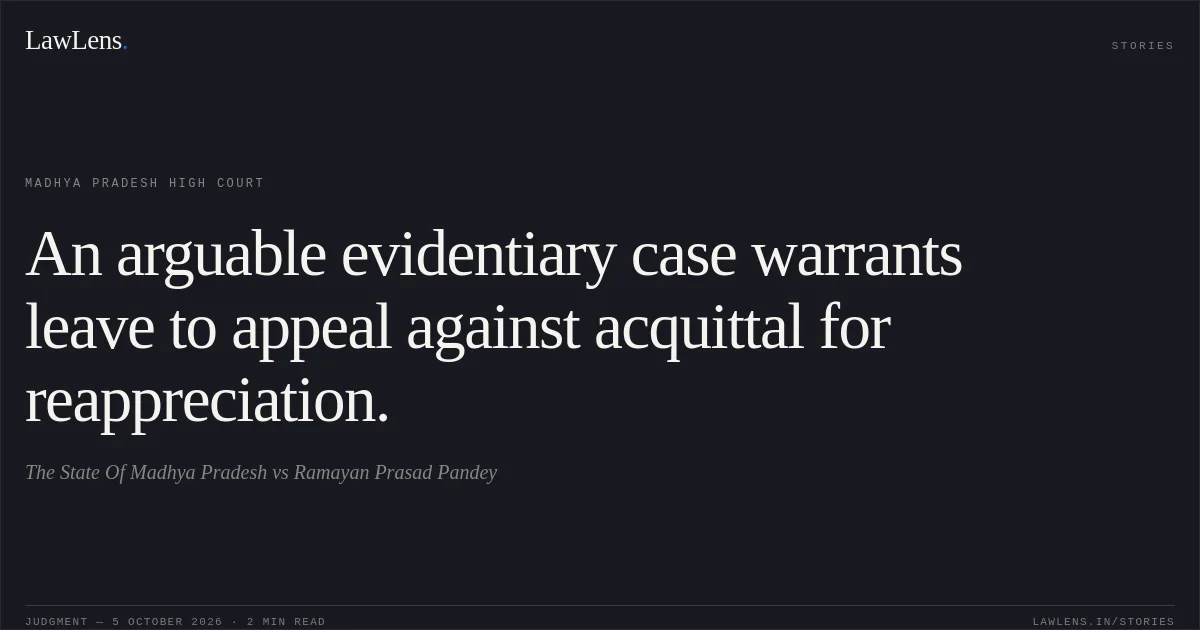
The State sought leave under Section 378(3) CrPC to appeal the respondent’s acquittal, dated 13 August 2019, of offences under Sections 7 and 13(1)(d) read with Section 13(2) of the Prevention of Corruption Act, 1988.
Source reference: para. 3The prosecution alleged that the respondent, a Patwari, demanded money in connection with revenue proceedings and accepted ₹3,000 in a trap; phenolphthalein-treated currency notes were recovered from his shirt pocket and traces were found on his hands and pocket.
Source reference: para. 4(a)The complainant initially supported the allegation but later gave an inconsistent account, and the respondent’s defence was that the money related to fines imposed for encroachment. The trial court accepted the defence and acquitted him.
Source reference: paras. 7, 19Issues
1. Whether the State’s application raised a prima facie and arguable case warranting leave to appeal against the acquittal.
Source reference: paras. 9, 202. Whether the evidence concerning the alleged demand and acceptance, the recovery of the tainted money, and the defence that it represented payment of a fine required reappreciation in appeal.
Source reference: paras. 19–20Law Applied
Section 378(3) CrPC requires the State to obtain leave before an appeal against acquittal may proceed. Under State of Maharashtra v. Sujay Mangesh Poyarekar, the leave court considers whether a prima facie case or arguable point exists; it should not conduct a final merits determination at that stage, and leave is warranted where the evidence requires deeper scrutiny.
Source reference: para. 9Under Neeraj Dutta v. State (NCT of Delhi), proof of demand and acceptance of illegal gratification is essential to establish the relevant offences under the Prevention of Corruption Act; those facts may be proved by direct or circumstantial evidence, and the Section 20 presumption applies to Section 7 once the facts in issue are proved.
Source reference: para. 17The Court also considered authorities addressing the need to prove demand and the limited significance of recovery alone in the absence of such proof.
Source reference: paras. 11–16Reasoning
The Court considered the complainant’s initial account of demand and acceptance, his identification of the voices in the recorded conversation, and the recovery of the tainted notes from the respondent’s shirt pocket, together with the phenolphthalein traces, as circumstances requiring closer examination.
Source reference: para. 20The complainant’s later inconsistent testimony did not, at the leave stage, dispose of the earlier account or the corroborating circumstances. Nor could the fine-payment defence be accepted without examining the prescribed method of depositing a government fine and the absence of an official receipt; the trial court’s treatment of these circumstances raised an arguable issue for appellate reappreciation.
Source reference: paras. 19–20The Court expressly avoided reaching a final view on guilt or the correctness of the acquittal.
Source reference: para. 20Holding
The Court held that an arguable case for reappreciation had been made out and granted leave to appeal without expressing any final opinion on the merits.
It directed the Registry to convert the miscellaneous criminal case into a regular criminal appeal, admitted the appeal for final hearing, and directed that it be listed in the December 2026 final-hearing list.
Source reference: paras. 21–24Acts & Sections Cited
4 provisions across 2 statutes referred to in this judgment. Each provision opens on LawLens.
Code of Criminal Procedure, 19731
Prevention of Corruption Act, 19883
Original Court PDF
The State Of Madhya PradeshvsRamayan Prasad Pandey
Click to open original judgment
Original judgment, available to read, download and summarize on LawLens.in