Facts
The petitioner, engaged in information-technology-enabled support, software-development and business-process outsourcing services, claimed a deduction of ₹1,19,15,838 under Section 80JJAA of the Income Tax Act, 1961, representing 30% of additional employees’ cost incurred during financial years 2016–17 and 2017–18.
Source reference: p.2, para. 2For assessment year 2018–19, the petitioner filed its revised return declaring total income of ₹10,02,19,300. The return was selected for scrutiny, and the Assessing Officer called for details concerning the Section 80JJAA deduction, including employee particulars and earlier-year claims. The petitioner furnished the requested details and supporting documents.
Source reference: p.2, para. 2.1; p.4, para. 6By assessment order dated 2 February 2021 under Section 143(3), the Assessing Officer accepted the deduction after recording that the details of eligible additional employees had been furnished and verified.
Source reference: p.5, para. 7Subsequently, the respondent issued a notice under Section 148A(b), alleging that the petitioner had wrongly claimed ₹85,66,720 in respect of employees recruited during financial year 2016–17, and passed an order under Section 148A(d), followed by a notice under Section 148.
Source reference: p.3, para. 2.2Issues
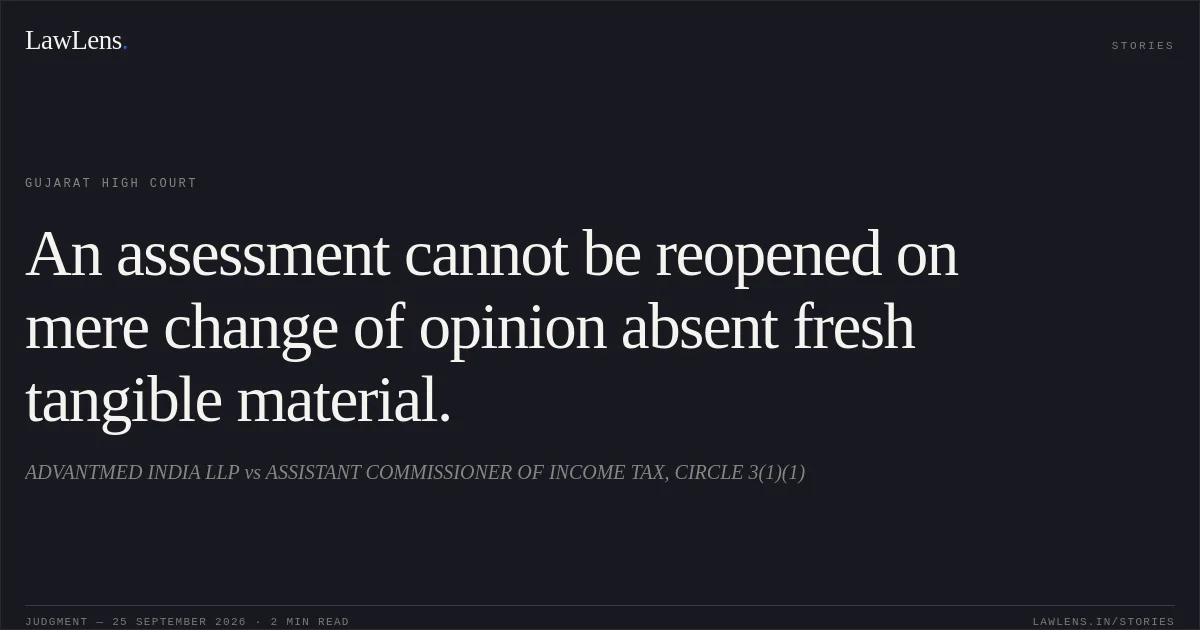
Whether the notice issued under Section 148 and the order passed under Section 148A(d) for assessment year 2018–19 were invalid as being based on a mere change of opinion after the same Section 80JJAA claim had been examined and accepted in scrutiny assessment under Section 143(3).
Source reference: p.1, para. 1; p.5, para. 7Whether the respondent had identified any fresh or tangible material, independent of the material examined during the original scrutiny assessment, to establish escapement of income chargeable to tax.
Source reference: p.6, para. 8Law Applied
The Court applied Sections 143(2) and 143(3) of the Income Tax Act, 1961, governing scrutiny assessment; Section 80JJAA, concerning deduction for eligible additional employees; and Sections 148, 148A(b) and 148A(d), governing reassessment notices and the preliminary procedure for determining whether income has escaped assessment.
Source reference: pp.1–3, paras. 1–2.2The governing legal principle was that reassessment cannot be initiated merely on a change of opinion regarding an issue that was previously examined and accepted in a scrutiny assessment; the Assessing Officer must possess fresh or tangible material indicating escapement of income.
Source reference: p.6, para. 8Reasoning
The Court found that the original scrutiny proceedings expressly examined the petitioner’s Section 80JJAA claim. The Assessing Officer had sought details of the deduction and the additional employees, received the petitioner’s supporting documents, and specifically accepted the deduction of ₹1,19,15,838 in the assessment order under Section 143(3).
Source reference: p.4, para. 6; p.5, para. 7The subsequent reassessment proceedings concerned the same deduction and the same employee-cost material. Since the respondent failed to demonstrate any fresh or tangible material beyond what had already been considered in the original assessment, the proposed disallowance of ₹85,66,720 represented a re-examination of an already concluded issue and therefore amounted to a change of opinion.
Source reference: p.6, para. 8Holding
The Court answered the issues in favour of the petitioner. It held that the reopening of the assessment for assessment year 2018–19 was founded on a mere change of opinion and was unsupported by any fresh or tangible material.
Accordingly, the notice dated 7 April 2022 issued under Section 148 and the consequential order dated 7 April 2022 passed under Section 148A(d) were quashed and set aside. The rule was made absolute to that extent.
Source reference: p.6, para. 8Acts & Sections Cited
5 provisions across 1 statute referred to in this judgment. Linked provisions open on LawLens.
Income Tax Act, 19615
Original Court PDF
ADVANTMED INDIA LLPvsASSISTANT COMMISSIONER OF INCOME TAX, CIRCLE 3(1)(1)
Click to open original judgment
Original judgment, available to read, download and summarize on LawLens.in