Facts
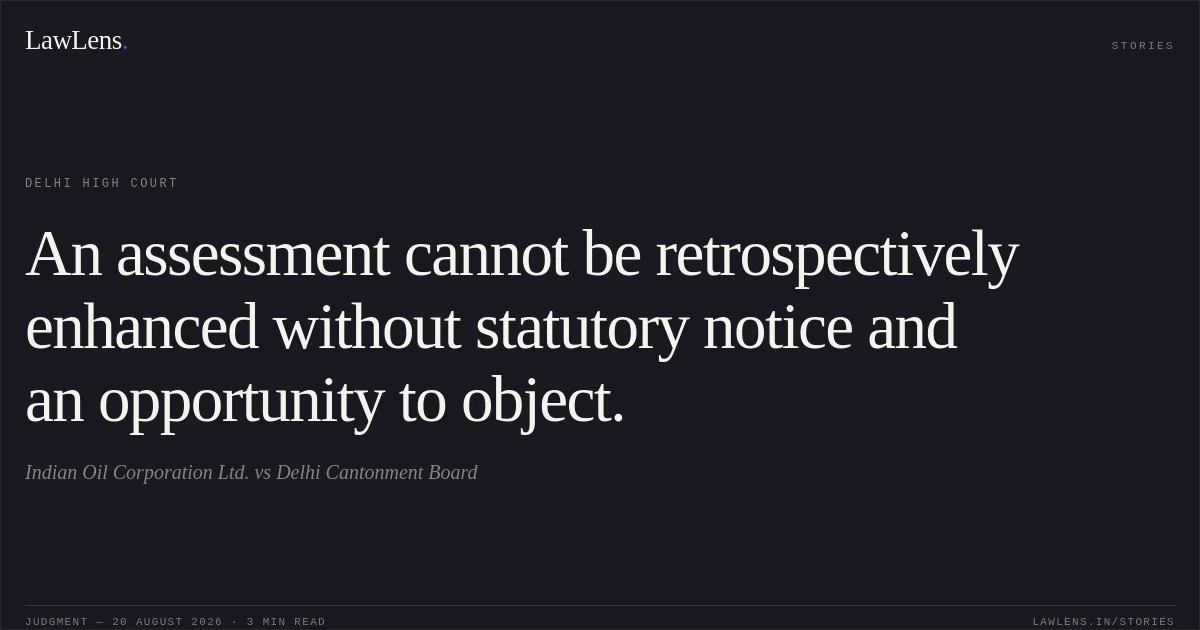
Indian Oil Corporation Ltd. (“IOC”) operated an Aviation Fuel Station on licensed land at Palam, Delhi Cantonment.
Source reference: pp. 2–3For the triennial period 1995–96 to 1997–98, the Delhi Cantonment Board (“DCB”) issued a notice proposing an annual rateable value (“ARV”) of ₹53,30,379, later revising it to approximately ₹44,43,698 after IOC’s objections.
Source reference: pp. 2–3In earlier proceedings, the High Court directed DCB to reassess IOC’s liability and pass a reasoned order.
Source reference: p. 3Following further litigation, DCB granted a hearing but, by its assessment order dated 29 August 2014, enhanced the ARV to ₹1,77,49,299 with retrospective effect from 1995–96, allegedly by correcting an arithmetical error.
Source reference: pp. 3–4IOC challenged the order on the ground that the substantial enhancement and altered valuation methodology were introduced without a fresh statutory notice or opportunity to object.
Source reference: p. 4DCB opposed the writ petition on the ground that IOC had an alternate statutory appellate remedy under the Cantonments Act, 2006.
Source reference: p. 4Issues
Whether DCB could enhance the ARV from the amount proposed or previously communicated to ₹1,77,49,299 without issuing a fresh notice specifying the proposed enhancement and its basis.
Source reference: paras. 11–15; pp. 5–7Whether the impugned assessment order was invalid for violating Sections 79(2) and 79(3) of the Cantonments Act, 2006 and the principles of natural justice.
Source reference: paras. 13–14, 24; pp. 6–7, 9Whether the existence of an alternate statutory remedy barred the High Court from exercising its writ jurisdiction under Article 226.
Source reference: paras. 22–24; pp. 9–10Law Applied
The Court applied Section 79 of the Cantonments Act, 2006, which permits amendment of an assessment list in cases including erroneous valuation or an increase in property value, but requires prior notice of at least one month, an opportunity to file objections, and a hearing before the amendment is made; its proviso also restricts retrospective liability for periods preceding the year of assessment.
Source reference: para. 13; pp. 6–7The Court further applied the principle that an assessment cannot be enhanced beyond the amount proposed in the statutory notice without giving the affected assessee notice of the proposed enhancement and an effective opportunity to challenge its basis and quantum.
Source reference: para. 12; p. 6On alternate remedy, the Court relied on The Assistant Commissioner of State Tax v. Commercial Steel Limited, Civil Appeal No. 5121/2021, holding that an alternate remedy is not an absolute bar to writ jurisdiction where, inter alia, there is violation of natural justice or an excess of jurisdiction.
Source reference: para. 22; p. 9It also relied on Ramditti Jiwandaram Narang Public Charitable Trust v. Municipal Corporation of Delhi for the principle that a statutory appeal does not necessarily preclude writ relief where the jurisdictional validity of the assessment is challenged.
Source reference: para. 23; p. 10Reasoning
The Court found that the original notice proposed an ARV of approximately ₹53.30 lakh, and DCB had earlier maintained that the assessment was approximately ₹44.43 lakh or ₹53.30 lakh, depending on the relevant communication.
Source reference: paras. 11, 16–19; pp. 5–9Nevertheless, the impugned order fixed the ARV at ₹1.77 crore—more than three times the amount proposed—without issuing a fresh notice under the applicable statutory scheme.
Source reference: paras. 15, 20; pp. 7–9The Court held that the subsequent personal hearing, granted pursuant to earlier judicial directions, could not cure the absence of prior notice of the substantially enhanced valuation or the changed valuation methodology.
Source reference: paras. 17–21; pp. 7–9DCB’s characterization of the increase as a mere arithmetical correction was rejected because the magnitude of the enhancement and the altered basis of valuation demonstrated that it was not a simple clerical correction.
Source reference: para. 21; p. 9Since the assessment was made without complying with the mandatory notice and objection requirements, it was found to be without jurisdiction and in breach of natural justice.
Source reference: paras. 22–24; pp. 9–10That jurisdictional defect justified exercise of writ jurisdiction notwithstanding the alternate statutory remedy.
Source reference: paras. 22–24; pp. 9–10Holding
The High Court allowed the writ petition and quashed DCB’s assessment order dated 29 August 2014 fixing the ARV at ₹1,77,49,299.
Any demand raised pursuant to that order was declared ineffective and unenforceable.
Source reference: para. 25; p. 10DCB was permitted to pass a fresh assessment order for the relevant period in accordance with law, after issuing the requisite notice and giving IOC an effective opportunity of hearing.
Source reference: para. 26; p. 10Acts & Sections Cited
10 provisions across 1 statute referred to in this judgment. Each provision opens on LawLens.
Original Court PDF
Indian Oil Corporation Ltd.vsDelhi Cantonment Board
Click to open original judgment
Original judgment, available to read, download and summarize on LawLens.in