Facts
G2K Trust appealed against orders of the Income Tax Appellate Tribunal, Chennai, which had affirmed the Commissioner of Income Tax (Appeals)’ rejection of its appeals as time-barred.
Source reference: p. 2–3The delay was 2,235 days. The Trust relied on the death of its auditor but did not explain why it took approximately seven years to appoint a replacement; it had also filed returns for subsequent years.
Source reference: p. 2–3The High Court heard the two tax appeals together because they raised a common issue concerning condonation of delay.
Source reference: p. 2–3Issues
Whether the Trust established sufficient cause to condone the 2,235-day delay in filing its appeals.
Source reference: p. 2Whether the Tribunal erred in affirming the Commissioner of Income Tax (Appeals)’ rejection of the appeals as time-barred.
Source reference: p. 2, 6Law Applied
The Court applied the principle that condonation of delay is discretionary and requires a bona fide, sufficient explanation; delay is not condoned as a matter of course or generosity.
Source reference: p. 3The length of delay is relevant, and the court must assess the explanation before considering the merits of the underlying dispute.
Source reference: p. 3–5It relied on Karnataka Power Corporation Ltd. v. K. Thangappan, (2006) 4 SCC 322, on the judicial and reasonable exercise of discretion in cases of delay; Shivamma v. Karnataka Housing Board, 2025 INSC 1104, on the relevance of the delay’s length and the need to examine bona fides before merits; and Thirunagalingam v. Lingeswaran, 2025 INSC 672, on the requirement of reasonable grounds and the rule that substantial justice does not justify condonation where it would prejudice the opposing party.
Source reference: p. 3–5Reasoning
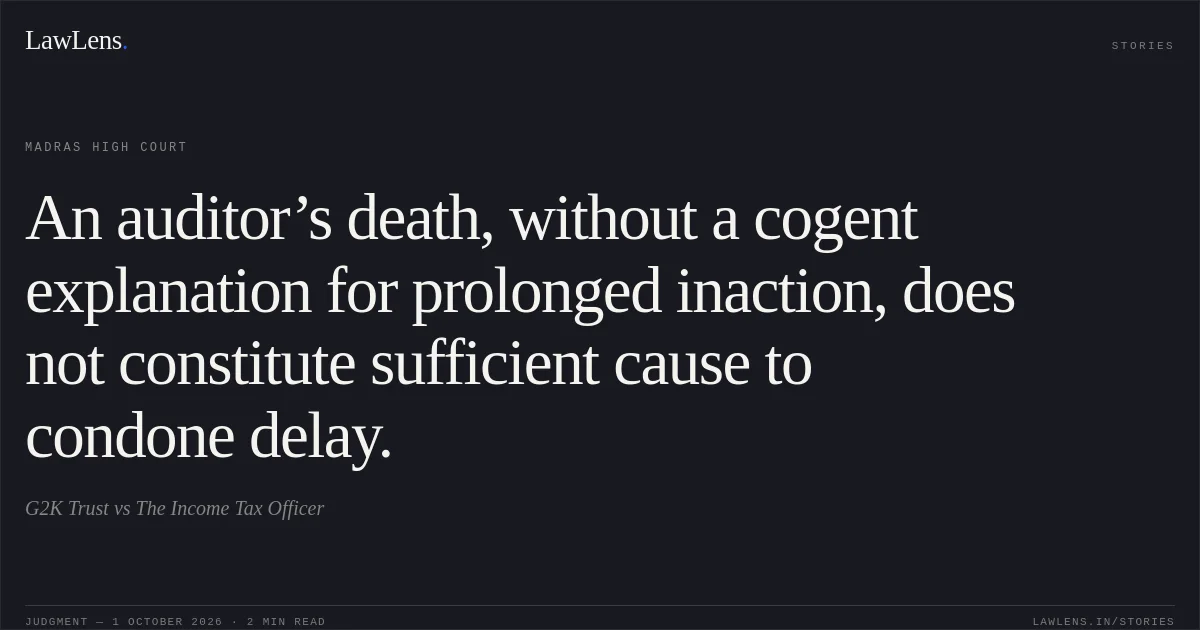
The Trust’s explanation—that its auditor had died—did not account for the approximately seven-year delay or explain why a replacement auditor was not appointed sooner.
Source reference: p. 2–3The explanation was general, vague, and unsupported by cogent documentary evidence; the Trust’s filing of returns in subsequent years also undermined its asserted inability to act.
Source reference: p. 2–3Applying the cited principles, the Court found that the Trust had not shown sufficient cause and that the delay could not be condoned merely to reach the merits of the appeals.
Source reference: p. 3–6Holding
The High Court held that no valid or cogent reason had been given to condone the 2,235-day delay.
It found no merit in either tax appeal and dismissed both appeals, with no order as to costs.
Source reference: p. 6Original Court PDF
G2K TrustvsThe Income Tax Officer
Click to open original judgment
Original judgment, available to read, download and summarize on LawLens.in