Facts
The petitioner was appointed as Deputy Superintendent of Police (Wireless) on 04.09.1992 and was subsequently placed as Additional Superintendent of Police (Wireless) on 30.05.1998. He received successive time-scale benefits, including the pay scale of ₹12,000–15,500 with effect from 01.01.2002 after completion of nine years of service.
Source reference: p.2, para. 2Upon his promotion as Superintendent of Police (Wireless) on 05.02.2002, however, he was fixed in the lower pay scale of ₹10,025–15,100 instead of protecting the ₹12,000–15,500 scale that he had already been drawing. He also claimed the pay scale of ₹14,300–18,150 with effect from 01.01.2007 upon completion of fourteen years under the Assured Career Progression Scheme (ACPS).
Source reference: pp.2–4, paras. 3–4The respondents rejected the claim on the ground that the promotional post carried the scale of ₹10,025–15,100, that pay fixation was governed by the feeder and promotional posts’ time scales rather than the placement scale, and that the petitioner was not entitled to a fourteen-year benefit after promotion before completion of fourteen years in the feeder grade.
Source reference: pp.6–7, para. 6The petitioner relied, inter alia, on the fact that his junior, Shri Rajesh Verma, had been granted protection of the ₹12,000–15,500 scale upon promotion to the same post and had subsequently received the higher ACPS benefit.
Source reference: pp.10–12, paras. 14–16Issues
Whether the petitioner was entitled to protection of the ₹12,000–15,500 pay scale that he was drawing as Additional/Deputy Superintendent of Police (Wireless) upon promotion as Superintendent of Police (Wireless) on 05.02.2002?
Source reference: pp.10–17, paras. 14–23Whether the petitioner was entitled to the ₹14,300–18,150 pay scale with effect from 01.01.2007 on completion of fourteen years under the ACPS, notwithstanding his promotion before completion of fourteen years in the feeder grade?
Source reference: pp.6–7, 16–17, paras. 6 and 24Whether the petitioner’s monetary arrears were restricted by delay and laches to three years preceding the institution of the petition?
Source reference: pp.17–19, para. 25Law Applied
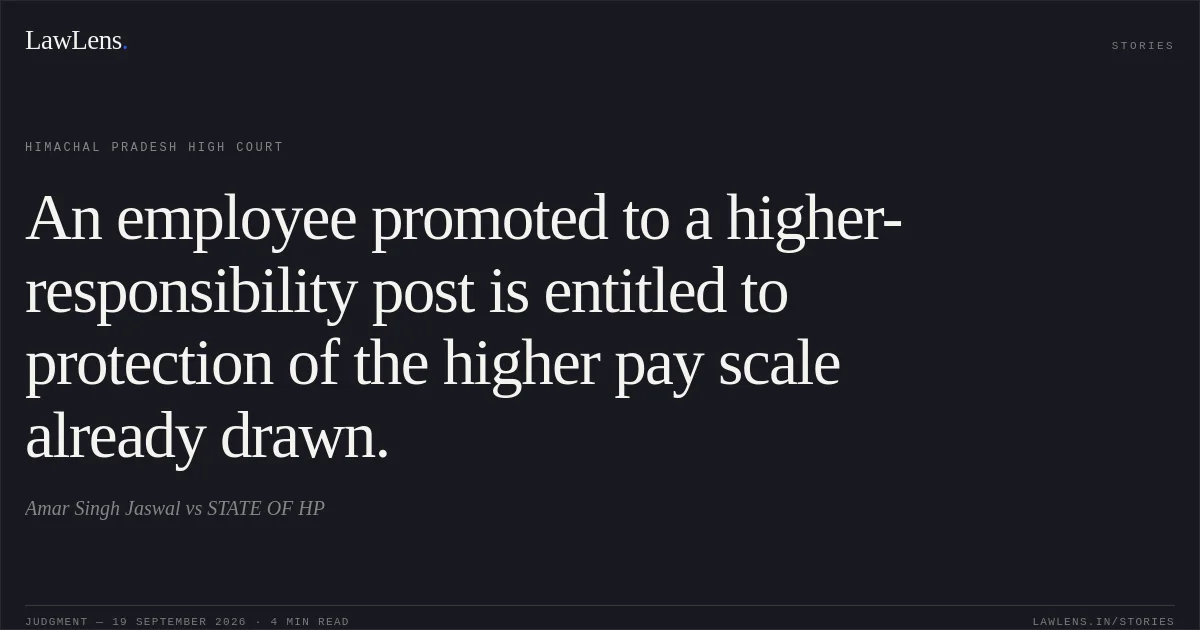
The Court applied Articles 14 and 16 of the Constitution, holding that similarly situated employees in the same service cannot be subjected to different standards in pay fixation and pay protection.
Source reference: pp.15–17, paras. 22–23It applied the principle that an employee promoted to a post carrying higher duties and responsibilities cannot ordinarily be fixed at a lower scale than the scale already being drawn in the lower post, particularly where the same benefit was granted to a similarly situated junior.
Source reference: pp.12–17, paras. 16 and 23The Court considered the applicable pay-scale notifications, including the Notification dated 06.03.2002 governing the four-tier/ACPS structure.
Source reference: pp.2, 16–17, paras. 2 and 24Applying Union of India v. Tarsem Singh, (2008) 8 SCC 648, the Court held that although pay and pension-related claims may constitute continuing wrongs, consequential arrears are normally restricted to three years before filing of the writ petition.
Source reference: pp.17–19, para. 25Reasoning
The Court found that the petitioner had already been granted the ₹12,000–15,500 scale before his promotion, while his junior, promoted to the same post, was granted protection of that scale upon promotion.
Source reference: pp.10–12, para. 14Since the promotional post involved higher duties and responsibilities, fixing the petitioner at ₹10,025–15,100 resulted in a lower scale than the one he was already drawing and created discriminatory treatment contrary to Articles 14 and 16.
Source reference: pp.12–17, paras. 16, 22–23The Court therefore rejected the respondents’ reliance on the promotional post’s ordinary scale and their contention that the petitioner was claiming impermissible “negative parity,” observing that the junior’s benefit had not been shown to be erroneous and that both employees were similarly situated.
Source reference: pp.15–16, para. 22The Court further held that the petitioner could not be denied the fourteen-year ACPS benefit merely because he had been promoted before completing fourteen years in the feeder grade. His junior had received equivalent treatment, and the petitioner had not received any corresponding financial benefit after promotion.
Source reference: p.17, para. 24Nevertheless, applying Tarsem Singh, the Court restricted the monetary consequences of the retrospective pay fixation to three years before institution of the petition, while granting the entitlement notionally from the relevant earlier dates.
Source reference: pp.17–19, para. 25Holding
The petition was allowed. The respondents were directed to grant the petitioner the pre-revised pay scale of ₹12,000–15,500 on his promotion as Superintendent of Police (Wireless) with effect from 05.02.2002 and the pre-revised pay scale of ₹14,300–18,150 with effect from 01.01.2007 under the ACPS.
All consequential benefits were directed to follow, but monetary arrears were limited to the period of three years preceding institution of the petition. If the arrears were not paid within three months, the respondents were directed to pay interest at 6% per annum from the date of expiry of that period until actual payment. No order as to costs was made.
Source reference: p.19, para. 26Original Court PDF
Amar Singh JaswalvsSTATE OF HP
Click to open original judgment
Original judgment, available to read, download and summarize on LawLens.in