Facts
The petitioner completed her A.N.M. training and was appointed as a Lady Health Worker against an A.N.M. vacancy by Memo No. 568 dated 20 April 1994. She joined on 21 April 1994.
Source reference: pp. 3–4Her services, along with those of 12 other employees, were terminated without show-cause notice by Memo No. 1423 dated 7 November 1994 on the ground that the appointments were illegal and contrary to governmental circulars and reservation policy.
Source reference: pp. 3–4By order dated 26 June 2000 in C.W.J.C. No. 2829 of 1999, similarly situated employees were directed to be reinstated, with the intervening period counted for service purposes but without salary for that period.
Source reference: p. 4Pursuant to the same order, the petitioner was reinstated on 16 November 2000. However, after a subsequent show-cause notice, her services were again terminated on 31 December 2002 on the ground that she was not a party to the earlier writ petition.
Source reference: pp. 4–5The High Court set aside the second termination order on 26 November 2009, directed her reinstatement, and left the issue of consequential salary benefits to be decided by the competent authority.
Source reference: p. 5The State’s appeal before the Division Bench and its Special Leave Petition before the Supreme Court were dismissed.
Source reference: pp. 5–6The petitioner was ultimately reinstated on 24 October 2011.
Source reference: pp. 6–7Her claim for salary for the period from 31 December 2002 to 24 October 2011 was rejected on the principle of “no work no pay” by Memo Nos. 1692 dated 11 September 2024 and 2039 dated 28 October 2024, which rejection was approved by the Director-in-Chief on 21 March 2025.
Source reference: pp. 6–7, 20–23Issues
Whether the petitioner was entitled to salary for the period from 31 December 2002 to 24 October 2011, during which she remained out of service pursuant to a termination order subsequently set aside by the High Court.
Source reference: para. 7.1; pp. 20–22Whether the respondents could deny the petitioner back wages by applying the principle of “no work no pay” without establishing that she was gainfully employed during the intervening period.
Source reference: para. 7.1; pp. 21–22Whether the petitioner was entitled to have the entire period counted for service-related and other consequential benefits, consistently with the treatment accorded to similarly situated employees.
Source reference: pp. 7–17, 22–23Law Applied
The Court applied the principle that reinstatement following an illegal termination ordinarily carries the entitlement to consequential benefits, including back wages, subject to the facts of the case.
Source reference: paras. 5.1, 7.1Relying on Deepali Gundu Surwase v. Kranti Junior Adhyapak Mahavidyalaya, (2013) 10 SCC 324, it held that once termination is found illegal, the employer must specifically plead and prove gainful employment if back wages are to be denied; otherwise, denial of back wages may unjustly punish the employee and reward the employer.
Source reference: paras. 5.1, 7.1The Court also relied on the equality principle in service jurisprudence stated in State of Karnataka v. C. Lalitha, (2006) 2 SCC 747, and K.T. Veerappa v. State of Karnataka, (2006) 9 SCC 406, that similarly situated employees should ordinarily receive similar treatment.
Source reference: paras. 5.2–5.3The Full Bench decision in Amresh Kumar Singh v. State of Bihar, 2018 (2) PLJR 929, was relied upon for extending benefits to identically situated employees where the State had already implemented judicial orders in favour of similarly placed persons.
Source reference: para. 5.4The earlier order in C.W.J.C. No. 2829 of 1999 governed the petitioner’s first period of absence, for which salary had expressly been denied, whereas the later period arose from a separate termination that had been judicially set aside.
Source reference: paras. 7–7.1Reasoning
The Court distinguished the petitioner’s first period of absence following the 1994 termination from the later period beginning on 31 December 2002.
Source reference: pp. 5–6, 20–21Although the earlier order dated 26 June 2000 denied salary to the employees covered by that proceeding, the petitioner’s subsequent termination was independently quashed in C.W.J.C. No. 6565 of 2008, and that decision attained finality after dismissal of the State’s appeals.
Source reference: pp. 5–6, 20–21The petitioner had therefore been kept out of service because of an unlawful administrative action of the respondents, rather than by her own choice.
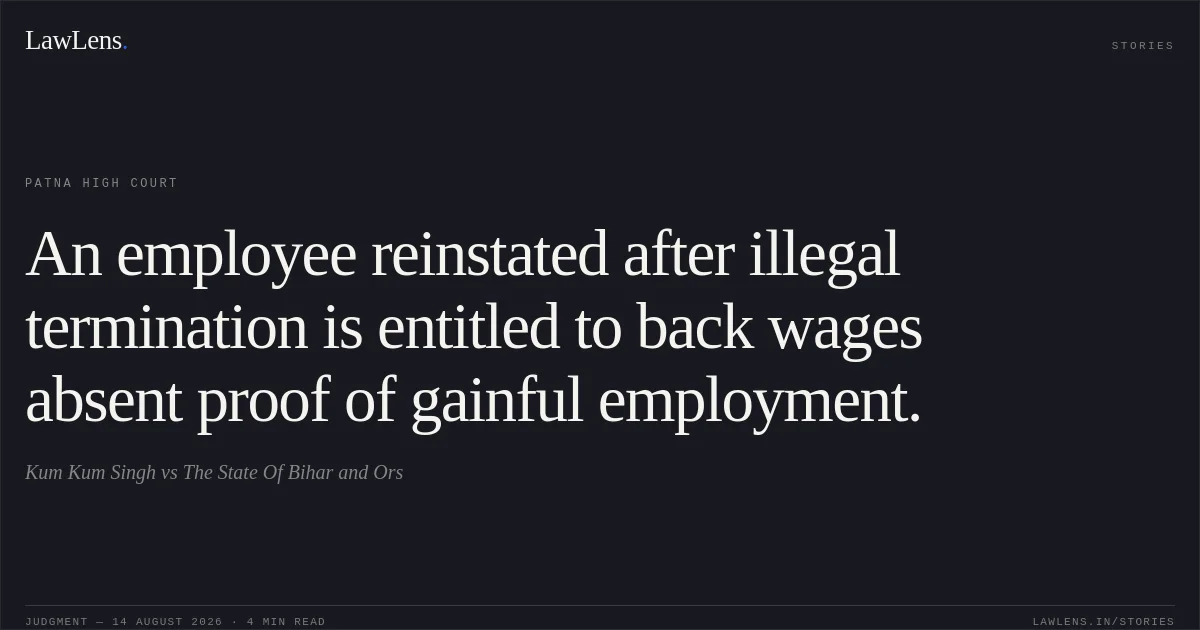
Source reference: para. 7.1Applying Deepali Gundu Surwase, the Court held that the respondents could not rely merely on “no work no pay”; they were required to plead and prove that the petitioner had been gainfully employed during the intervening period.
Source reference: para. 7.1No such proof was shown.
Source reference: para. 7.1The fact that similarly situated employees had received corresponding service benefits further supported treating the petitioner in the same manner.
Source reference: paras. 5.2–5.4, 7.1Holding
The High Court allowed the writ petition.
It quashed Memo No. 1692 dated 11 September 2024, Memo No. 2039 dated 28 October 2024, and Letter No. 328(6) dated 21 March 2025, insofar as they denied the petitioner salary on the basis of “no work no pay”.
Source reference: para. 7.2The petitioner was held entitled to payment of her entire salary for the period from 31 December 2002 to 24 October 2011.
Source reference: para. 7.2The respondents were directed to make payment within four months from receipt or production of the judgment.
Source reference: para. 7.2The entire period was also directed to be counted for service-related and other consequential benefits to which the petitioner was otherwise entitled.
Source reference: para. 7.2Pending applications, if any, were disposed of.
Source reference: paras. 8–9Original Court PDF
Kum Kum SinghvsThe State Of Bihar and Ors
Click to open original judgment
Original judgment, available to read, download and summarize on LawLens.in