Facts
The Petitioner was appointed as a Full-Time Assistant Teacher at a recognised and aided secondary school on 10 June 1994 against a sanctioned post, and his appointment was approved by the Education Officer.
Source reference: paras. 3–4He became deemed permanent after completing two years of service under Section 5(2) of the Maharashtra Employees of Private Schools (Conditions of Service) Regulation Act, 1977 (“MEPS Act”).
Source reference: paras. 3–4He was arrested on 5 December 1997 in connection with offences under Sections 498A and 306 of the IPC and was placed under deemed suspension under Rule 33(5) of the Maharashtra Employees of Private Schools (Conditions of Service) Rules, 1981 (“MEPS Rules”), although he remained in custody only until 15 December 1997.
Source reference: paras. 5–6The Management did not initiate disciplinary proceedings or pass an order terminating his service.
Source reference: paras. 5–6A Sessions Court convicted him on 7 December 1999, but he preferred a criminal appeal and was released on bail.
Source reference: paras. 11–14Subsistence allowance was paid only up to 10 December 2001, apart from a payment of Rs. 9,61,148/- made in July 2018 pursuant to directions of the Education Authorities and the Lokayukta.
Source reference: paras. 15–21The Management challenged the directions for payment before the High Court, which stayed them on 25 February 2019; that writ petition remained pending.
Source reference: para. 23The Petitioner superannuated on 28 February 2023 without resuming duty.
Source reference: para. 25The High Court subsequently set aside his conviction and acquitted him by judgment dated 6 February 2025; the acquittal was stated to have attained finality.
Source reference: para. 24He thereafter sought cancellation of the suspension, arrears of subsistence allowance and salary, pension, gratuity, commutation and other retiral benefits.
Source reference: paras. 26–27The Management did not appear in the present proceedings, and the status of his service remained disputed, since the Petitioner claimed that he had never been terminated while the Management had earlier asserted that his services stood terminated.
Source reference: para. 37Issues
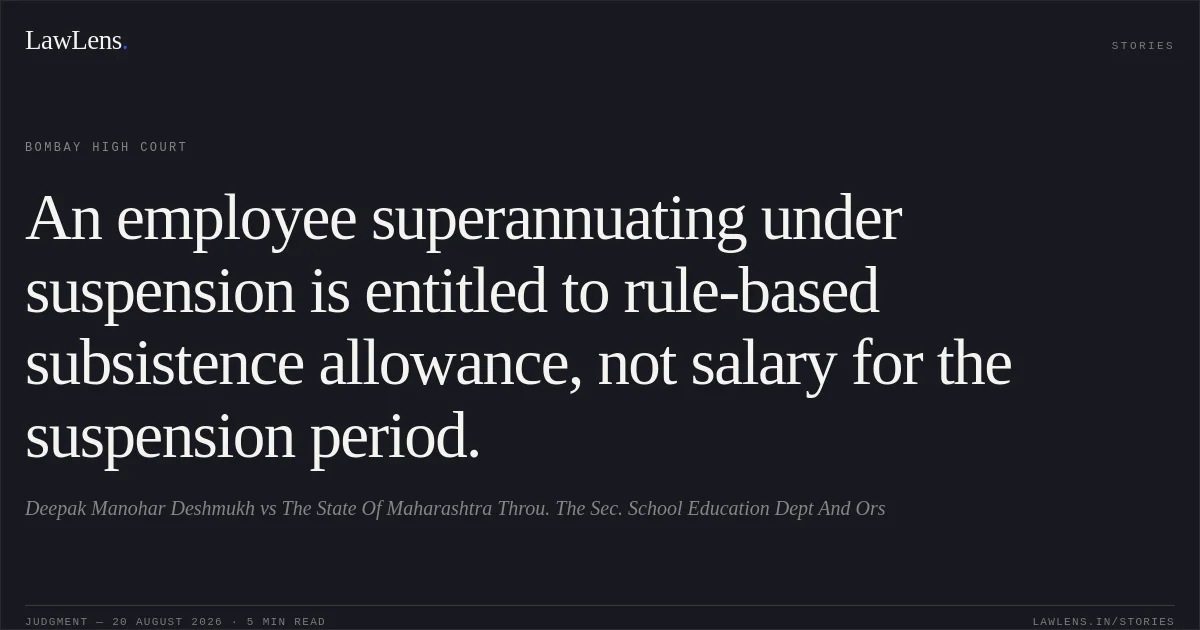
Whether the Petitioner was entitled to salary, allowances and consequential service benefits for the period during which he remained under suspension and did not render service.
Source reference: paras. 31, 38–41Whether the Petitioner was entitled to subsistence allowance for the entire period from 5 December 1997 until his superannuation on 28 February 2023, and how that allowance was required to be calculated under Rule 34 of the MEPS Rules.
Source reference: paras. 32, 40–41Whether the Petitioner was entitled to reinstatement, pension, gratuity and other retiral benefits after his acquittal, particularly when the acquittal occurred after his superannuation.
Source reference: paras. 33, 38–40Whether the Management could have taken any final action concerning the Petitioner’s service while his criminal appeal against conviction remained pending.
Source reference: paras. 36–39Law Applied
The Court applied Section 5(2) of the MEPS Act, under which an employee completing the prescribed period of continuous service becomes deemed permanent.
Source reference: para. 4Rule 33(5) of the MEPS Rules provides for deemed suspension where an employee is detained in custody for more than forty-eight hours or is undergoing imprisonment, and regulates payment of pay and allowances until the criminal proceedings conclude or the employee is otherwise entitled to resume duty.
Source reference: para. 35Under Rule 33(6), following acquittal, the Management must consider whether to institute or continue a departmental enquiry; following conviction, it may terminate the employee only after the appeal or revision period has expired and, where an appeal is filed, after the conviction is finally confirmed.
Source reference: paras. 33, 35–38Rule 34(1) entitles a suspended employee to subsistence allowance equivalent to leave salary on half pay together with applicable Dearness Allowance, subject to variation after four months depending on whether the prolonged suspension is attributable to the employee.
Source reference: para. 35Under the proviso to Rule 34(2), following conviction and imprisonment, subsistence allowance is reduced to a nominal amount of Re. 1/- per month until removal or reinstatement; after acquittal by an appellate court, the employee becomes entitled to the normal rate from the date of acquittal until termination of any enquiry.
Source reference: paras. 32, 35, 40Rule 34(3) deems an employee who reaches superannuation while under suspension to have retired on attaining the age of retirement and permits continuation of pending proceedings, while Rule 34(4)–(6) governs determination of pay, allowances and treatment of the period of absence upon reinstatement.
Source reference: para. 35Salary and consequential monetary benefits are ordinarily payable for actual service rendered, whereas a suspended employee is entitled to subsistence allowance in accordance with the Rules.
Source reference: paras. 31–32, 40–41Reasoning
The Court held that the Petitioner’s suspension originated in the criminal proceedings and that, despite his conviction, the Management could not finally terminate him while his criminal appeal remained pending under Rule 33(6).
Source reference: paras. 36, 38Since the Petitioner superannuated before his acquittal, reinstatement or a post-acquittal departmental determination under Rule 33(6) was no longer possible; Rule 34(3) therefore operated to treat him as having retired while under suspension.
Source reference: paras. 33, 39The Court rejected the claim for salary and consequential benefits for the entire period of suspension because the Petitioner rendered no service during that period and had worked only from 10 June 1994 to 4 December 1997.
Source reference: paras. 31, 40–41Nevertheless, the Management remained liable to pay subsistence allowance for the full period of suspension.
Source reference: paras. 32, 40–41The Court directed computation under Rule 34, including the normal rate initially, the applicable nominal rate of Re. 1/- per month after conviction, and the amounts otherwise payable under the Rules, while giving credit for the Rs. 9,61,148/- already paid.
Source reference: paras. 32, 40–41The Court also noted that the stay operating in the Management’s earlier writ petition did not extinguish the Petitioner’s substantive entitlement to subsistence allowance.
Source reference: paras. 34, 36, 40Holding
The petition was dismissed and the Rule was discharged.
The Respondents were directed to compute and pay the Petitioner’s subsistence allowance for the period from 5 December 1997 to 28 February 2023 in accordance with Rule 34 of the MEPS Rules, after deducting the Rs. 9,61,148/- already paid; the balance, if any, was to be released as arrears.
Source reference: para. 41(i)–(ii)The claim for salary, allowances and other consequential monetary benefits was restricted to the period during which the Petitioner actually worked, namely 10 June 1994 to 4 December 1997.
Source reference: para. 41(iii)The Petitioner was permitted to make a representation to the Education Officer and/or the Management regarding such benefits, which was to be decided within four weeks of receipt.
Source reference: para. 41(iv)The Court did not grant the claimed pension, gratuity, commutation or other retiral benefits, holding that the Petitioner had worked for only approximately three years and had not completed the qualifying service required for pension.
Source reference: para. 40Acts & Sections Cited
2 provisions across 2 statutes referred to in this judgment. Each provision opens on LawLens.
Maharashtra Employees of Private Schools (Conditions of Service) Regulation Act, 1977.1
Indian Penal Code, 18601
Original Court PDF
Deepak Manohar DeshmukhvsThe State Of Maharashtra Throu. The Sec. School Education Dept And Ors
Click to open original judgment
Original judgment, available to read, download and summarize on LawLens.in