Facts
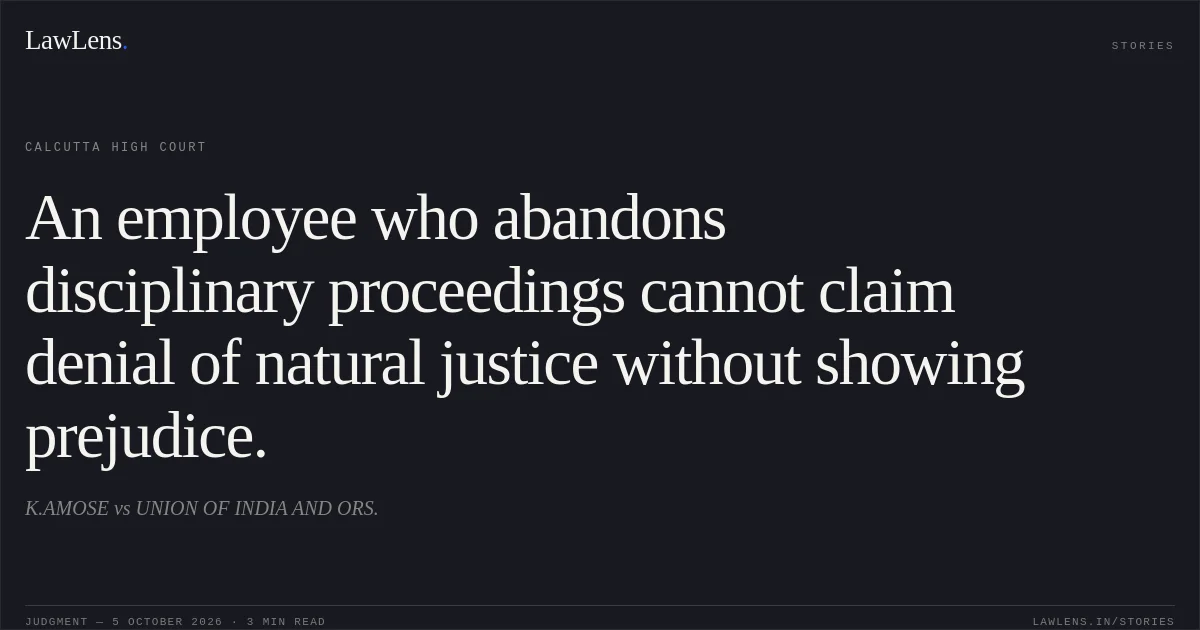
The petitioner, an APWD employee appointed in 1988, was charged in 2019 with securing appointment by misstating his date of birth and later submitting a false Diploma in Civil Engineering certificate.
Source reference: para. 2–8, 11–14, 19–25He did not file a written defence.
Source reference: para. 2–8, 11–14, 19–25After his Defence Assistant cross-examined the department’s witnesses, the petitioner alleged bias against the Enquiry Officer and stopped participating.
Source reference: para. 2–8, 11–14, 19–25The Enquiry Officer found the charges proved, and the Disciplinary Authority dismissed him on 28 April 2020.
Source reference: para. 2–8, 11–14, 19–25The petitioner challenged the disciplinary action and related orders before the Central Administrative Tribunal, which dismissed his applications; he then brought this writ petition.
Source reference: para. 2–8, 11–14, 19–25Issues
1. Whether the enquiry was procedurally unfair because officials other than those named in the charge memo testified and because the Enquiry Officer continued after the petitioner alleged bias.
Source reference: para. 26–28, 41–462. Whether non-supply of the enquiry report before dismissal vitiated the disciplinary proceedings.
Source reference: para. 31–34, 48–493. Whether the delay between the alleged misconduct and the charge memo warranted setting aside the disciplinary proceedings.
Source reference: para. 29, 50–524. Whether the Tribunal’s decision disclosed grounds for interference under Article 226.
Source reference: para. 40–41, 54–57Law Applied
Natural justice is not governed by a rigid formula; a claimant must show prejudice from the alleged procedural breach, and a person who knowingly chooses not to participate may be treated as having waived the objection (Board of Directors, H.P. Transport Corporation v. K.C. Rahi).
Source reference: para. 47Non-supply of an enquiry report does not automatically invalidate disciplinary action; the employee must establish real prejudice, and relief is appropriate where supplying the report could have affected the result (Managing Director, ECIL v. B. Karunakar; Union of India v. Bishamber Das Dogra).
Source reference: para. 48–49Delay may make disciplinary proceedings unfair where it is unexplained and the department knew of the alleged misconduct, but the assessment depends on the circumstances (State of Madhya Pradesh v. Bani Singh).
Source reference: para. 50–51Disciplinary charges are assessed on a preponderance of probabilities, not by the strict evidentiary standards applicable in a criminal trial.
Source reference: para. 53Judicial review under Article 226 does not warrant interference absent a sustainable legal or procedural defect.
Source reference: para. 56Reasoning
The Court found that the petitioner raised the objection to the witnesses’ identities only before the High Court, and that the witnesses held relevant positions, testified about official records, and were cross-examined without objection; the complaint therefore disclosed no demonstrated prejudice.
Source reference: para. 41The bias allegation came after the departmental witnesses had been cross-examined, and the petitioner then abandoned the enquiry and was absent from the residence where he was required to stay.
Source reference: para. 42–46The Court held that his conduct waived the natural-justice objection and supported the department’s account that repeated attempts to serve the enquiry report had failed.
Source reference: para. 42–46He also failed to show how receiving the report would have affected the outcome.
Source reference: para. 48–49The Court distinguished Bani Singh because the department initiated proceedings after learning of the alleged false credentials, rather than knowingly allowing the matter to remain unaddressed for years.
Source reference: para. 50–52The criminal-evidence authorities cited by the petitioner did not govern proof in the departmental enquiry.
Source reference: para. 53Holding
The Court held that the petitioner had not established a prejudicial procedural defect, a basis for setting aside the enquiry on delay grounds, or any other ground for judicial review.
It dismissed the writ petition and declined to interfere with the Tribunal’s decision.
Source reference: para. 54–58Acts & Sections Cited
5 provisions across 1 statute referred to in this judgment. Each provision opens on LawLens.
Indian Penal Code, 18605
Original Court PDF
K.AMOSEvsUNION OF INDIA AND ORS.
Click to open original judgment
Original judgment, available to read, download and summarize on LawLens.in