Facts
The petitioner, a BMTC driver since 18 April 1987, applied for voluntary retirement on 29 January 2013, citing a medical condition, and thereafter did not attend work.
Source reference: p. 2–3, paras. 1–2The Corporation’s Medical Board examined him on 13 November 2013, and a committee considered his case on 27 June 2014.
Source reference: p. 2–3, paras. 1–2The Corporation paid retirement benefits of ₹6,00,000 on 14 February 2015 and leave encashment of ₹1,13,379 on 15 November 2014.
Source reference: p. 2–3, paras. 1–2The petitioner claimed wages up to 13 November 2013 and interest for delayed payment of benefits.
Source reference: p. 2–3, paras. 1–2The Labour Court dismissed his application under Section 33C(2) of the Industrial Disputes Act, 1947; he challenged that decision in this writ petition.
Source reference: p. 5, para. 6Issues
Whether the petitioner was entitled to wages for the period after applying for voluntary retirement when he did not attend work.
Source reference: p. 5–6, para. 6Whether the petitioner was entitled to interest on his retirement benefits and, if so, from what date.
Source reference: p. 6–7, paras. 7–10Law Applied
The Court considered Section 33C(2) of the Industrial Disputes Act, 1947, under which a Labour Court may determine and compute a workman’s monetary entitlement.
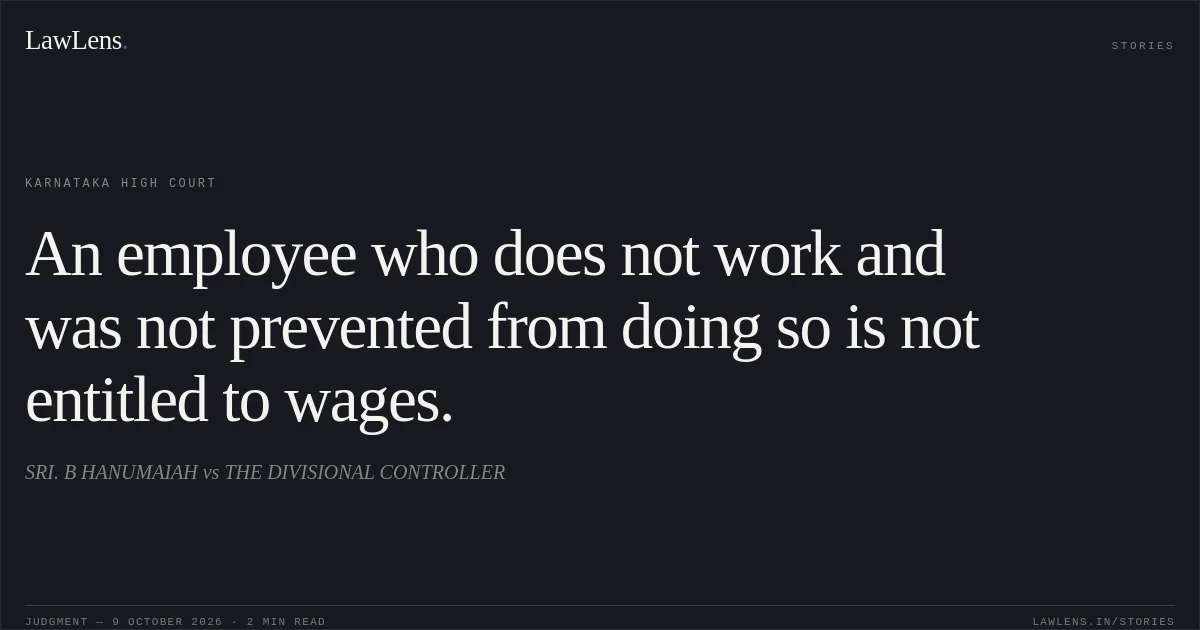
Source reference: no citationIt applied the principle of “no work, no pay” to the wage claim, holding that wages were not payable for the period in which the petitioner did not work and had not shown that the Corporation prevented him from performing his duties.
Source reference: p. 6, para. 6The judgment cites no precedent or specific statutory provision governing interest on the retirement benefits; it left that question for the Corporation to consider in accordance with law.
Source reference: p. 8, para. 11Reasoning
The petitioner did not work from 29 January 2013 through the consideration and acceptance of his voluntary-retirement request, and he did not establish that the Corporation had prevented him from working.
Source reference: p. 6, para. 6The Court therefore upheld the rejection of wages for that period under the “no work, no pay” principle.
Source reference: p. 6, para. 6As to interest, the parties disputed whether it ran from 13 November 2013, when the resignation was said to take effect, or only after the committee’s decision and the period prescribed under the scheme.
Source reference: pp. 6–7, paras. 7–10The Court did not resolve that dispute and reserved the issue for the Corporation’s determination.
Source reference: pp. 6–7, paras. 7–10Holding
The writ petition was disposed of.
The Court upheld the Labour Court’s decision on the wage claim but granted the petitioner liberty to submit a representation, with relevant documents, concerning interest on his retirement benefits within four weeks of receiving the order.
Source reference: p. 8, para. 11The Corporation was directed to consider the representation in accordance with law and communicate its decision within three months of its submission.
Source reference: p. 8, para. 11Acts & Sections Cited
1 provisions across 1 statute referred to in this judgment. Linked provisions open on LawLens.
Industrial Disputes Act, 19471
Original Court PDF
SRI. B HANUMAIAHvsTHE DIVISIONAL CONTROLLER
Click to open original judgment
Original judgment, available to read, download and summarize on LawLens.in