Facts
The Respondent supplied fancy-dress material to the Appellant school for ₹4,78,000, against which the Appellant paid an advance of ₹1,00,000.
Source reference: p. 2The Respondent claimed the balance of ₹3,78,000 remained unpaid; the Appellant asserted that it had made further cash payments.
Source reference: p. 2The Respondent instituted a commercial recovery suit.
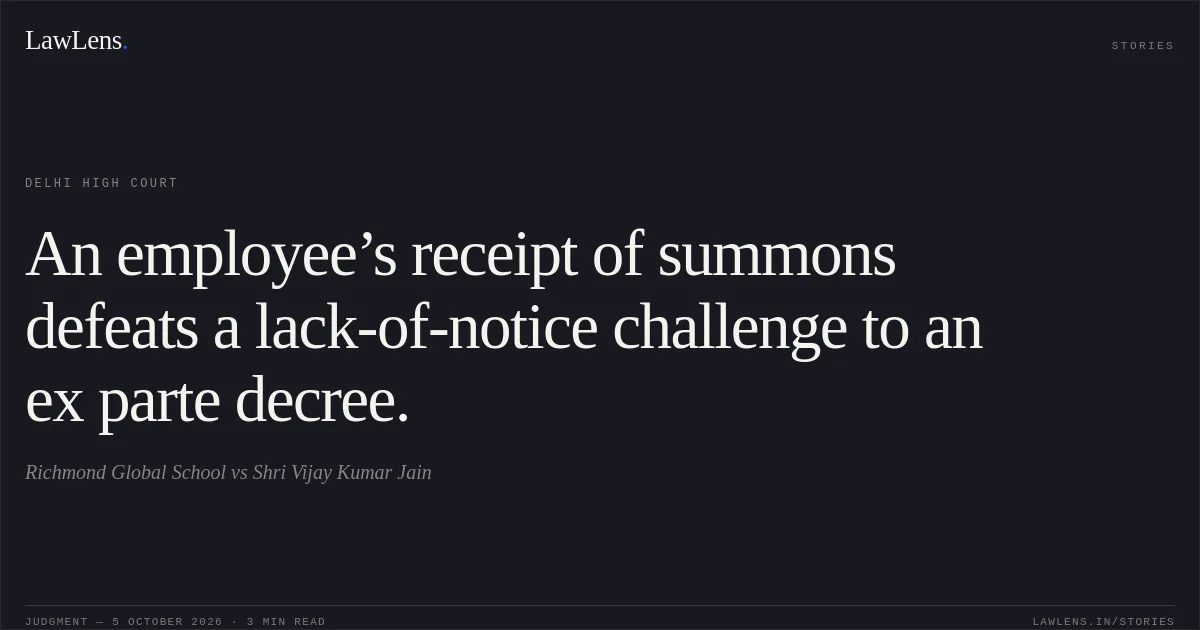
Source reference: p. 4Summons were accepted at the school by Joginder, an employee, and the Commercial Court later proceeded ex parte after the defendants failed to appear or file a written statement.
Source reference: pp. 4–5On 22 September 2023, the Court decreed ₹3,78,000 against the Appellant, with interest and costs.
Source reference: p. 5After receiving execution notices, the Appellant applied under Order IX Rule 13 CPC to set aside the decree, claiming it had not learned of the suit summons earlier; it filed the application on 12 January 2024 and sought condonation of delay.
Source reference: p. 5The Commercial Court dismissed the applications, finding the petition time-barred and the explanation insufficient, and also rejecting the Appellant’s case on the merits.
Source reference: pp. 6–7The Appellant appealed.
Source reference: no citationIssues
Whether the Appellant established sufficient cause to condone the delay in filing its Order IX Rule 13 CPC application
Source reference: pp. 6–7, para. 13Whether the ex parte decree should be set aside on the ground that summons had not been duly served or that sufficient cause prevented the Appellant from appearing
Source reference: pp. 7–8, paras. 14–15Law Applied
Article 123 of the Schedule to the Limitation Act, 1963 prescribes the limitation period for an application to set aside an ex parte decree; where summons were not duly served, limitation runs from the date the applicant had knowledge of the decree.
Source reference: p. 6, para. 13Under Order IX Rule 13 CPC, an ex parte decree may be set aside if summons were not duly served or the defendant was prevented by sufficient cause from appearing.
Source reference: no citationUnder its second proviso, a decree is not to be set aside for an irregularity in service where the defendant had notice of the hearing date and sufficient time to appear.
Source reference: p. 9, para. 17“Sufficient cause” requires an adequate explanation consistent with diligence and bona fides; discretion must be exercised judicially.
Source reference: p. 9, para. 17The Court also relied on *Basawaraj v. Land Acquisition Officer*, (2013) 14 SCC 81, in considering the requirement of sufficient cause for condonation of delay.
Source reference: p. 6, para. 13Reasoning
The Court found no basis to disturb the Commercial Court’s conclusions.
Source reference: no citationThe Appellant’s own case accepted that Joginder, then its employee, received the summons; the process server’s report also stated that he accepted them after speaking by telephone.
Source reference: pp. 7–8, para. 15The Court considered the assertion that Joginder did not inform management, or later left the school, insufficient to establish non-service or sufficient cause.
Source reference: pp. 7–8, para. 15The Appellant also failed to act with adequate diligence after learning of the execution proceedings: its application was filed beyond the period calculated by the Commercial Court, and the explanation for the delay—including the timing of its certified-copy application—was rejected.
Source reference: pp. 6–7, paras. 12–13, 16The asserted payments and the pending proceedings under the Negotiable Instruments Act did not resolve whether the Appellant had sufficient cause for its non-appearance in the recovery suit.
Source reference: p. 8, para. 16Holding
The High Court held that the Appellant had not shown sufficient cause to condone the delay or to set aside the ex parte decree under Order IX Rule 13 CPC.
It found no reason to interfere with the Commercial Court’s order and dismissed the appeal as devoid of merit, with no order as to costs.
Source reference: p. 9, para. 18Acts & Sections Cited
3 provisions across 3 statutes referred to in this judgment. Each provision opens on LawLens.
Commercial Courts Act, 20151
Negotiable Instruments Act, 18811
Limitation Act, 19631
Original Court PDF
Richmond Global SchoolvsShri Vijay Kumar Jain
Click to open original judgment
Original judgment, available to read, download and summarize on LawLens.in