01Facts
The fourth respondent, a Drawing Teacher in the appellant-aided school, was initially suspended on 27.11.2017 following allegations of misconduct and an FIR under Sections 294(b), 341 and 506(i) IPC. He was dismissed after disciplinary proceedings, but approval of the dismissal was not granted by the educational authorities. The suspension was subsequently cancelled, and he rejoined duty on 10.08.2018 pursuant to orders in an earlier writ petition, with the school undertaking to pay salary from the date of joining; the question of salary for the intervening period was left to the disciplinary proceedings.
¶ 3–5, 17–20On the basis of a pending second charge memo dated 13.07.2018, the teacher was again suspended on 16.02.2019. The school did not issue any order revoking the suspension or calling upon him to resume duty until 21.03.2020, when he was directed to join; he joined on 24.03.2020.
¶ 5, 13, 18, 21In an earlier writ petition, the High Court permitted him to appeal under Section 23(b) of the Tamil Nadu Recognised Private Schools (Regulation) Act, 1973. The Joint Director, after hearing the parties, directed the school to pay salary for the relevant suspension period, holding that the teacher could not be treated as unauthorisedly absent when the suspension had not been revoked. The learned Single Judge upheld that order, and the school preferred the present writ appeal.
¶ 6–8, 13–14, 22–2502Issues
i.1. Whether proceedings under Section 23(b) of the Tamil Nadu Recognised Private Schools (Regulation) Act, 1973, were appellate proceedings and whether the appellant was entitled to insist upon strict compliance with all requirements of natural justice, including supply of documents and a further personal hearing.
¶ 26–28ii.2. Whether the fourth respondent was entitled to salary for the period during which he remained under suspension because the school had neither revoked the suspension nor directed him to resume duty.
¶ 30–31iii.3. Whether suspension automatically stood revoked after the statutory periods referred to by the appellant, thereby making the teacher responsible for not joining duty.
¶ 10, 14, 3103Law Applied
The Court applied Section 23(b) of the Tamil Nadu Recognised Private Schools (Regulation) Act, 1973, under which an aggrieved employee may pursue an appeal before the prescribed educational appellate authority.
¶ 6, 23, 27–28Since the proceedings were appellate in nature, the Court held that the authority was not exercising original disciplinary jurisdiction; nevertheless, the parties had to be afforded a meaningful opportunity of hearing, which had been granted in the present case.
¶ 14, 25, 27–28The Court further applied the principle that an employee placed under suspension cannot be treated as unauthorisedly absent while the suspension order remains operative; the employer must expressly revoke the suspension and call upon the employee to resume duty before withholding liability on the ground of non-joining.
¶ 30–31The Court distinguished Mardia Chemicals Ltd. v. Union of India, (2004) 4 SCC 311, holding that the character of proceedings under Section 23(b) was materially different from proceedings under Section 17 of the SARFAESI Act.
¶ 32Provisions in the judgment · 4 · Linked ones open on LawLens
Indian Penal Code, 1860 Section 294Section 341Section 506
Securitisation and Reconstruction of Financial Assets and Enforcement of Security Interest Act, 2002 Section 17
04Reasoning
The appellant had participated in the proceedings before the Joint Director after the High Court expressly directed the fourth respondent to pursue the statutory appeal under Section 23(b), and the appellant had appeared, filed written submissions, and responded to further queries.
¶ 23–25, 27–28It therefore could not subsequently contend that the Joint Director was exercising original jurisdiction or that the proceedings were invalid for want of a fuller enquiry. The Court also found no denial of natural justice because both parties were given opportunities to present their cases and the appellant’s written explanation was considered.
¶ 14, 25, 28On the substantive issue, the school had suspended the teacher on 16.02.2019 and did not revoke that order until it called him to resume duty on 21.03.2020. The Court rejected the argument that the teacher was bound to rejoin automatically after four months, holding that the obligation to cancel the suspension and direct resumption rested on the employer.
¶ 29–31Since the teacher joined immediately after receiving the direction, the intervening period could not be treated as unauthorised absence, and the school was liable to pay salary for that period.
¶ 29–3105Holding
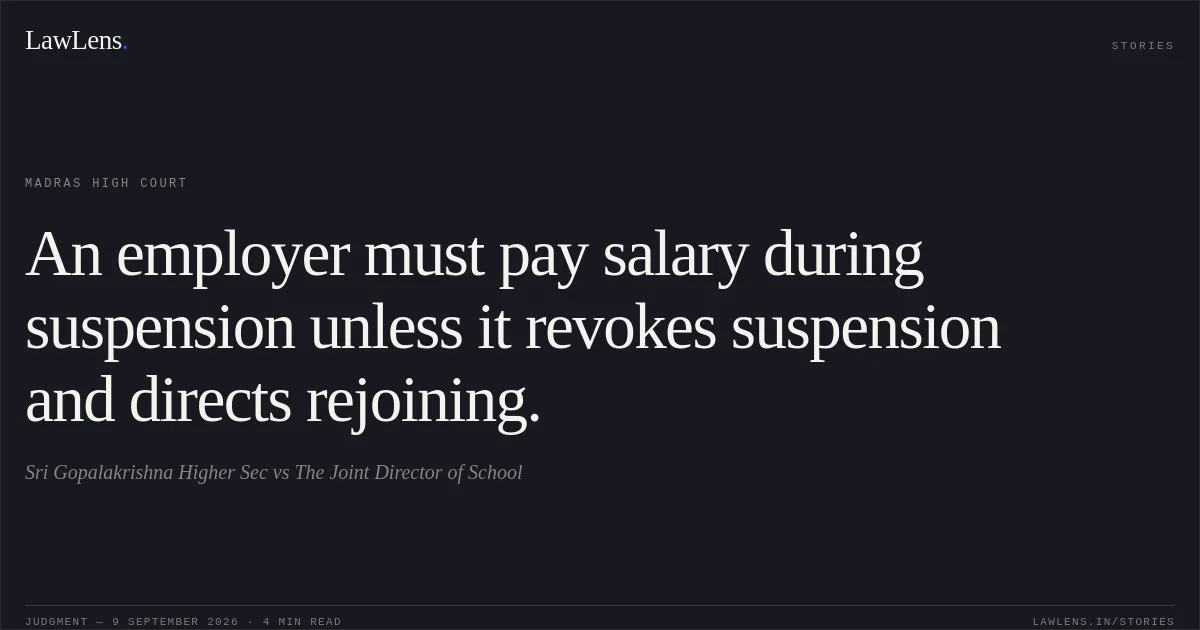
The writ appeal was dismissed. The Court upheld the Joint Director’s order dated 27.03.2024 directing the appellant school to pay the fourth respondent salary for the period of suspension from 18.06.2019 to 24.03.2020.
¶ 32–33It held that the Section 23(b) proceedings were appellate proceedings, that adequate opportunity of hearing had been provided, and that the teacher could not be treated as unauthorisedly absent while the suspension order remained unrevoked.
¶ 32–33Compliance with the salary direction was ordered within four weeks from receipt of the judgment, and the connected miscellaneous petition was closed without costs.
¶ 32–33Original Court PDF
Sri Gopalakrishna Higher SecvsThe Joint Director of School
Click to open original judgment
Original judgment, available to read, download and summarize on LawLens.in