Facts
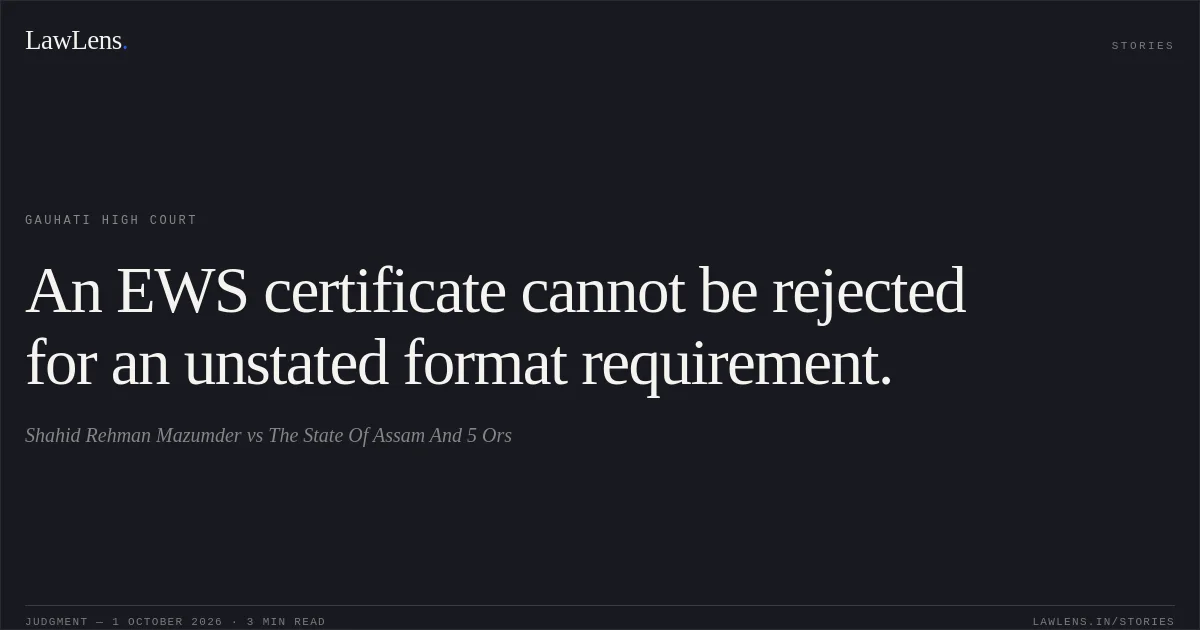
The petitioner applied under the EWS category for the post of Junior Engineer (Civil) pursuant to APSC Advertisement No. 03/2020. At document verification, he produced an Income and Asset Certificate issued by the competent Circle Officer and stated to be valid for financial year 2019–2020. His candidature was rejected because the certificate was considered invalid for the relevant period.
Source reference: para. 2–4, 30The petitioner had earlier approached the Court in WP(C) No. 4441/2022 concerning publication of the selection results; following the Court’s direction, his aggregate marks were published as 127.50, above the EWS cut-off of 113.25.
Source reference: para. 5, 26, 35In 2024, candidates from the same recruitment obtained relief in WP(C) No. 6138/2022 concerning rejection of EWS certificates, and six were later recommended for appointment. The petitioner sought similar consideration, asserting that one of those candidates had submitted a certificate in the same format and that one EWS vacancy remained.
Source reference: para. 6–8, 34, 39He filed the present petition in December 2025.
Source reference: para. 17Issues
1. Whether the petitioner’s delay in bringing the present claim barred consideration of his request for relief in light of his earlier proceeding concerning the same recruitment.
Source reference: para. 25–292. Whether rejection of the petitioner’s EWS certificate was sustainable, and whether he was entitled to parity with candidates granted relief in WP(C) No. 6138/2022.
Source reference: para. 30–41Law Applied
The Court applied the principles governing delay and laches under Article 226: although no fixed limitation period governs writ petitions, the applicant’s delay and conduct are relevant, and relief may be denied to a person who remained inactive and seeks to benefit from another’s litigation (Chairman/Managing Director, U.P. Power Corporation Ltd. v. Ram Gopal, (2021) 13 SCC 225; State of U.P. v. Arvind Kumar Srivastava, (2015) 1 SCC 347).
Source reference: para. 27The latter decision also recognises the general principle that similarly situated persons should ordinarily receive similar treatment, subject to exceptions including delay, acquiescence and fence-sitting.
Source reference: para. 27, 37The Court further applied the equality principle in Articles 14 and 16 to the petitioner’s claim of differential treatment.
Source reference: para. 16In the context of this recruitment, the coordinate Bench’s decision in WP(C) No. 6138/2022 had directed acceptance of EWS certificates and consideration against existing vacancies where the advertisement prescribed no particular certificate format.
Source reference: para. 31, 38Reasoning
The Court held that the petitioner could not be treated as a wholly inactive fence-sitter: he had earlier approached the Court concerning the same recruitment, sought information about his rejection, and later made a representation after the 2024 judgment was acted upon. In those circumstances, delay alone did not bar examination of his claim.
Source reference: para. 26–29On the merits, the petitioner’s certificate was issued by the competent authority and specified validity for 2019–2020, while the advertisement prescribed no particular EWS certificate format. The Court considered the certificate-related objection insufficient, particularly given the circumstances of the EWS framework at the time and the treatment of a same-recruitment candidate whose certificate was stated to be in the same format.
Source reference: para. 30–34, 41The petitioner also scored above the EWS cut-off, and consideration of his candidature against an available vacancy would not disturb existing appointments.
Source reference: para. 35, 38–40Holding
The Court set aside the rejection of the petitioner’s candidature on the EWS certificate ground.
It directed the respondents, particularly the APSC, to accept and verify the certificate and reconsider the petitioner for appointment according to merit and subject to all other eligibility requirements. If otherwise eligible and within the zone of selection, he is to be recommended and appointed against the available EWS vacancy without disturbing existing appointments. The exercise was directed to be completed within six weeks of receipt of a certified copy of the order; the petition was allowed with no order as to costs.
Source reference: para. 42–43Original Court PDF
Shahid Rehman MazumdervsThe State Of Assam And 5 Ors
Click to open original judgment
Original judgment, available to read, download and summarize on LawLens.in