Facts
The respondent, a government employee, was issued notices concerning unauthorised absence and alleged violations of the M.P. Civil Services (Conduct) Rules, 1965 and the applicable Leave Rules. He was suspended on 30 December 2016 and charge-sheeted on 1 February 2017. After he allegedly failed to participate in the departmental inquiry despite newspaper publication, the disciplinary authority dismissed him from service on 25 February 2019.
Source reference: para. 3(i)–(ii); p. 1The respondent thereafter submitted representations and an appeal, which was dismissed by the appellate authority in a cryptic order dated 29 December 2021.
Source reference: para. 3(iii); pp. 2–3In Writ Petition No. 5129 of 2021, the Writ Court, by order dated 7 May 2026, set aside the dismissal and appellate orders and remanded the matter for a fresh inquiry, permitting the respondent to submit his reply to the charge-sheet.
Source reference: para. 3(iv); p. 2The State challenged that order in the present writ appeal. The eight-day delay in filing the appeal was condoned.
Source reference: para. 2; p. 1Issues
Whether the disciplinary authority could validly dismiss the respondent in an ex parte departmental inquiry merely because he failed to respond to notices and did not participate in the inquiry.
Source reference: paras. 4–6; pp. 2–3Whether the Writ Court was justified in setting aside the dismissal and appellate orders and directing a fresh inquiry after finding violations of natural justice and non-consideration of the respondent’s defence.
Source reference: paras. 5–7; pp. 2–4Whether the appellate authority’s cryptic dismissal of the respondent’s appeal, without considering the grounds raised therein, could be sustained.
Source reference: para. 7; p. 3Law Applied
The Court considered Article 311(3) of the Constitution, under which disciplinary action may be taken without a regular inquiry only where it is not reasonably practicable to hold such an inquiry.
Source reference: para. 3(iii); p. 2It applied the principles of natural justice governing ex parte departmental inquiries, particularly the rule that non-participation by a delinquent employee does not relieve the department of its obligation to prove the charges by producing and examining the relevant witnesses.
Source reference: no citationThe Court relied on State of Uttar Pradesh and Others v. Saroj Kumar Sinha, (2010) 2 SCC 772, which holds that an Inquiry Officer acts as a quasi-judicial authority and must provide a reasonable opportunity of hearing; even in an ex parte inquiry, the charges must be established through evidence.
Source reference: para. 5; pp. 2–3The disciplinary and appellate authorities were also required to consider the employee’s defence and pass a reasoned order.
Source reference: no citationReasoning
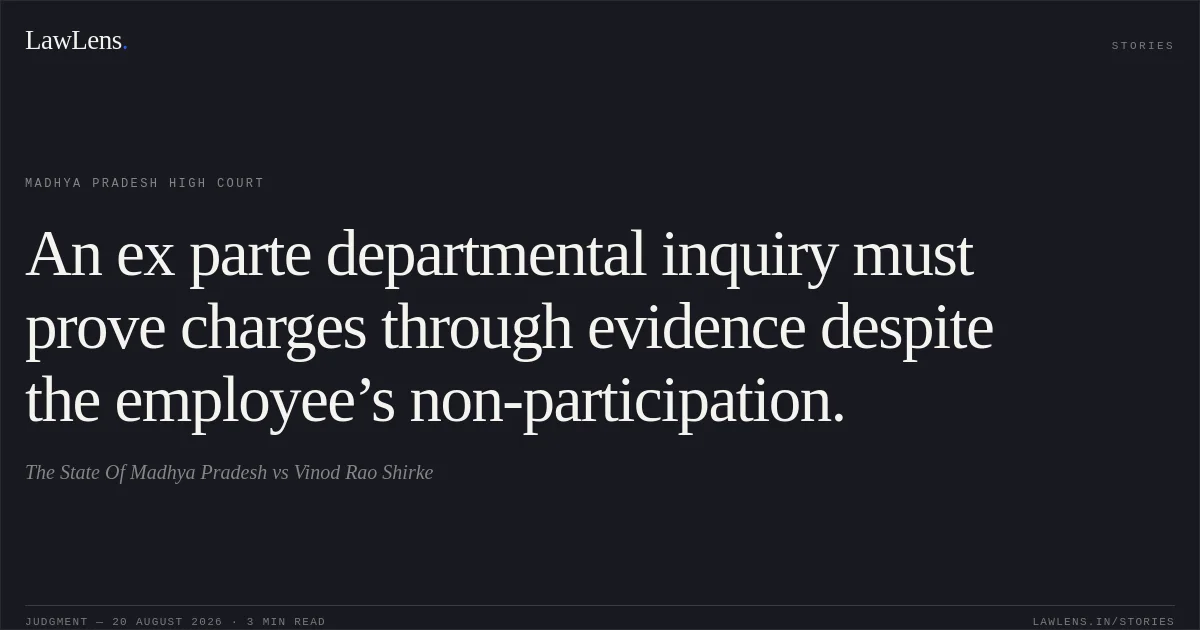
The Court held that the respondent’s failure to participate in the inquiry did not authorise the disciplinary authority to dispense with proof of the charges.
Source reference: para. 5; pp. 2–3The department was required to conduct a legally valid ex parte inquiry, including recording the statements of the witnesses cited in the charge-sheet and assessing the evidence against the respondent.
Source reference: para. 5; pp. 2–3The respondent had, immediately after dismissal, submitted detailed representations alleging that the notices were sent to an incorrect address and that the District Education Officer had acted with bias and hostility, including in relation to the respondent’s wife.
Source reference: para. 7; p. 3These grounds were not considered by the disciplinary authority or the appellate authority.
Source reference: para. 7; p. 3Further, the appellate order was cryptic and failed to address the grounds raised in the appeal, while the newspaper notice allegedly lacked adequate publicity.
Source reference: para. 7; p. 3Consequently, the Writ Court correctly found procedural infirmities and ordered a fresh inquiry rather than affirming the dismissal.
Source reference: no citationHolding
The High Court answered the issues against the State and found no error in the Writ Court’s order.
It held that the respondent’s non-participation did not dispense with the department’s duty to prove the charges in accordance with natural justice, and that the unreasoned appellate order and failure to consider the respondent’s defence justified interference.
Source reference: paras. 5–7; pp. 2–4The eight-day delay was condoned, but the writ appeal and connected challenge to the stay proceedings were ultimately dismissed.
Source reference: paras. 2, 6, 9; pp. 1, 3–4The order setting aside the dismissal and appellate orders, remanding the matter for a fresh departmental inquiry, and permitting the respondent to file his reply to the charge-sheet was thereby affirmed.
Source reference: paras. 2, 6, 9; pp. 1, 3–4Original Court PDF
The State Of Madhya PradeshvsVinod Rao Shirke
Click to open original judgment
Original judgment, available to read, download and summarize on LawLens.in