Facts
The petitioners had challenged a 2010 sale deed concerning ancestral land in Special Civil Suit No. 49 of 2017.
Source reference: para. 4After the land was acquired for a National Highway and compensation was determined, the parties entered into a compromise decree dated 25 April 2023.
Source reference: para. 4, pp. 2–3Under it, respondent No. 1 agreed to pay the petitioners ₹32,50,000 with interest at 9% per annum from the date of the application until realization; the decree contemplated that compensation received from the Authority would first be deposited in respondent No. 1’s account and then paid to the petitioners.
Source reference: para. 4, pp. 2–3Respondent No. 1 received substantial compensation, including approximately ₹8.48 crores in 2023, but did not pay the decretal amount.
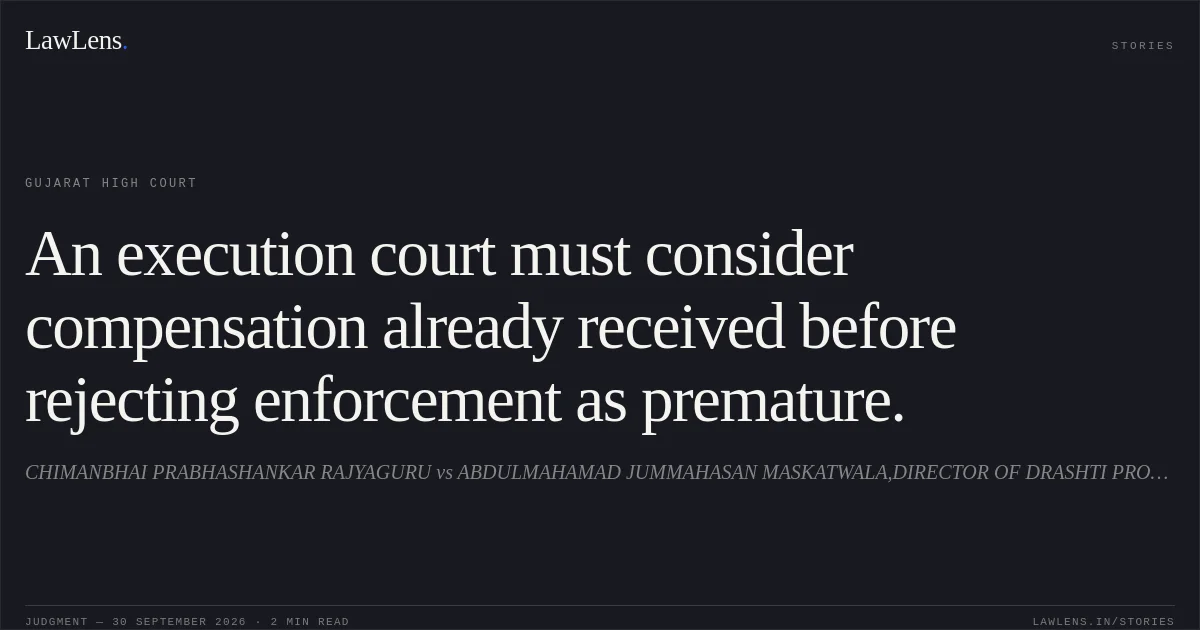
Source reference: para. 4, p. 3The Executing Court rejected the petitioners’ execution application as premature, reasoning that the full compensation had not been received and the decree was conditional.
Source reference: para. 4, p. 3The petitioners challenged that order.
Source reference: para. 4, p. 3Issues
Whether the Executing Court erred in rejecting the execution application as premature despite respondent No. 1 having received substantial compensation.
Source reference: paras. 4–6, pp. 3–4Whether the impugned order should be set aside and the execution application reconsidered on its merits.
Source reference: paras. 8–9, pp. 4–6Law Applied
The Court relied on the principle that an executing court must consider the terms of the decree and ensure that the decree-holder can obtain its fruits.
Source reference: paras. 8–9, pp. 4–6It also recognized that execution must be considered in light of the decree’s nature, the extent of compliance, and the rights arising under it.
Source reference: paras. 8–9, pp. 4–6Reasoning
The Executing Court had rejected the application at the threshold without properly examining the decree, the extent to which its terms had been complied with, or the petitioners’ rights under it.
Source reference: para. 8, pp. 4–5The High Court noted that the decree entitled the petitioners to ₹32,50,000 and that respondent No. 1 had received approximately ₹8.48 crores.
Source reference: para. 8, pp. 4–5In those circumstances, rejecting execution as premature without further examination was an error of fact and law.
Source reference: para. 8, pp. 4–5The High Court did not finally determine the decree’s executability; it held that the issue required fresh consideration on the merits.
Source reference: para. 8, pp. 4–5Holding
The Court allowed the petition to the extent of quashing and setting aside the Executing Court’s order and remanding the execution application for fresh adjudication on the merits, after giving both parties a reasonable opportunity to be heard.
It directed the Executing Court to dispose of the matter expeditiously and the parties to cooperate without seeking unnecessary adjournments.
Source reference: para. 9, p. 6The petition was disposed of, any interim relief was vacated, and no order as to costs was made.
Source reference: paras. 9–10, p. 6Original Court PDF
CHIMANBHAI PRABHASHANKAR RAJYAGURUvsABDULMAHAMAD JUMMAHASAN MASKATWALA,DIRECTOR OF DRASHTI PROPERTIES PVT LTD,SANJAY SHANTILAL PANCHAL
Click to open original judgment
Original judgment, available to read, download and summarize on LawLens.in