Facts
The appellant was convicted under Sections 364 and 302 of the Indian Penal Code (IPC) for allegedly abducting and killing his ten-year-old nephew, whose body was recovered from Baluaha Ghat.
Source reference: pp. 2–4, 8–9; paras. 2–4, 16–17The prosecution relied principally on a last-seen account, an alleged extra-judicial confession, and matrimonial discord as motive; the medical evidence indicated death by strangulation.
Source reference: pp. 2–4, 8–9; paras. 2–4, 16–17The appellant challenged the convictions, arguing that the circumstantial evidence was insufficient and that the investigation and trial had material defects.
Source reference: pp. 12–13, 18–24; paras. 24–26, 36–45The High Court reviewed the testimony, the unexamined Investigating Officer, the alleged confession, and the appellant’s examination under Section 313 CrPC.
Source reference: pp. 12–13, 18–24; paras. 24–26, 36–45Issues
1. Whether the prosecution proved a complete and conclusive chain of circumstantial evidence establishing that the appellant abducted and killed the deceased
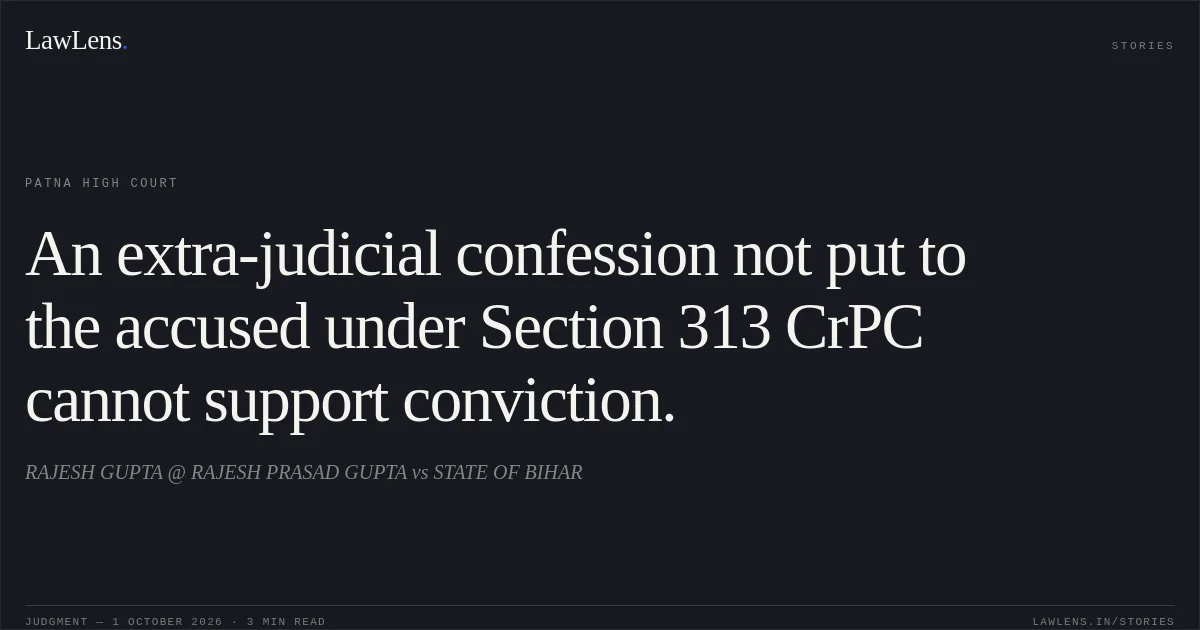
Source reference: pp. 12–16; paras. 26–292. Whether the alleged extra-judicial confession could be relied upon when its voluntariness and proof were disputed, and it had not been put to the appellant under Section 313 CrPC
Source reference: pp. 18–20, 23–24; paras. 37, 44–453. Whether investigative and trial defects—including non-examination of the Investigating Officer and an inadequate Section 313 examination—prejudiced the defence
Source reference: pp. 17–24; paras. 32–36, 39–45Law Applied
In a case resting on circumstantial evidence, the circumstances must be fully established, conclusive, consistent only with guilt, exclude every reasonable hypothesis of innocence, and form a complete chain pointing to the accused (Sharad Birdhichand Sarda v. State of Maharashtra, drawing on Hanumant v. State of Madhya Pradesh).
Source reference: pp. 13–14; para. 27Motive assumes importance in a case based purely on circumstantial evidence (Pannayar v. State of Tamil Nadu).
Source reference: p. 16; paras. 30–31A confession induced by threat is irrelevant under Section 24 of the Evidence Act; confessions made to police or while in police custody are subject to Sections 25 and 26.
Source reference: pp. 19–20; para. 37Contradictions in prior statements must be put to the witness and proved through the Investigating Officer in accordance with Sections 145 and 155 of the Evidence Act (Tahsildar Singh v. State of Uttar Pradesh).
Source reference: pp. 5, 18; paras. 8, 36Under Section 313 CrPC, material incriminating circumstances must be fairly and specifically put to the accused; circumstances not put cannot be relied upon (State of U.P. v. Mohd. Iqram, Naval Kishore Singh v. State of Bihar, Tara Singh v. State, and Sharad Birdhichand Sarda).
Source reference: pp. 21–23; paras. 40–43Delay in lodging the FIR may affect the spontaneity of the prosecution case (Thulia Kali v. State of Tamil Nadu).
Source reference: p. 17; paras. 32–33Reasoning
The medical evidence established strangulation, but did not identify the appellant as the perpetrator; the towel allegedly used was neither seized nor produced.
Source reference: pp. 8–9, 15; paras. 16, 29, 38The last-seen circumstance rested on one witness, while the additional claimed eyewitness was not found reliable; the evidence did not establish where the body was thrown or connect the alleged act with its recovery.
Source reference: pp. 14–15, 19–20; paras. 28–29, 37The alleged confession was doubtful in its circumstances, potentially affected by threats, and not proved through the Chaukidar or Investigating Officer; critically, it was not put to the appellant under Section 313 CrPC and therefore could not be used to convict him.
Source reference: pp. 18–20, 23–24; paras. 37, 44–45The alleged motive was considered weak, and the unexplained FIR delay and unproved witness contradictions further undermined the prosecution case.
Source reference: pp. 16–18; paras. 31–36The remaining evidence did not satisfy the required standard for a complete chain excluding innocence.
Source reference: pp. 15–16, 24; paras. 29, 46Holding
The High Court held that the prosecution had not proved the appellant’s guilt beyond reasonable doubt.
It allowed the appeal, set aside the convictions under Sections 364 and 302 IPC and the sentences imposed, and acquitted the appellant; as he was on bail, he was discharged from his bail-bond liabilities.
Source reference: pp. 24–25; paras. 46–49Acts & Sections Cited
5 provisions across 2 statutes referred to in this judgment. Each provision opens on LawLens.
Indian Penal Code, 18603
Code of Criminal Procedure, 19732
Original Court PDF
RAJESH GUPTA @ RAJESH PRASAD GUPTAvsSTATE OF BIHAR
Click to open original judgment
Original judgment, available to read, download and summarize on LawLens.in