Facts
The petitioner, a contractual employee serving as an Assistant Engineer, was posted as In-charge District Engineer, Giridih, in his own pay scale by notification dated 31 July 2025.
Source reference: p. 1The State later gave the in-charge posting to a permanent employee, who assumed charge.
Source reference: p. 1The petitioner alleged that other similarly situated contractual employees continued to hold independent charge and that he had been discriminated against under a departmental circular dated 19 May 2026.
Source reference: p. 1The intervenor’s application to be added was allowed; the State had not filed a counter-affidavit.
Source reference: pp. 1–2Issues
1. Whether the petitioner’s in-charge posting gave him a vested right to remain as In-charge District Engineer, Giridih.
Source reference: pp. 2–32. Whether the petitioner could seek consideration of his claim of disparity with similarly situated contractual employees.
Source reference: p. 3Law Applied
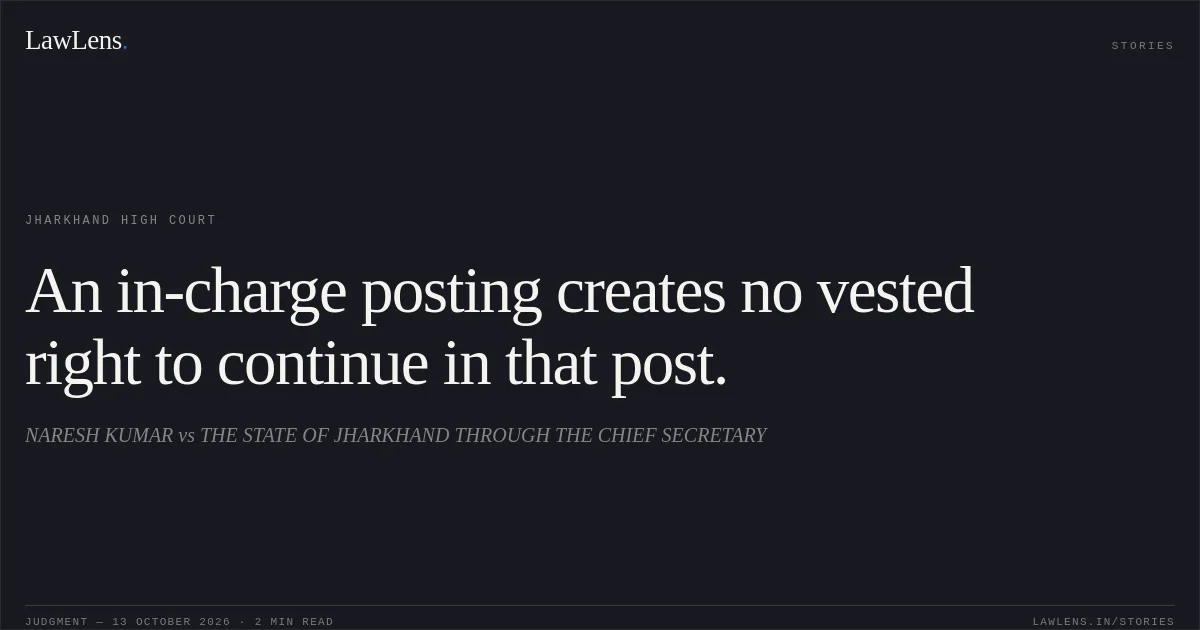
An in-charge or current-duty-charge posting is a stop-gap arrangement and does not confer a vested or indefeasible right to remain in the post.
Source reference: p. 3In State of Punjab & Ors. v. Arun Kumar Aggarwal & Ors., (2007) 10 SCC 402, the Supreme Court held that current-duty charge does not create an indefeasible right to the post or a right to regularisation.
Source reference: p. 3The Court also allowed the petitioner to raise his claim of unequal treatment for consideration in accordance with law and the principle of parity.
Source reference: p. 4Reasoning
The petitioner was a contractual employee who held the in-charge post only in his own pay scale; that arrangement did not give him a right to continue after another employee was placed in charge.
Source reference: pp. 2–4The Court therefore found no basis to grant relief on the claim to retain the post, particularly as the petitioner had shown no financial loss.
Source reference: pp. 2–4However, it considered his separate contention that similarly situated contractual employees continued to hold independent charge and permitted him to raise that disparity before the competent respondent.
Source reference: pp. 2–4Holding
The Court held that the petitioner had no vested right to remain in the in-charge post and granted no relief on that claim.
The writ petition was disposed of with liberty to the petitioner to approach the concerned respondent regarding the alleged disparity; the respondents were directed to decide the matter in accordance with law and the principle of parity within eight weeks of receiving the order.
Source reference: p. 4Original Court PDF
NARESH KUMARvsTHE STATE OF JHARKHAND THROUGH THE CHIEF SECRETARY
Click to open original judgment
Original judgment, available to read, download and summarize on LawLens.in