Facts
The complainant alleged that the accused owed him ₹12,00,000 and issued a cheque dated 5 March 2017 for that amount. The cheque was returned with the endorsement “account closed”; after notice and non-payment, the complainant filed a complaint under Section 138 of the Negotiable Instruments Act, 1881 (NI Act).
Source reference: pp. 3–4, 14–15The trial court convicted the accused and imposed a fine of ₹12,10,000; the appellate court affirmed the conviction and sentence.
Source reference: pp. 4–5In revision, the accused contended, among other things, that the cheque had been lost or stolen and that the statutory presumptions had been rebutted.
Source reference: pp. 5–7Issues
1. Whether the concurrent findings of conviction disclosed perversity, gross error, or another basis warranting interference in the High Court’s revisional jurisdiction.
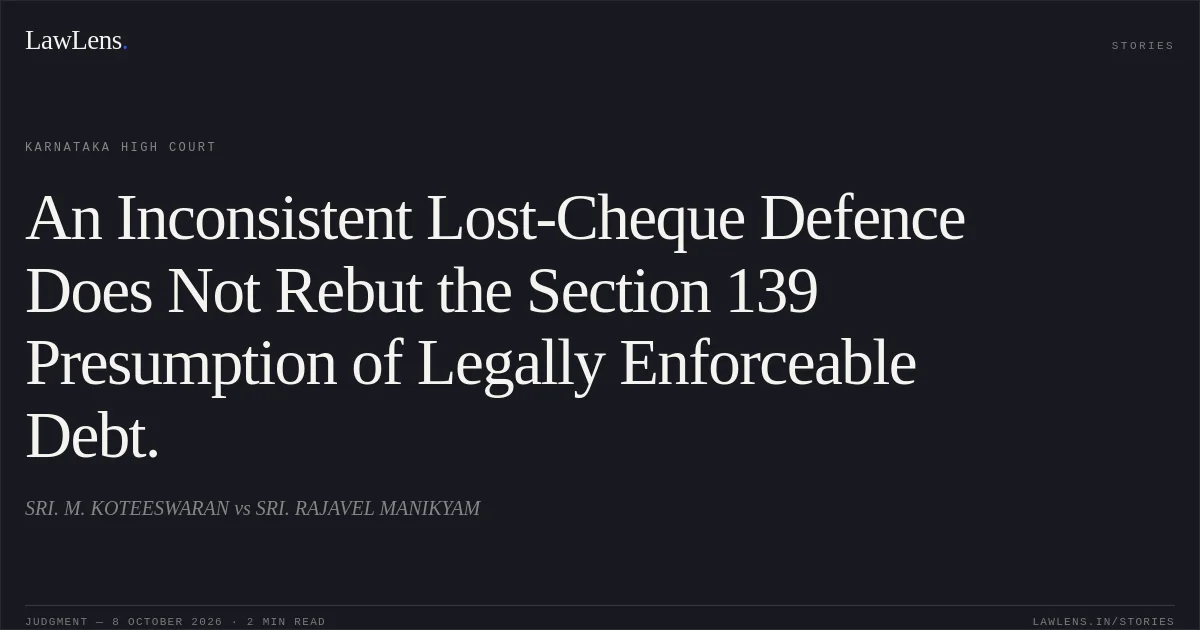
Source reference: pp. 8–132. Whether the accused had rebutted the presumptions under Sections 118 and 139 of the NI Act by raising a probable defence that the cheque was lost or stolen and was not issued towards a legally enforceable debt.
Source reference: pp. 13–22Law Applied
Section 138 of the NI Act criminalises the dishonour of a cheque issued towards a legally enforceable debt or liability when the statutory requirements—including presentation, written demand, and failure to pay within the prescribed period—are met.
Source reference: pp. 13–15Sections 118(a) and 118(b) raise presumptions as to consideration and the date of the instrument, while Section 139 presumes that the holder received the cheque in discharge of a debt or liability; these presumptions are rebuttable on a balance of probabilities.
Source reference: pp. 13–16Under Sections 397 and 401 of the Code of Criminal Procedure, 1973, revisional review is supervisory, not a second appeal; interference with concurrent findings is justified where they are perverse, grossly erroneous, unreasonable, unsupported by material, or based on an arbitrary exercise of discretion.
Source reference: pp. 9–12The Court relied on Kuntegowda v. Thurubaiah, 2026 SCC OnLine SC 1485, and State of Kerala v. Puttumana Illath Jathavedan Namboodiri, (1999) 2 SCC 452.
Source reference: pp. 9–12Reasoning
The Court found that the cheque’s dishonour, notice, and non-payment satisfied the relevant statutory requirements, thereby attracting the presumptions under Sections 118 and 139.
Source reference: pp. 14–16It considered the accused’s accounts of how the cheque was lost inconsistent: his reply notice, cross-examination, and defence evidence differed as to when and how the cheques went missing and how many were involved.
Source reference: pp. 16–22The police document relied upon was not shown to have been received, while another complaint concerning three cheques was made after the legal notice; the accused also produced no documentary support for his account of the money received from the complainant.
Source reference: pp. 16–22The Court therefore concluded that the defence did not rebut the statutory presumptions and that the lower courts’ assessment disclosed no ground for revisional interference.
Source reference: pp. 21–23Holding
The High Court held that the accused had not established a basis to disturb the concurrent findings of conviction and sentence.
The criminal revision petition was dismissed, leaving the trial court’s judgment as affirmed by the appellate court undisturbed.
Source reference: pp. 22–24Acts & Sections Cited
9 provisions across 3 statutes referred to in this judgment. Each provision opens on LawLens.
Code of Criminal Procedure, 19734
Bharatiya Nagarik Suraksha Sanhita, 20232
Negotiable Instruments Act, 18813
Original Court PDF
SRI. M. KOTEESWARANvsSRI. RAJAVEL MANIKYAM
Click to open original judgment
Original judgment, available to read, download and summarize on LawLens.in