Facts
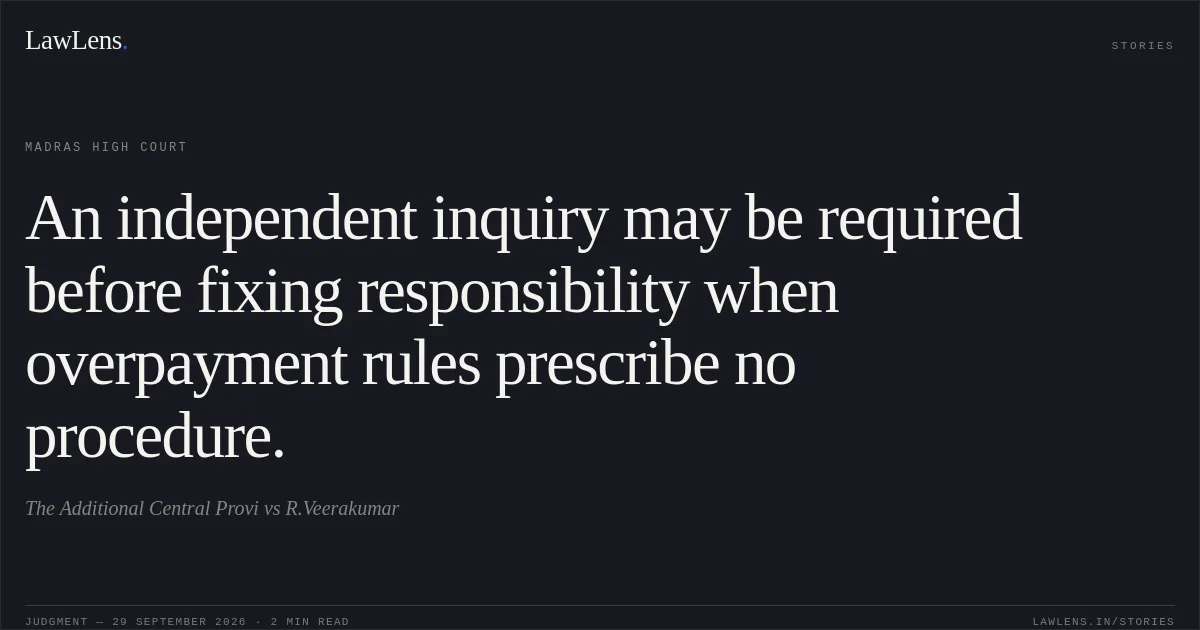
The Employees’ Provident Fund Organisation (EPFO) challenged two Central Administrative Tribunal orders concerning overpayments to employees of Madurai Coats (Private Limited).
Source reference: para. 2–3The Tribunal had directed the EPFO to appoint an Independent Inquiry Officer to examine the applicants’ defence and determine whether other persons were responsible for the lapses.
Source reference: para. 2–3The EPFO relied on the Manual of Accounting Procedure, which provides for an Overpayment Review Committee to examine the circumstances of an overpayment and fix responsibility among officers or officials.
Source reference: para. 5–6The officers had contended before the Tribunal that responsibility could not be attributed solely to them.
Source reference: para. 8The Tribunal’s orders were challenged in these writ petitions under Article 226 of the Constitution.
Source reference: para. 2Issues
1. Whether the Tribunal’s direction to appoint an Independent Inquiry Officer was sustainable despite the Manual of Accounting Procedure assigning overpayment review and responsibility-fixing to the Overpayment Review Committee.
Source reference: para. 5–6, 92. Whether the Tribunal’s orders warranted interference in the EPFO’s writ petitions.
Source reference: para. 8–10Law Applied
Article 226 of the Constitution provides the High Court’s jurisdiction to review the challenged Tribunal orders.
Source reference: no citationUnder clauses 14.6.2 and 14.6.3 of the EPFO Manual of Accounting Procedure, an Overpayment Review Committee—comprising the Regional Provident Fund Commissioner as Chairperson and two specified members—must review overpayments, examine relevant records and circumstances, and fix responsibility and recoverable amounts.
Source reference: para. 5The Manual does not prescribe the manner in which the Committee must conduct that inquiry or reach its conclusions.
Source reference: para. 9No judicial precedents were cited.
Source reference: no citationReasoning
The Court accepted that the Manual empowered the Committee to fix responsibility, but observed that it did not specify how that responsibility was to be determined.
Source reference: para. 9Because the officers had argued that other officials might also have been responsible, and the Tribunal considered that responsibility could not be properly fixed without an adequate inquiry, the direction for an Independent Inquiry Officer was not inconsistent with any prescribed procedure in the Manual.
Source reference: para. 8–9The Court therefore found no basis to interfere with the Tribunal’s orders.
Source reference: no citationHolding
The Court answered the issues against the EPFO and dismissed both writ petitions, leaving the Tribunal’s directions in place.
No costs were awarded, and the connected miscellaneous petition was closed.
Source reference: para. 10Original Court PDF
The Additional Central ProvivsR.Veerakumar
Click to open original judgment
Original judgment, available to read, download and summarize on LawLens.in