Facts
The Trial Court had initially granted an ad-interim injunction in favour of the plaintiff/appellant.
Source reference: no citationBy Order No. 54 dated 2 July 2026, it vacated that injunction, apparently relying on the plaintiff’s absence in person and without giving reasons.
Source reference: para. 7The appellant’s appeal was filed on 2 September 2026, after the limitation period had expired on or about 1 August 2026.
Source reference: paras. 2–3In the intervening period, the appellant had mistakenly pursued a petition under Article 227 of the Constitution against the order.
Source reference: paras. 2–3Issues
Whether the delay in filing the appeal should be condoned where it resulted from the appellant’s bona fide, mistaken pursuit of an Article 227 petition.
Source reference: paras. 2–5Whether the Trial Court’s vacation of the ad-interim injunction could stand when the order gave no adequate reasons and relied on the plaintiff’s absence in person.
Source reference: paras. 7–8Law Applied
Under Order XXXIX Rule 4 of the Code of Civil Procedure, an injunction may be discharged, varied or set aside on the grounds provided by that provision; the court must address the relevant basis for doing so.
Source reference: paras. 3, 8, 11A judicial order vacating an injunction must give reasons sufficient to explain the decision.
Source reference: paras. 3, 8, 11The judgment also refers to Order VII Rule 11 CPC as governing the defendant’s pending application for rejection of the plaint, and to Article 227 of the Constitution in describing the appellant’s mistaken procedural recourse.
Source reference: paras. 3, 8, 11No precedent is cited.
Source reference: no citationReasoning
The Court accepted the appellant’s bona fide error in pursuing an Article 227 petition as a sufficient explanation for the approximately 33-day delay and condoned it.
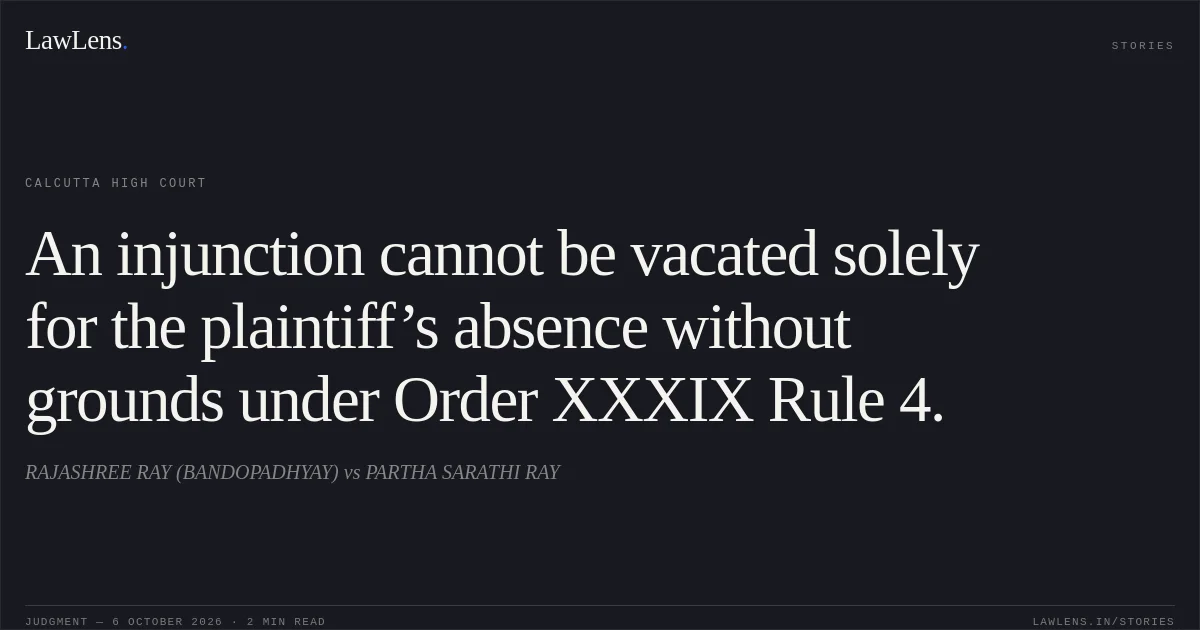
Source reference: paras. 2–5On the merits, it found that the plaintiff’s absence in person did not, by itself, establish a basis under Order XXXIX Rule 4 CPC to vacate the injunction.
Source reference: paras. 7–9Because the impugned order contained no meaningful reasoning, it could not be sustained.
Source reference: paras. 7–9Holding
The Court allowed CAN 1 of 2026 and condoned the delay.
It admitted and allowed FMAT 355 of 2026, setting aside the Trial Court’s Order No. 54 dated 2 July 2026.
Source reference: paras. 5–6, 9CAN 2 of 2026 was disposed of.
Source reference: paras. 10–12The Trial Court was asked to decide the defendant’s Order VII Rule 11 application as expeditiously as possible, preferably within three weeks after reopening following the annual vacation, and thereafter to take up and decide the injunction application promptly, depending on the outcome of the rejection application.
Source reference: paras. 10–12There was no order as to costs.
Source reference: paras. 10–12Original Court PDF
RAJASHREE RAY (BANDOPADHYAY)vsPARTHA SARATHI RAY
Click to open original judgment
Original judgment, available to read, download and summarize on LawLens.in