Facts
The appellant, an officer of the Bihar Administrative Service, was posted as Senior Deputy Collector with duties connected to the Transport Department at Bhabhua in March 2016.
Source reference: paras. 3–4; pp. 2–3On 16 March 2016, the Vigilance Investigation Bureau conducted a raid at the Karmanasha Check-Post and allegedly recovered unaccounted money from the appellant, in excess of the lawful collections made through vehicle-penalty proceedings.
Source reference: paras. 3–4; pp. 2–3A departmental proceeding was initiated against him for the alleged irregularities and unauthorised absence.
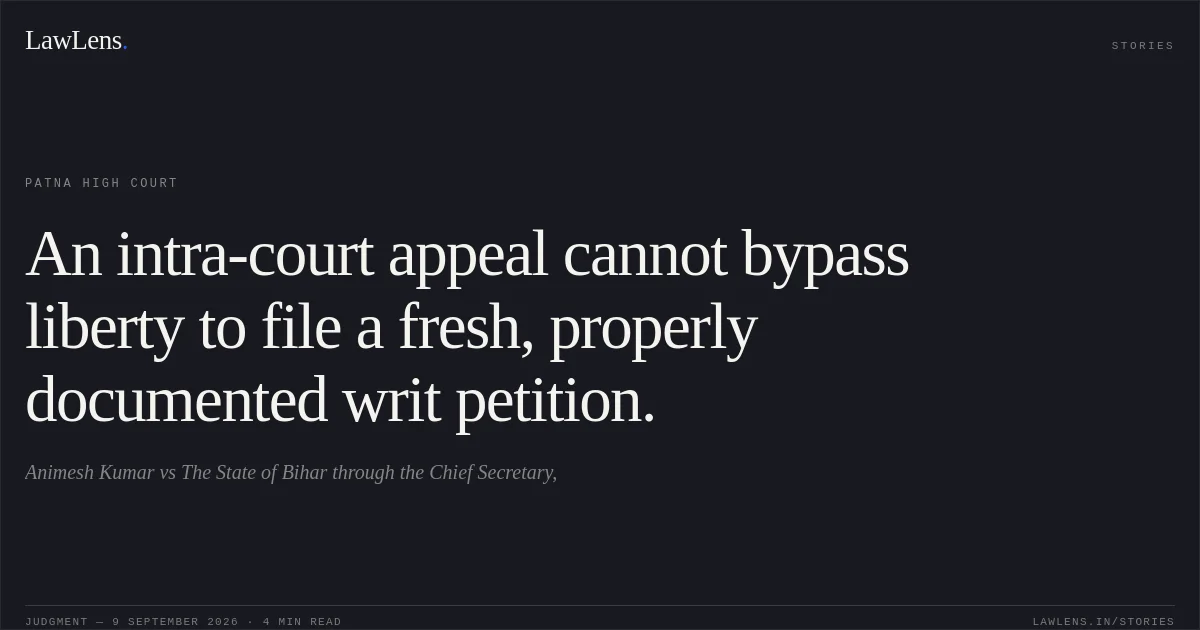
Source reference: para. 5; pp. 3–4The learned Single Judge dismissed CWJC No. 10467 of 2024 because the writ petition was unsupported by the relevant documents, while granting liberty to the appellant to file a fresh, properly documented writ petition.
Source reference: paras. 1, 9; pp. 1, 6Instead of availing that liberty, the appellant preferred the present Letters Patent Appeal and attempted to place additional and translated documents on record for the first time at the appellate stage.
Source reference: paras. 10, 12; pp. 6–7Issues
Whether an intra-court appeal lies, or interference is warranted, against an order dismissing a writ petition for want of supporting documents while granting liberty to file a fresh properly documented petition?
Source reference: paras. 9, 12; pp. 6–7Whether the appellant could introduce additional or translated documents for the first time in the Letters Patent Appeal after failing to annex supporting documents to the writ petition?
Source reference: para. 12; p. 7Whether the departmental findings and punishment were liable to be interfered with in judicial review on the ground that the appellant had not been directly assigned duties at the relevant check-post and had allegedly been held vicariously liable?
Source reference: paras. 6, 13; pp. 4–5, 7–8Whether the rejection of the appellant’s departmental appeal on the ground of limitation warranted interference, having regard to the alleged non-supply or non-communication of the punishment order?
Source reference: paras. 14–16; pp. 8–15Law Applied
An intra-court appellate court ordinarily will not permit a litigant to circumvent the procedure or opportunity granted by the Single Judge, particularly where the writ petition was dismissed for incomplete pleadings rather than on merits.
Source reference: para. 12; p. 7In judicial review of disciplinary proceedings, the High Court does not sit as an appellate court to reappreciate evidence; interference is justified only where the findings are perverse, based on no evidence, or vitiated by breach of natural justice causing demonstrable prejudice.
Source reference: para. 13; p. 8The Court relied on Union of India v. Ganesh Das Bhojraj, (2000) 9 SCC 461, for the principle that publication in the Official Gazette is the ordinary mode of bringing a general rule or notification to the notice of persons concerned and that individual service is not ordinarily required.
Source reference: paras. 14–15; pp. 8–14Under Rule 25 of the Bihar Government Servants (Classification, Control and Appeal) Rules, 2005, an appeal against a punishment order must generally be filed within forty-five days from delivery of the order, although the appellate authority may condone delay upon being satisfied that sufficient cause exists.
Source reference: para. 16; pp. 14–15Its decision on sufficient cause will not ordinarily be disturbed unless it is perverse, arbitrary, or based on no material.
Source reference: para. 16; pp. 14–15Reasoning
The Court held that the Single Judge’s order was essentially a dismissal for incomplete pleadings or non-prosecution, not an adjudication on the merits.
Source reference: para. 12; p. 7Since the appellant had expressly been granted liberty to file a fresh writ petition with all relevant documents, he could not bypass that course by introducing documents for the first time in the LPA.
Source reference: para. 12; p. 7Even on a prima facie examination, the Court found no basis for interference with the disciplinary findings.
Source reference: para. 13; p. 8The fact that the Inquiry Officer recorded findings favourable to the appellant concerning his lack of direct assignment at the check-post did not, by itself, establish perversity in the conclusion of partial or vicarious liability.
Source reference: para. 13; p. 8Reappreciation of the disciplinary evidence was outside the permissible scope of judicial review in the absence of proof of perversity, absence of evidence, or violation of natural justice.
Source reference: para. 13; p. 8Since the authority had considered the explanation and rejected the appeal on limitation, and no perversity, arbitrariness, or non-application of mind was shown, substitution of the Court’s view was unwarranted.
Source reference: para. 16; pp. 14–15Holding
The Letters Patent Appeal was dismissed.
The Court held that the appellant could not introduce supporting documents for the first time in the LPA after the Single Judge had dismissed the writ petition for want of documents while granting liberty to file a fresh petition.
Source reference: paras. 18–19; p. 15It further found no prima facie ground to interfere with the disciplinary findings or the rejection of the delayed departmental appeal.
Source reference: paras. 18–19; p. 15The liberty granted by the Single Judge to file a fresh writ petition with all supporting documents was expressly preserved.
Source reference: paras. 18–19; p. 15There was no order as to costs.
Source reference: paras. 18–19; p. 15Acts & Sections Cited
1 provisions across 1 statute referred to in this judgment. Linked provisions open on LawLens.
Motor Vehicles Act, 19881
Original Court PDF
Animesh KumarvsThe State of Bihar through the Chief Secretary,
Click to open original judgment
Original judgment, available to read, download and summarize on LawLens.in