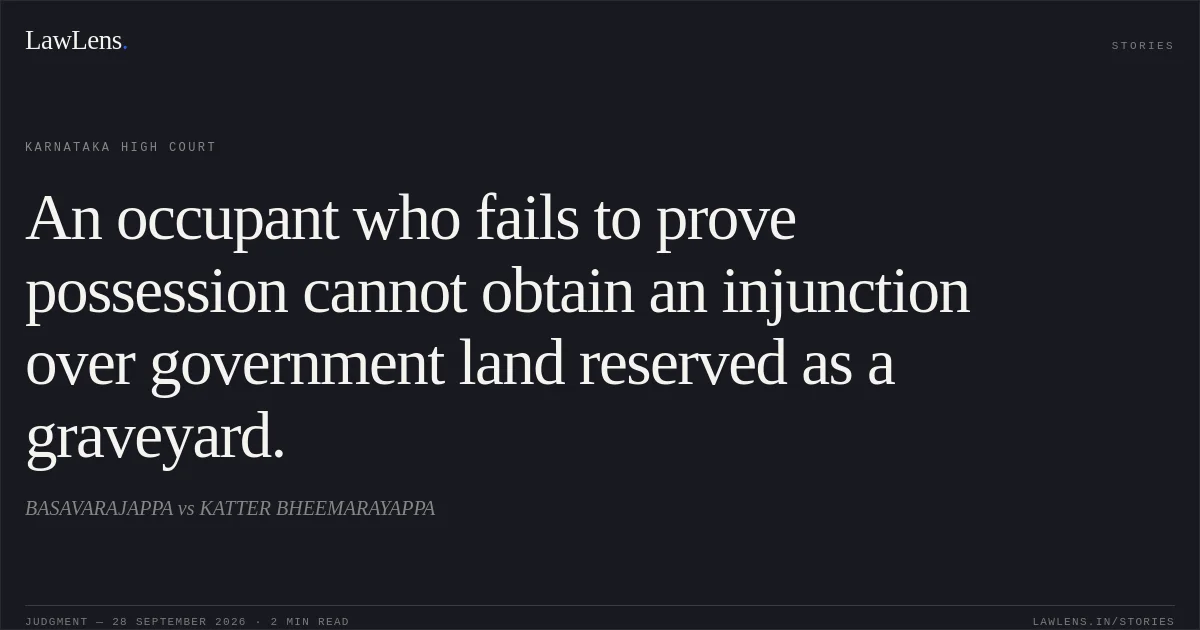
Facts
The appellants, plaintiffs in O.S. No. 106/2006, sought a permanent injunction concerning 4 acres 30 guntas in Sy. No. 121, Guddekoppa Village, claiming possession through their family’s cultivation.
Source reference: pp. 3–6; paras. 3–6The respondents asserted that the Government land had been reserved in part for a Hindu burial ground.
Source reference: pp. 3–6; paras. 3–6A related suit, O.S. No. 87/2009, seeking a declaration concerning the burial-ground reservation, was tried with the appellants’ suit; both suits were dismissed. The First Appellate Court dismissed the appellants’ appeal and confirmed the dismissal of O.S. No. 106/2006.
Source reference: pp. 3–6; paras. 3–6During the second appeal, the Karnataka Appellate Tribunal (KAT) dismissed the appellants’ challenge to the reservation of 3 acres for a burial ground, and that decision was not further challenged.
Source reference: pp. 44–51; paras. 17–19Issues
1. Whether the concurrent findings dismissing the appellants’ injunction suit raised a substantial question of law warranting interference under Section 100 CPC, particularly in light of the alleged non-consideration of evidence of possession.
Source reference: pp. 6–8; paras. 7–92. Whether the appellants established a basis for interference with the concurrent findings on possession and entitlement to an injunction, given the final KAT decision upholding the reservation of the land for a burial ground.
Source reference: pp. 44–52; paras. 17–20Law Applied
Under Section 100 of the Code of Civil Procedure, a second appeal lies only where a substantial question of law arises; concurrent factual findings do not warrant interference merely because a party disputes the appreciation of evidence.
Source reference: pp. 6–8, 51–52; paras. 7–9, 20A plaintiff seeking a permanent injunction based on possession must establish actual possession of the property at the relevant time.
Source reference: pp. 15–16; para. 11The Trial Court also referred to Section 41(h) of the Specific Relief Act, 1963, concerning refusal of an injunction where an equally efficacious remedy is available.
Source reference: pp. 15–16; para. 11The courts below considered authorities concerning protection of settled possession and the limits on injunctions concerning public land; the High Court’s decision, however, rested on the absence of a substantial question of law and the finality of the KAT order.
Source reference: pp. 14–16, 25–28; paras. 11, 22–25Reasoning
The concurrent courts found that the appellants had not proved possession when the suit was filed: the relevant revenue records described the land as Government land and, subsequently, as reserved for a Hindu graveyard, while the appellants’ names did not appear in the records for the suit period.
Source reference: pp. 37–44; paras. 48–62The High Court also noted that the appellants’ claim for regularisation had been rejected and that the KAT had dismissed their challenge to the reservation of 3 acres for a burial ground.
Source reference: pp. 44–52; paras. 17–20Because that KAT decision had attained finality, and the appellants’ grounds did not establish legal error in the concurrent findings, the High Court found no substantial question of law requiring consideration in second appeal.
Source reference: pp. 44–52; paras. 17–20Holding
The High Court held that no substantial question of law arose and found no merit in the second appeal.
It dismissed RSA No. 1466 of 2017 at the admission stage, leaving undisturbed the concurrent dismissal of the appellants’ suit for permanent injunction.
Source reference: pp. 51–52; para. 20Acts & Sections Cited
17 provisions across 4 statutes referred to in this judgment. Each provision opens on LawLens.
Code of Civil Procedure, 19084
Specific Relief Act, 19635
Indian Penal Code, 18607
Limitation Act, 19631
Original Court PDF
BASAVARAJAPPAvsKATTER BHEEMARAYAPPA
Click to open original judgment
Original judgment, available to read, download and summarize on LawLens.in
![Omission from service records alone cannot defeat a widow’s claim for compassionate-appointment consideration.. SMT ARISHI DEVI vs ORDNANCE FACTORY. CAT - ['Allahabad']. LawLens](/stories/thumbnails/omission-from-service-records-alone-cannot-defeat-a-widows-claim-for-compassionate-appoint-885232d4acd04973bf42ec35220c8374.webp)
![Compassionate appointment claims must receive a third consideration when previously considered only twice.. LALIT SHARMA vs D/o Post. CAT - ['Allahabad']. LawLens](/stories/thumbnails/compassionate-appointment-claims-must-receive-a-third-consideration-when-previously-consid-7df116bb81b1454bab2ecaddec606237.webp)