Facts
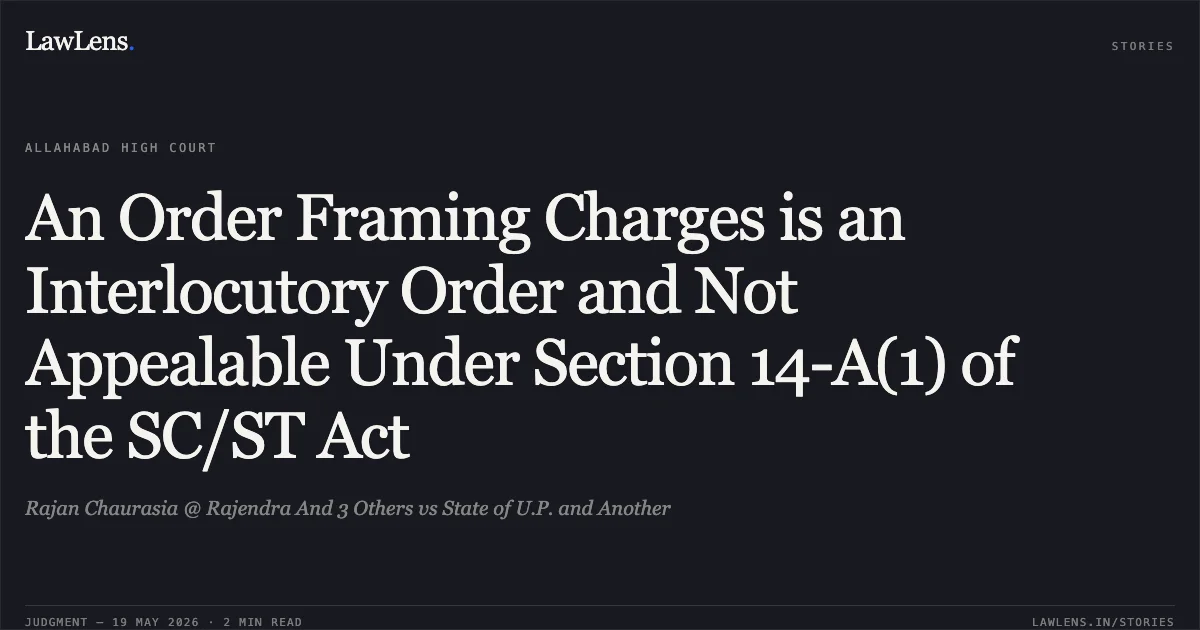
The appellants filed a criminal appeal under Section 14-A(1) of the Scheduled Castes and the Scheduled Tribes (Prevention of Atrocities) Act, 1989 (SC/ST Act), challenging an order dated September 15, 2025, passed by the Special Judge (SC/ST Act), Deoria.
Source reference: para. 2The impugned order framed charges against the appellants under Sections 427, 504, 506 of the IPC and Sections 3(1)(da) and 3(1)(dha) of the SC/ST Act.
Source reference: para. 2The State and the complainant raised a preliminary objection, arguing that an order framing charges is an interlocutory order and is therefore barred from appeal under Section 14-A(1) of the Act.
Source reference: para. 3Issues
1. Whether the order of framing of charge is an interlocutory order?
Source reference: para. 82. Whether an appeal under Section 14-A of the SC/ST Act is maintainable against an interlocutory order?
Source reference: para. 8Law Applied
Section 14-A(1) of the SC/ST Act, which stipulates that an appeal lies to the High Court from any judgment, sentence, or order, provided it is "not being an interlocutory order".
Source reference: para. 21-22The Supreme Court’s interpretation in Ratilal Bhanji Mithani v. State of Maharashtra (1979) and State Th. CBI v. Jitendra Kumar Singh (2014), which established that a trial begins with the framing of charges; prior proceedings are merely inquiries.
Source reference: para. 11, 14Amar Nath v. State of Haryana (1977) to define interlocutory orders as those of a purely interim nature that do not finally dispose of the rights of the parties.
Source reference: para. 16, 18V.C. Shukla v. State (1980), which explicitly held that framing of charge is an interlocutory order because the trial remains "alive" until conviction or acquittal.
Source reference: para. 23-24Reasoning
The Court reasoned that an order is interlocutory if it does not terminate the proceedings or finally decide the rights of the parties.
Source reference: para. 18Applying the precedents of the Apex Court, the Court noted that once charges are framed, the trial commences and the magistrate loses the power to discharge the accused; the proceedings must culminate in either acquittal or conviction.
Source reference: para. 11-13, 19Therefore, while the refusal to frame charges (resulting in discharge) would be a final order, the decision to frame charges and proceed with the trial constitutes an intermediate/interlocutory step in the judicial process.
Source reference: para. 23Since Section 14-A(1) of the SC/ST Act expressly excludes "interlocutory orders" from the ambit of appealable orders, the statutory bar applies.
Source reference: para. 22The Court also referenced similar findings from the Himachal Pradesh High Court to reinforce that the proper remedy against such orders lies in revisional or inherent jurisdiction, not an appeal under the SC/ST Act.
Source reference: para. 25Holding
The Court answered the first issue by holding that the order of framing of charge is an interlocutory order.
Consequently, on the second issue, it held that the present criminal appeal is not maintainable under Section 14-A(1) of the SC/ST Act.
Source reference: para. 22, 27The appeal was dismissed, granting the appellants liberty to seek other available legal remedies.
Source reference: para. 27-28Acts & Sections Cited
14 provisions across 3 statutes referred to in this judgment. Each provision opens on LawLens.
Scheduled Castes and the Scheduled Tribes (Prevention of Atrocities) Act, 19891
Indian Penal Code, 18603
Code of Criminal Procedure, 1973
Original Court PDF
Rajan Chaurasia @ Rajendra And 3 OthersvsState of U.P. and Another
Click to open original judgment
Original judgment, available to read, download and summarize on LawLens.in