Facts
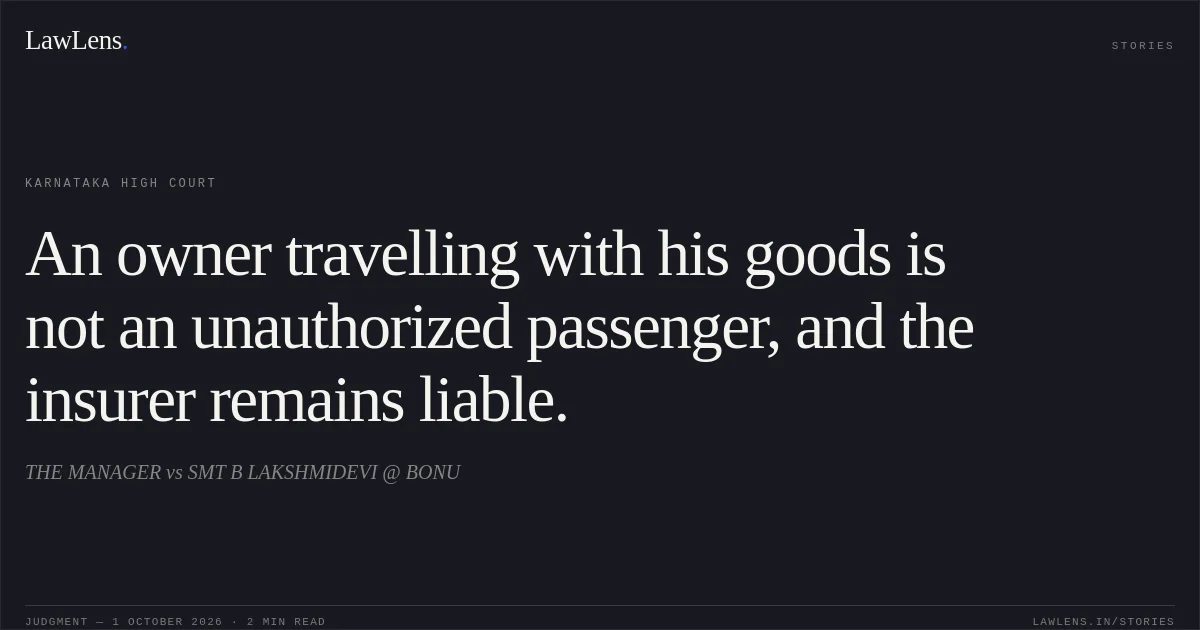
B. Thippanna @ Chinnabba died following an accident on 30 September 2010 while travelling in a goods vehicle with agricultural produce.
Source reference: p.3His wife and children sought compensation.
Source reference: p.3The Motor Accident Claims Tribunal awarded Rs.7,36,000 with interest at 8% per annum and directed the insurer to pay.
Source reference: p.3The insurer appealed, disputing liability on the ground that the deceased was an unauthorised passenger in a goods vehicle, that the driver was not joined, and that the compensation was excessive.
Source reference: pp.4–5The High Court found that the deceased was travelling with the goods as their owner.
Source reference: pp.6–8Issues
1. Whether the insurer could avoid liability because the deceased was allegedly an unauthorised passenger in a goods vehicle and the driver was not joined as a party.
Source reference: pp.4–5, 7–82. Whether the compensation awarded by the Tribunal required reassessment, including in the absence of a cross-appeal or cross-objections by the claimants.
Source reference: pp.8–10Law Applied
The appeal was brought under Section 173(1) of the Motor Vehicles Act.
Source reference: p.3The Court relied on Surekha v. Santosh, (2021) 16 SCC 467, for the principle that a court may grant just compensation even in the absence of a cross-appeal or cross-objections by the claimants.
Source reference: p.8In reassessing compensation, the Court applied the principles of notional income, future prospects, personal-expense deductions, multiplier, and conventional heads of compensation to the facts of the case.
Source reference: pp.9–10The insurer’s reliance on Section 134(c) and Section 158(6) of the Motor Vehicles Act and Rule 235 of the Karnataka Motor Vehicles Rules, 1989, was recorded as an argument, not as a basis for the Court’s decision.
Source reference: p.4Reasoning
The Court rejected the insurer’s challenge to liability because the evidence—including the accident records and the presence of produce at the scene—supported the Tribunal’s finding that the deceased was travelling with his goods, rather than as a passenger.
Source reference: pp.6–8It also held that the driver’s non-joinder did not defeat the claim: notice had been served on the vehicle owner, who did not give evidence or produce the driver or driving licence.
Source reference: p.8On compensation, the Court assessed the deceased’s notional monthly income at Rs.5,500, took his age as 55 and applied a multiplier of 11, added 10% for future prospects, and deducted one-fifth for personal expenses given the number of dependants.
Source reference: pp.9–10Applying Surekha, it reassessed compensation despite the absence of a claimants’ cross-appeal.
Source reference: p.8Holding
The High Court disposed of the appeal and enhanced the total compensation from Rs.7,36,000 to Rs.9,48,880, with interest at 6% per annum from the date of the petition until realisation.
It directed the insurer to deposit the enhanced amount of Rs.2,12,880, with applicable interest, within one month.
Source reference: p.10The deceased’s wife was permitted to withdraw the entire amount, including accrued interest.
Source reference: p.10Acts & Sections Cited
3 provisions across 1 statute referred to in this judgment. Each provision opens on LawLens.
Motor Vehicles Act, 19883
Original Court PDF
THE MANAGERvsSMT B LAKSHMIDEVI @ BONU
Click to open original judgment
Original judgment, available to read, download and summarize on LawLens.in