Facts
Respondent No. 2 alleged that the petitioners assaulted and threatened him during an incident on 16 July 2022.
Source reference: para. 2A relative of the petitioners had separately lodged a complaint concerning the same incident, which resulted in a charge-sheet against respondent No. 2.
Source reference: para. 2Respondent No. 2 later filed a private complaint; the Magistrate referred it to the police for investigation, and the police filed a charge-sheet against the petitioners for offences under Sections 323, 324, 504 and 506 read with Section 34 IPC.
Source reference: paras. 2–4, 12The petitioners sought to quash the charge-sheet and the Magistrate’s cognizance order, arguing, among other things, that the Magistrate had not applied his mind when referring the complaint for investigation.
Source reference: paras. 1, 6–7Issues
1. Whether the charge-sheet and subsequent proceedings against the petitioners should be quashed under Section 482 CrPC, given the allegations, witness statements and medical records.
Source reference: paras. 1, 8, 132. Whether the alleged failure of the Magistrate to record satisfaction when referring the complaint to the police justified quashing the proceedings after investigation and filing of the charge-sheet.
Source reference: paras. 7, 14–16Law Applied
Section 482 CrPC confers discretionary inherent jurisdiction, which is not to be exercised to quash proceedings where the record discloses a cognizable offence and no miscarriage of justice is shown.
Source reference: paras. 15–16The Court applied the principle in Anurag Bhatnagar v. State (NCT of Delhi), AIR 2025 SC 3427: after a Magistrate’s order has led to registration of an FIR, completion of investigation and filing of a charge-sheet, the court may decline to interfere where the order is not illegal or without jurisdiction and the subsequent proceedings disclose an offence.
Source reference: para. 15The complaint had been referred for investigation under Section 156(3) CrPC.
Source reference: paras. 4, 7Reasoning
The Court found that the incident was supported prima facie by eyewitness statements and medical records showing that respondent No. 2 sustained injuries.
Source reference: para. 13It therefore held that the proceedings could not be quashed at that stage.
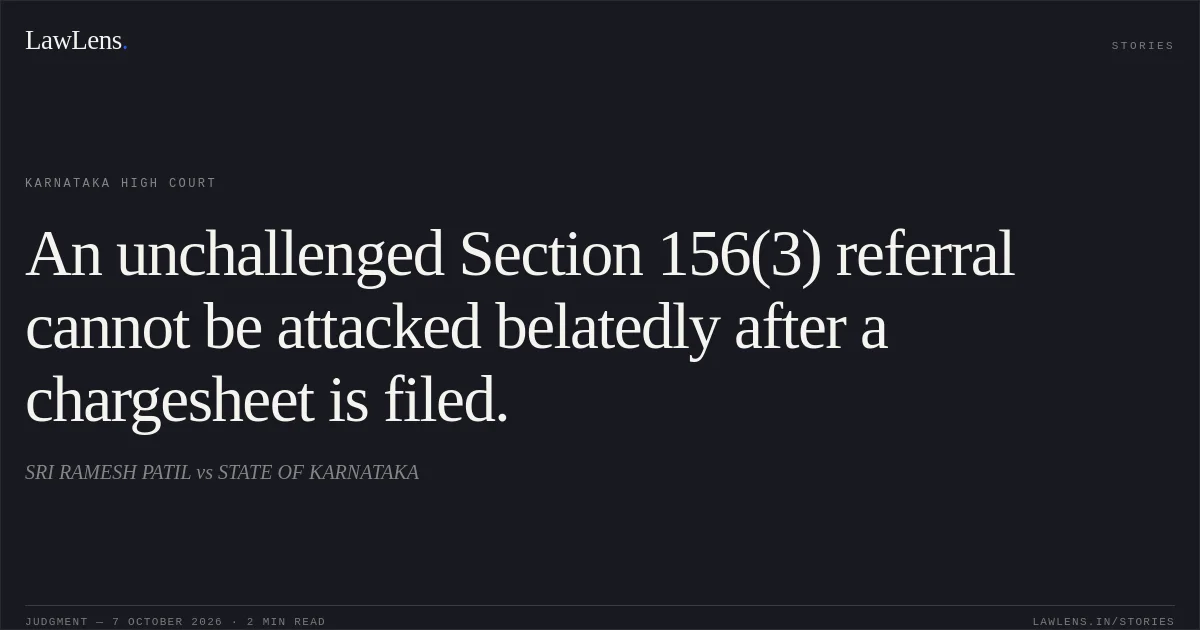
Source reference: para. 13As to the challenge to the referral order, the Court noted that the petitioners had not challenged it before the police registered the FIR, investigated the case and filed the charge-sheet, after which the Magistrate took cognizance.
Source reference: paras. 14–16Applying Anurag Bhatnagar, the Court declined to set aside the proceedings on the asserted defect in the referral order.
Source reference: paras. 14–16Holding
The Court answered both issues against the petitioners and dismissed the petition as devoid of merit, declining to exercise its inherent jurisdiction under Section 482 CrPC.
It clarified that its observations should not affect the Trial Court’s consideration of the case.
Source reference: para. 17Acts & Sections Cited
8 provisions across 2 statutes referred to in this judgment. Each provision opens on LawLens.
Code of Criminal Procedure, 19732
Indian Penal Code, 18606
Original Court PDF
SRI RAMESH PATILvsSTATE OF KARNATAKA
Click to open original judgment
Original judgment, available to read, download and summarize on LawLens.in