Facts
The dispute concerned Flat No. 3389, Vasant Kunj, New Delhi, originally allotted to defendant no. 1, Padam Chand Jain, who acquired its freehold title through a conveyance deed dated 28 August 2003.
Source reference: pp. 2–3, paras. 3.1–3.5On 5 February 2007, he executed a registered Gift Deed transferring the property to his elder son, Arun Jain, the plaintiff.
Source reference: pp. 2–3, paras. 3.1–3.5On the same date, Arun Jain executed a General Power of Attorney in favour of his father to manage the property while Arun was residing abroad.
Source reference: pp. 2–3, paras. 3.1–3.5After disputes arose, the plaintiff revoked the GPA in 2013.
Source reference: pp. 2, 10–11, paras. 3.6–3.7, 30Defendant no. 1 instituted a suit seeking cancellation of the Gift Deed, alleging fraud, but unconditionally withdrew it on 6 June 2015 and did not thereafter institute proceedings for cancellation.
Source reference: pp. 2, 10–11, paras. 3.6–3.7, 30The plaintiff subsequently filed a suit for declaration of ownership and permanent injunction.
Source reference: no citationDuring its pendency, he sought judgment on admissions under Order XII Rule 6 CPC, relying on the defendants’ admission of the execution and registration of the Gift Deed.
Source reference: p. 3, para. 3.9The Trial Court allowed the application and decreed the suit, holding that the Gift Deed was absolute, unconditional and validly executed.
Source reference: pp. 3–4, para. 4It further held that the alleged oral understanding requiring the plaintiff to maintain his parents, and the absence of delivery of possession or original title documents, could not defeat the registered Gift Deed.
Source reference: pp. 3–4, para. 4The defendants appealed under Section 96 CPC.
Source reference: no citationIssues
Whether the execution and registration of the Gift Deed constituted clear and unequivocal admissions justifying judgment under Order XII Rule 6 CPC, or whether the defendants’ pleas disclosed bona fide triable issues.
Source reference: pp. 5–8, paras. 9–13, 49–51Whether the alleged oral understanding that the gift was a temporary or conditional arrangement could be relied upon to vary or contradict the terms of the registered Gift Deed.
Source reference: pp. 5–7, paras. 10, 18; pp. 11–12, para. 33Whether non-delivery of physical possession and original title documents invalidated or postponed the effectiveness of the registered gift of immovable property.
Source reference: pp. 5, 12–14, paras. 11, 20, 34–38Whether the donor could unilaterally revoke the absolute Gift Deed by notice under Section 126 of the Transfer of Property Act, 1882, or supersede it through a subsequent Will.
Source reference: pp. 6–8, 14–15, paras. 12, 19, 39–43Whether Section 23 of the Maintenance and Welfare of Parents and Senior Citizens Act, 2007 applied retrospectively to invalidate the Gift Deed executed before the Act came into force.
Source reference: pp. 8–9, 15–16, paras. 14, 23, 44–48Law Applied
The Court applied Order XII Rule 6 CPC, under which judgment may be entered on clear, unequivocal admissions appearing in pleadings, documents or the surrounding circumstances.
Source reference: no citationSections 91, 92 and 94 of the Indian Evidence Act, 1872, which restrict oral evidence from contradicting, varying or explaining away the plain terms of a written instrument.
Source reference: pp. 11–12, para. 33Sections 122 and 123 of the Transfer of Property Act, 1882, under which a gift requires acceptance and, for immovable property, a registered instrument executed by the donor and attested by two witnesses, but not delivery of possession or original title documents.
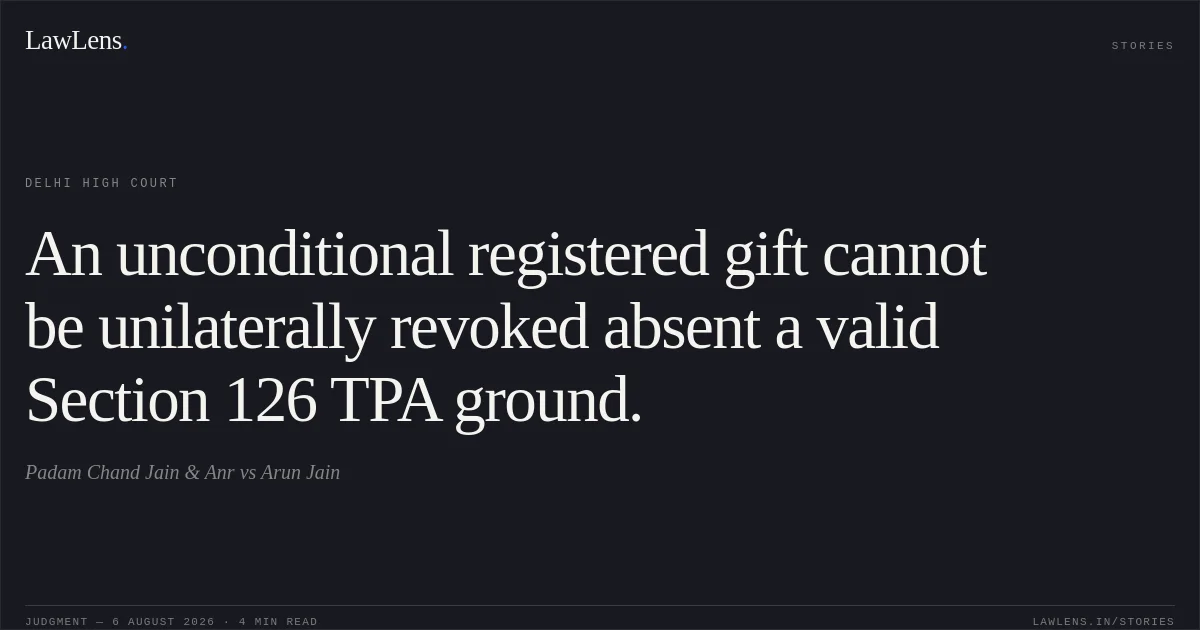
Source reference: pp. 12–14, paras. 36–38Section 126 TPA, under which an unconditional gift cannot be unilaterally revoked by the donor absent a legally recognised condition of revocation.
Source reference: p. 14, paras. 39–42The Court relied on Roop Kumar v. Mohan Thedani, (2003) 6 SCC 595, Promila Gulati v. Anil Gulati, 2015 SCC OnLine Del 7406, Mohinder Singh Verma v. J.P.S. Verma, 2014 SCC OnLine Del 2565, Sahdev Singh Verma v. J.P.S. Verma, 2015 SCC OnLine Del 11654, Asokan v. Lakshmi Kutty, (2007) 13 SCC 210, and Ramti Devi v. Union of India, 1995 (1) SCC 198.
Source reference: pp. 11–15, paras. 33, 37–42It further held, following Charanjeet Singh Ahluwalia v. Union of India, 2023 SCC OnLine Del 2730, that Section 23 of the Senior Citizens Act does not retrospectively disturb rights vested under a transfer made before the Act’s commencement.
Source reference: pp. 15–16, paras. 46–48Reasoning
The Court found that the defendants had admitted both the execution and registration of the Gift Deed.
Source reference: p. 9, para. 25The Deed expressly described the plaintiff as the “absolute and exclusive owner” and recorded that possession had been delivered; the GPA executed contemporaneously also recognised the plaintiff’s absolute ownership and merely authorised the father to manage the property while the plaintiff lived abroad.
Source reference: pp. 9–10, paras. 26–29The alleged oral arrangement requiring the plaintiff to maintain his parents was inconsistent with the written instruments and with the father’s earlier cancellation suit, which had proceeded on an allegation of fraud rather than a conditional or temporary gift.
Source reference: pp. 10–12, paras. 30–33Under Sections 91, 92 and 94 of the Evidence Act, such a contrary oral understanding could not create a triable issue.
Source reference: pp. 10–12, paras. 30–33The Court further held that delivery of possession or title documents was not a statutory requirement under Section 123 TPA and therefore their alleged non-delivery did not affect the validity of the registered gift.
Source reference: pp. 12–14, paras. 34–38The subsequent revocation notice was ineffective because the Gift Deed was unconditional and contained no clause permitting revocation; a subsequent Will also could not defeat rights already vested in the plaintiff.
Source reference: pp. 14–15, paras. 39–43Section 23 of the Senior Citizens Act was unavailable because the Gift Deed pre-dated the statute and the provision could not operate retrospectively.
Source reference: pp. 15–16, paras. 44–48Since the defences were self-contradictory, legally untenable and did not disclose any genuine triable issue, judgment on admissions was proper.
Source reference: p. 16, paras. 49–51Holding
The Delhi High Court dismissed the appeal and upheld the Trial Court’s decree declaring Arun Jain the owner of the suit property and permanently restraining the defendants from alienating it or creating third-party rights.
It held that the registered Gift Deed was valid, absolute and continuing; it had not been validly revoked, was not affected by the alleged non-delivery of possession or documents, and could not be superseded by the subsequent Will.
Source reference: p. 17, paras. 52–53The pending applications were also disposed of.
Source reference: p. 17, paras. 52–53Original Court PDF
Padam Chand Jain & AnrvsArun Jain
Click to open original judgment
Original judgment, available to read, download and summarize on LawLens.in