Facts
The petitioner registered under the New Pattern Housing Registration Scheme, 1979, and deposited ₹4,500 in 1979.
Source reference: p. 1–2DDA issued him a registration certificate in 1980.
Source reference: p. 1–2The petitioner alleged that he received no allotment intimation and later learned that the flat had been allotted to another registrant.
Source reference: p. 1–2By letter dated 29 October 2007, DDA informed him that his allotment had been cancelled for non-payment and the flat re-allotted.
Source reference: p. 1–2He filed the writ petition in 2019 seeking restoration or re-allotment of the flat, or an alternative flat.
Source reference: p. 1–2DDA opposed the petition on delay and laches.
Source reference: p. 1–2The petitioner attributed the delay to having been told to wait under a “Tail-End Policy,” reliance on a lawyer who allegedly failed to file a case, and subsequent illness.
Source reference: p. 7–8Issues
1. Whether the writ petition should be dismissed for delay and laches, given that it was filed nearly twelve years after DDA communicated cancellation of the allotment
Source reference: p. 6–7, 92. Whether the petitioner’s explanation for the delay was sufficient to warrant the exercise of the High Court’s discretionary jurisdiction under Article 226
Source reference: p. 7–8Law Applied
Article 226 confers discretionary jurisdiction, and no fixed limitation period governs the filing of a writ petition; nevertheless, a court may refuse relief where the petitioner has delayed unreasonably or allowed the cause of action to become stale.
Source reference: p. 5–7In Mrinmoy Maity v. Chhanda Koley, (2024) 15 SCC 215, the Supreme Court held that delay and laches may, by themselves, justify dismissal where the delay is not satisfactorily explained; later representations do not revive a dead cause of action, and the assessment depends on the facts and circumstances of each case.
Source reference: p. 5–7Reasoning
The Court treated DDA’s letter of 29 October 2007 as notice that the allotment had been cancelled.
Source reference: p. 7–9The petitioner’s account of relying on a lawyer who did not file the case, followed by illness in 2015–16, did not satisfactorily explain why he waited nearly twelve years to seek judicial relief.
Source reference: p. 7–9Applying the principles in Mrinmoy Maity, the Court concluded that the delay was inexcusable and that Article 226 could not be used to revive the stale cause of action.
Source reference: p. 7–9Holding
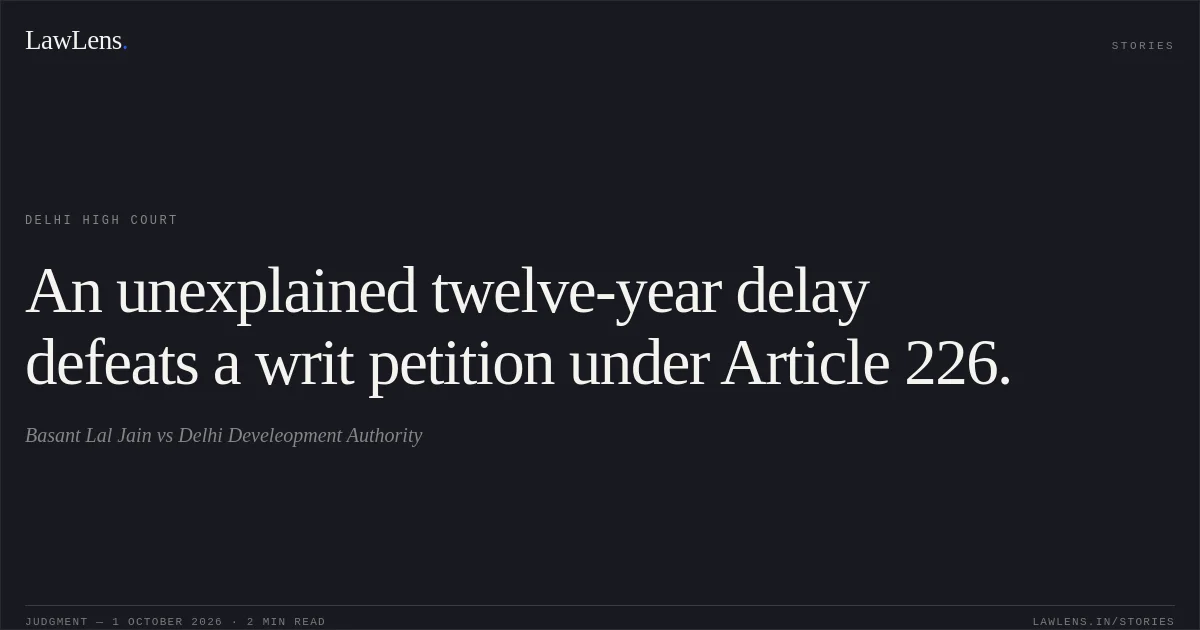
The Court held that the petition was hopelessly delayed and that the petitioner had given no justifiable explanation for the delay.
It dismissed the writ petition without granting the requested relief.
Source reference: p. 9Original Court PDF
Basant Lal JainvsDelhi Develeopment Authority
Click to open original judgment
Original judgment, available to read, download and summarize on LawLens.in