Facts
The complainant alleged that in 1999 the petitioner offered to procure a government primary-teacher appointment for ₹70,000 and received ₹50,000.
Source reference: p. 2–3After the appointment did not materialise, the petitioner allegedly gave assurances of other employment; the complainant sought repayment in 2007 and alleged that the petitioner refused on 23 March 2009.
Source reference: p. 2–3The complainant instituted Complaint Case No. 423 of 2009 alleging offences under Sections 406, 418 and 468 IPC.
Source reference: p. 2–3The Magistrate rejected the petitioner’s application under Section 245 CrPC for discharge, prompting this petition to quash that order.
Source reference: p. 2–3The petitioner asserted that the complaint arose from an earlier land transaction between the parties.
Source reference: p. 5Issues
1. Whether the Magistrate’s rejection of discharge should be quashed in light of the delay and the limitation period under Section 468 CrPC.
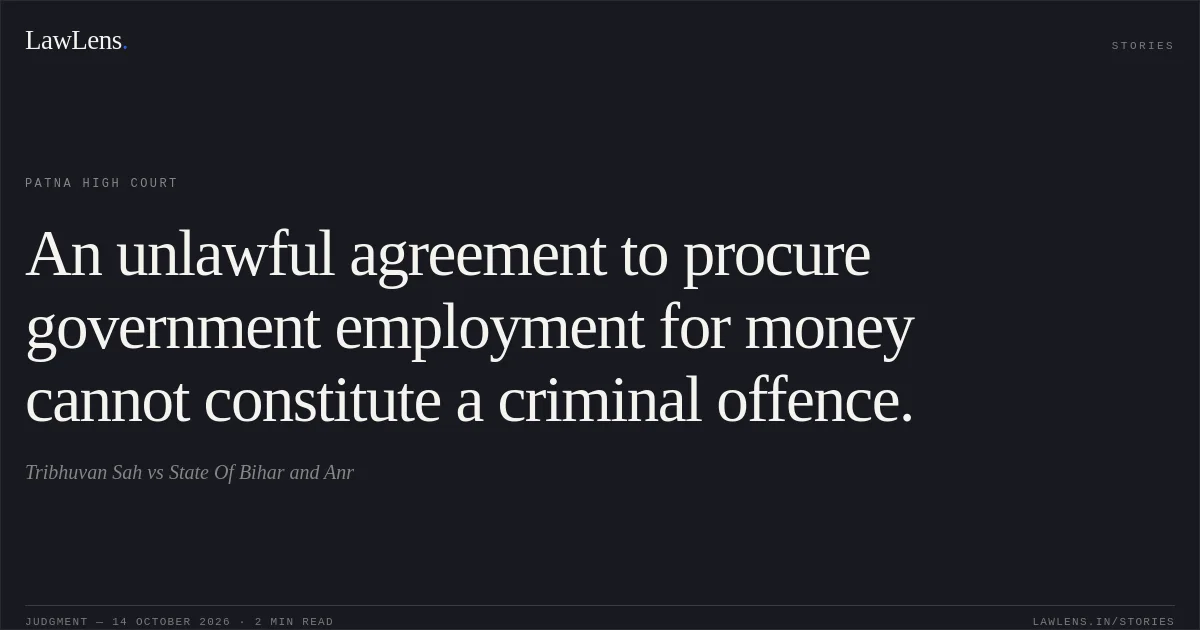
Source reference: p. 2–42. Whether the alleged agreement to procure government employment for money could sustain criminal prosecution where the agreement itself was unlawful.
Source reference: p. 4–5Law Applied
Section 468 CrPC bars cognizance of offences after the applicable limitation period; for offences punishable with imprisonment of up to three years, the period is three years.
Source reference: p. 3–4Under the Constitution Bench decision in Sarah Mathew v. Institute of Cardio Vascular Diseases, (2014) 2 SCC 62, the relevant date for computing limitation is the filing of the complaint or institution of prosecution, not the date on which the Magistrate takes cognizance.
Source reference: p. 3–4The Court also relied on Vijay Sharma v. State of Bihar, (2011) 1 PLJR 780, and Shiv Shankar Dubey v. State of Bihar, Cr. Misc. No. 36447 of 2014 (13 September 2017), for the principle that an agreement to obtain government employment in exchange for money is unlawful and cannot be enforced through criminal prosecution; Section 23 of the Indian Contract Act treats agreements opposed to law or public policy as void.
Source reference: p. 4–5Reasoning
The Court noted that the alleged transaction began in 1999 and the complaint was filed in 2009, and observed that Sections 406 and 418 IPC fell within the limitation bar discussed under Section 468 CrPC.
Source reference: p. 3It stated the governing limitation rule from Sarah Mathew.
Source reference: p. 3–4Independently, the allegation was that money had been paid to secure a government job—an arrangement the Court treated, following Vijay Sharma, as an unlawful agreement that could not be pursued through criminal prosecution.
Source reference: p. 4–5The Court also noted that the allegation was unsupported by documents.
Source reference: p. 4–5Holding
The High Court allowed the petition and quashed the Magistrate’s order dated 18 July 2017 rejecting the petitioner’s discharge application, insofar as it concerned the petitioner.
The operative order does not expressly state that the entire complaint or trial was quashed.
Source reference: p. 6Acts & Sections Cited
7 provisions across 3 statutes referred to in this judgment. Each provision opens on LawLens.
Code of Criminal Procedure, 19732
Indian Penal Code, 18603
Indian Contract Act, 18722
Original Court PDF
Tribhuvan SahvsState Of Bihar and Anr
Click to open original judgment
Original judgment, available to read, download and summarize on LawLens.in