01Facts
Devendra Kumar Tripathi, aged approximately 34–35 years, was travelling in a Maruti car at about 10:30 p.m. when the car collided with Truck No. HR-46/A-7486, which had been left stationary on the road after an earlier accident. The claimants alleged that the truck had no parking lights, rear lights, indicators, reflectors, or warning signs, making it invisible to approaching vehicles
¶ 4The Insurance Company contended that the accident resulted from the deceased’s rash and negligent driving and that the truck had been parked on the extreme left side of the road
¶ 5The Motor Accident Claims Tribunal, FTC-2, Nainital, held the truck driver negligent, rejected contributory negligence, and awarded compensation of ₹20,36,000 with interest at 7% per annum in M.A.C.P. No. 18 of 2007
¶ 2, 6The Insurance Company filed AO No. 159 of 2012 challenging negligence and liability, while the claimants filed AO No. 222 of 2012 seeking enhancement of compensation
¶ 302Issues
i.Whether the driver of the stationary truck was negligent, and whether the deceased was guilty of contributory negligence merely because the car collided with the truck from behind?
¶ 7–15ii.Whether the claimants were entitled to enhancement of compensation by applying future prospects to the deceased’s established income and by revising the amounts under the conventional heads?
¶ 16–21iii.What was the appropriate total compensation and applicable interest payable to the claimants?
¶ 19–2703Law Applied
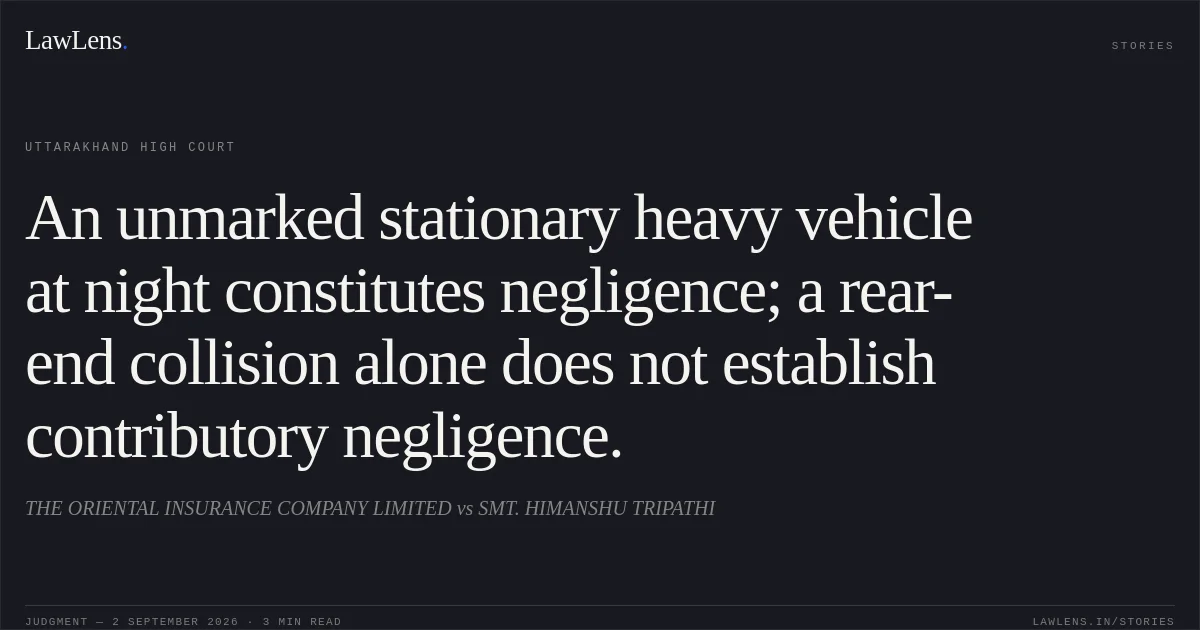
A stationary heavy vehicle on a public road, particularly at night, must be adequately illuminated, marked, and accompanied by reasonable warning precautions for the safety of other road users; merely being stationary does not absolve its driver from negligence
¶ 10–13A rear-end collision does not, by itself, establish negligence or contributory negligence of the following vehicle; contributory negligence must be proved by cogent and reliable evidence and cannot be presumed from conjecture
¶ 13–14For computation of motor accident compensation, the Court applied the Constitution Bench decision in National Insurance Company Limited v. Pranay Sethi, (2017) 16 SCC 680, under which a self-employed deceased aged below 40 years is entitled to a 40% addition towards future prospects
¶ 18The Court also applied the multiplier method, deducted one-third of the income towards the deceased’s personal and living expenses, and awarded conventional sums for funeral expenses, loss of estate, and loss of consortium
¶ 20–2104Reasoning
The Court found that the truck was admittedly stationary on the left side of the road at approximately 10:30 p.m.
¶ 10–11The eyewitness, PW-4, specifically testified that the truck lacked back lights, indicators, and reflectors, and this evidence was not effectively dislodged in cross-examination
¶ 11Since the Insurance Company produced no cogent evidence contradicting this testimony or establishing that the deceased had driven negligently, the truck driver’s failure to provide adequate warning constituted the proximate cause of the accident.
¶ 12–15The Court therefore rejected the Insurance Company’s argument that the rear-end collision automatically established contributory negligence
¶ 12–15For quantum, the Court considered the deceased’s income-tax returns for the relevant years. After deducting income tax, the average monthly income was taken at ₹16,000
¶ 17–19Applying a 40% addition for future prospects, the monthly income became ₹22,400; after deducting one-third for personal expenses, the annual contribution was ₹1,79,200. Applying the multiplier of 16 resulted in a loss of dependency of ₹28,67,200
¶ 20The Court further enhanced the conventional amounts in accordance with the applicable principles, awarding ₹15,000 for funeral expenses, ₹15,000 for loss of estate, and ₹80,000 for loss of consortium to the two claimants.
¶ 2105Holding
The Court affirmed the finding that the truck driver was negligent and rejected the plea of contributory negligence.
¶ 24AO No. 159 of 2012 filed by the Insurance Company was dismissed, while AO No. 222 of 2012 filed by the claimants was partly allowed
¶ 24The compensation was enhanced from ₹20,36,000 to ₹29,77,200, comprising ₹28,67,200 towards loss of dependency and ₹1,10,000 under conventional heads
¶ 21–22The enhanced compensation was directed to carry interest at 7% per annum from the date of filing of the claim petition until actual payment, subject to adjustment of any amount already paid or deposited
¶ 23, 25The Insurance Company was directed to deposit the enhanced amount with interest before the Tribunal within eight weeks of production of the certified judgment, after which the Tribunal was to disburse the amount to the claimants in accordance with law.
¶ 26–27Original Court PDF
THE ORIENTAL INSURANCE COMPANY LIMITEDvsSMT. HIMANSHU TRIPATHI
Click to open original judgment
Original judgment, available to read, download and summarize on LawLens.in