Facts
The petitioner, who has had a 90% hearing and speech impairment since birth, lived with her brother, a retired West Bengal government employee and her sole caregiver.
Source reference: paras. 3–8, 14–18Her brother submitted a form naming her as nominee for family pension; the authority received the form and the PPO recorded her name.
Source reference: paras. 3–8, 14–18After his death in November 2024, the authority rejected her claim in March 2025, stating that her inclusion had been inadvertent and that an unmarried sister was not eligible for family pension under the applicable rules.
Source reference: paras. 3–8, 14–18The petitioner sought family pension, relying, among other grounds, on promissory estoppel and legitimate expectation.
Source reference: paras. 9–10Issues
Whether an unmarried sister named in a deceased government employee’s pension documents is eligible for family pension under Rule 7.1(e) of the West Bengal Services (Death-cum-Retirement Benefit) Rules, 1971
Source reference: paras. 12–13, 32–33Whether the authority’s receipt of the nomination form and recording of the petitioner’s name in the PPO created a promise, legitimate expectation, or estoppel requiring payment of family pension
Source reference: paras. 14–31Whether the petitioner could seek relaxation of the eligibility rules under Rule 4 of the DCRB Rules, 1971
Source reference: paras. 45–48Law Applied
Rule 7.1(e) of the DCRB Rules, 1971 defines the family members eligible for family pension; the listed categories include a spouse, specified children and dependent parents, but not an unmarried sister.
Source reference: paras. 12–13Promissory estoppel requires a promise or representation by the party to be bound and reliance on it; it cannot be used to confer a benefit contrary to statute.
Source reference: paras. 20–31Legitimate expectation likewise requires a relevant representation by the authority.
Source reference: paras. 31, 44(h)Rule 4 empowers the Government to dispense with or relax a requirement of the rules where necessary to deal with a case justly and equitably.
Source reference: para. 45The Court distinguished State of Jharkhand v. Brahmputra Metallics Ltd., (2023) 10 SCC 634, and the cited decisions in Sabita Roy and Shiba Pada Sarkar on their facts.
Source reference: paras. 40–42Reasoning
The Court held that the petitioner’s unmarried-sister status placed her outside the categories eligible for family pension under Rule 7.1(e).
Source reference: paras. 14–18, 22–23The brother’s submission of the form and the authority’s receipt of it did not amount to acceptance of her eligibility: the entitlement question arose only after his death, and the authority then rejected the claim.
Source reference: paras. 14–18, 22–23Because the authority had made no promise or representation that the petitioner would receive family pension, neither promissory estoppel nor legitimate expectation applied; the nomination could not override the rules.
Source reference: paras. 20–31, 36–38The Court nevertheless considered the exceptional circumstances and identified Rule 4 as the route by which the petitioner could seek relaxation.
Source reference: paras. 45–48Holding
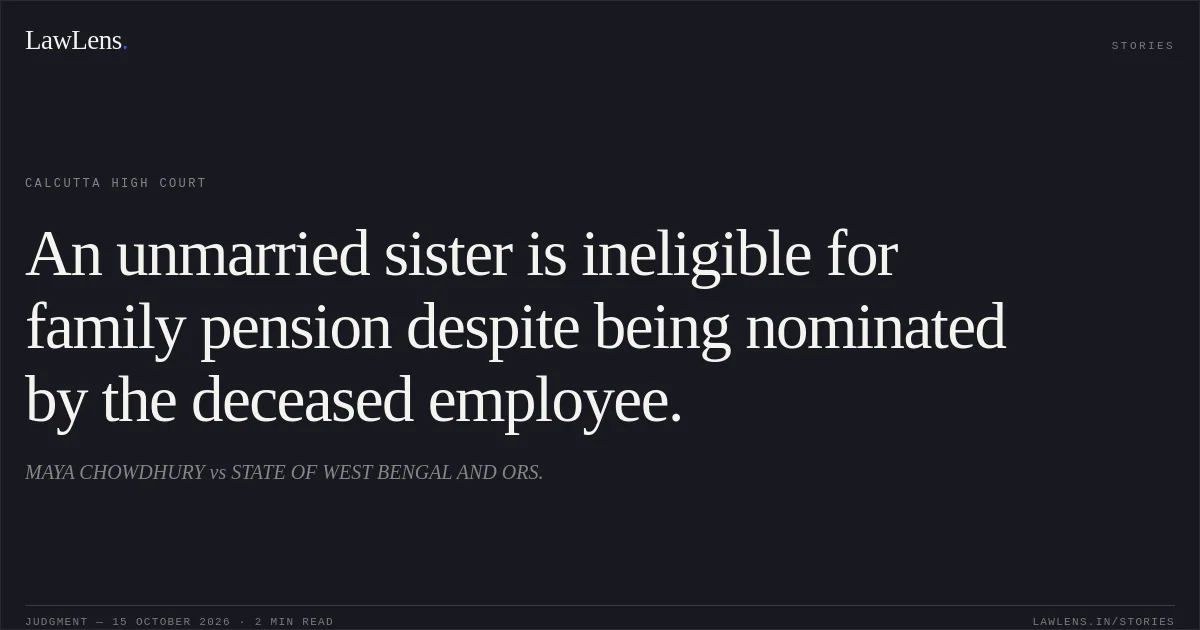
The Court held that the petitioner was not entitled to family pension under Rule 7.1(e), and that the nomination, as received and recorded, did not create an enforceable right or estoppel against the authorities.
It dismissed the petition but permitted the petitioner to apply to the Governor for relaxation under Rule 4, directing the State to provide assistance and ensure that the application was placed before the Governor for consideration.
Source reference: paras. 45–49Original Court PDF
MAYA CHOWDHURYvsSTATE OF WEST BENGAL AND ORS.
Click to open original judgment
Original judgment, available to read, download and summarize on LawLens.in


