Facts
Smt. Sheela Balram Sharma filed a complaint under Sections 43, 61, 66 and 66B of the Information Technology Act, 2000, alleging that Aditya Dhananjay Satwe, formerly her employee, had stolen the source code of her copyrighted software “Pharma SYS+” and used it to develop the software “CARE,” subsequently developed by Ulhash Raghvendra Amrite.
Source reference: p.2–3The Adjudicating Officer/Principal Secretary (IT), Government of Maharashtra, awarded Sharma compensation of ₹10 lakhs—₹5 lakhs each against the appellants—with interest at 12% per annum compounded monthly, and restrained them from selling or installing CARE and directed its removal from customers’ devices.
Source reference: p.2Satwe and Amrite challenged the finding, contending that CARE had been independently developed in Visual FoxPro, whereas Pharma SYS+ used FoxPro DOS, and that the expert and police-investigation materials were not properly proved or tested by cross-examination.
Source reference: p.3–4Sharma filed Cyber Appeal No. 6 of 2020 seeking enhancement of compensation.
Source reference: p.6The Tribunal summoned the original adjudication record and heard both appeals together.
Source reference: p.1, p.6Issues
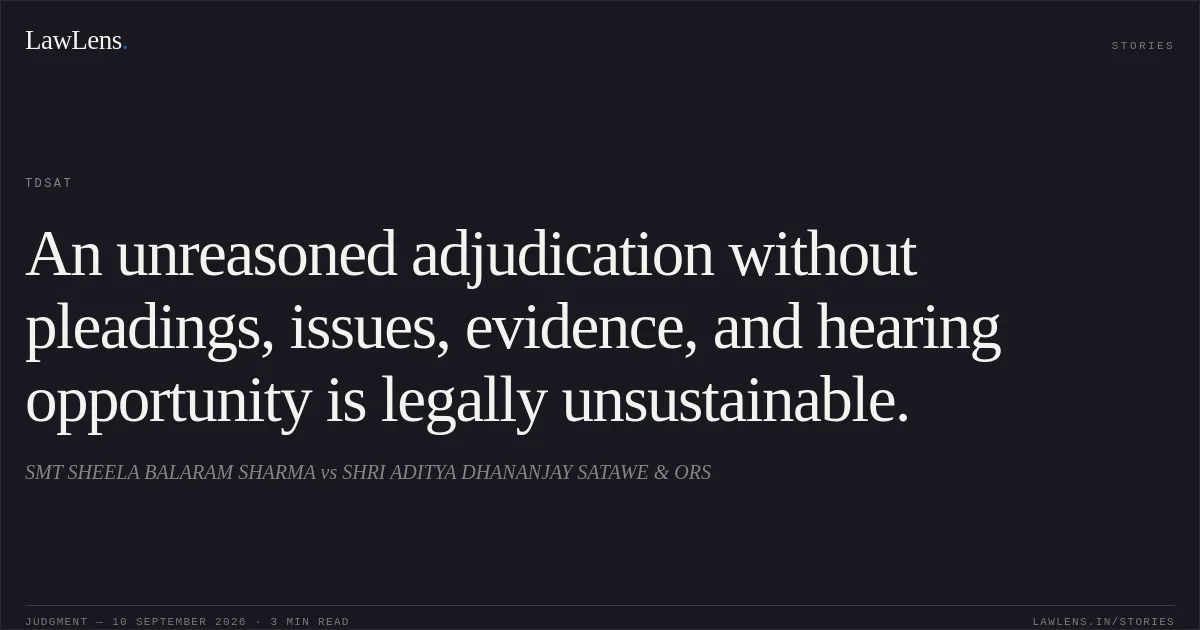
Whether the Adjudicating Officer’s order determining alleged theft of computer source code under the Information Technology Act was legally sustainable when it contained no adequate reasoning, framed no specific issues, and relied on an expert report without formally admitting or testing it in evidence.
Source reference: p.4–6 / paras. 8–9Whether the appeals should be decided on the merits or the matter should be remanded for fresh adjudication after permitting pleadings, evidence, rebuttal, and hearing.
Source reference: p.6 / paras. 9–10Whether the Tribunal could determine copyright infringement in the proceedings under the Information Technology Act, when such infringement fell within the jurisdiction of the appropriate civil forum under the Copyright Act and the Code of Civil Procedure.
Source reference: p.4–6 / paras. 8–10Law Applied
The Tribunal applied Sections 57 and 58 of the Information Technology Act, 2000, governing appeals to the Appellate Tribunal.
Source reference: p.2It recognised that the complaint concerned the alleged unauthorised use or theft of computer source code under the statutory framework of Sections 43 and 46 of the IT Act, while alleged copyright infringement was outside the limited jurisdiction being exercised and had to be pursued before the competent civil forum under the Copyright Act and the Code of Civil Procedure.
Source reference: p.5–6, paras. 8–10The Tribunal further applied the general requirement that a judicial or quasi-judicial determination must disclose the pleadings, disputed and admitted facts, issues for determination, evidence, submissions, findings, and reasons; the adjudicatory decision must therefore be a reasoned order consistent with the requirements identified with reference to Order XX of the CPC.
Source reference: p.5–6, para. 9Evidence relied upon must also be properly introduced and afforded procedural opportunity for challenge and rebuttal.
Source reference: p.4–5, para. 8Reasoning
The Tribunal found that the Adjudicating Officer had expressly limited the inquiry to alleged source-code theft, but nevertheless failed to identify the precise issues, record the evidence, or explain the basis for concluding that theft had occurred.
Source reference: p.4–6, para. 8The expert report prepared during the criminal investigation was relied upon without giving the parties an opportunity to establish its admissibility or test its contents through evidence and cross-examination.
Source reference: p.4–5, para. 8Moreover, the report appeared to indicate approximately 80% similarity and software development, rather than conclusively establishing theft, while the record also contained the appellants’ case that the two programs operated on different platforms and that CARE had been registered as their copyright.
Source reference: p.3–5, para. 8Since these matters required factual determination through proper pleadings and evidence, the Tribunal declined to decide the substantive merits.
Source reference: p.5–6, paras. 9–10It also maintained the distinction between source-code-related claims under the IT Act and copyright infringement claims falling within the jurisdiction of another civil forum.
Source reference: p.5–6, paras. 9–10Holding
Both Cyber Appeal No. 1 of 2020 and Cyber Appeal No. 6 of 2020 were allowed.
The impugned order awarding ₹10 lakhs, interest, and injunctive directions was set aside for procedural deficiencies and the matter was remanded to the Learned Adjudicating Officer for fresh adjudication concerning the alleged theft of source code within the scope of the IT Act.
Source reference: p.6, para. 10The Adjudicating Officer was directed to permit both parties to file pleadings, frame points for determination, lead and rebut evidence, make submissions, and pass a reasoned judgment.
Source reference: p.6, para. 10The parties were directed to appear on 3 November 2026, and the matter was ordered to be disposed of expeditiously without unnecessary adjournments.
Source reference: p.6–7, paras. 11–12The Tribunal clarified that its observations on the merits were only procedural and that the Adjudicating Officer must decide the matter independently.
Source reference: p.7, para. 13Acts & Sections Cited
6 provisions across 1 statute referred to in this judgment. Each provision opens on LawLens.
Information Technology Act, 20006
Original Court PDF
SMT SHEELA BALARAM SHARMAvsSHRI ADITYA DHANANJAY SATAWE & ORS
Click to open original judgment
Original judgment, available to read, download and summarize on LawLens.in