Facts
The plaintiffs claimed rights in land originally purchased by their father, Bhagwat Das, and defendant Umed Das.
Source reference: no citationThey relied, among other things, on an agreement dated 16 May 1997 (Exhibit P-6), said to record Umed Das’s relinquishment of rights in 2.40 acres.
Source reference: no citationThe Trial Court dismissed the suit for failure to prove the plaintiffs’ case; the First Appellate Court reversed that decision in part and directed delivery of possession of the 2.40 acres to the plaintiffs.
Source reference: para. 2–3, 8–10The defendants appealed under Section 100 CPC.
Source reference: para. 11The High Court also considered that defendant Rajendra Kumar was a minor and had not been duly represented at the appellate stage.
Source reference: para. 11, 32–36Issues
Whether the First Appellate Court’s decree, founded on Exhibit P-6, was legally sustainable when that document was unregistered and allegedly insufficiently stamped.
Source reference: para. 11; para. 20–29Whether the First Appellate Court could proceed to judgment against a minor defendant without ensuring his proper representation through a legally appointed guardian.
Source reference: para. 11; para. 32–37Law Applied
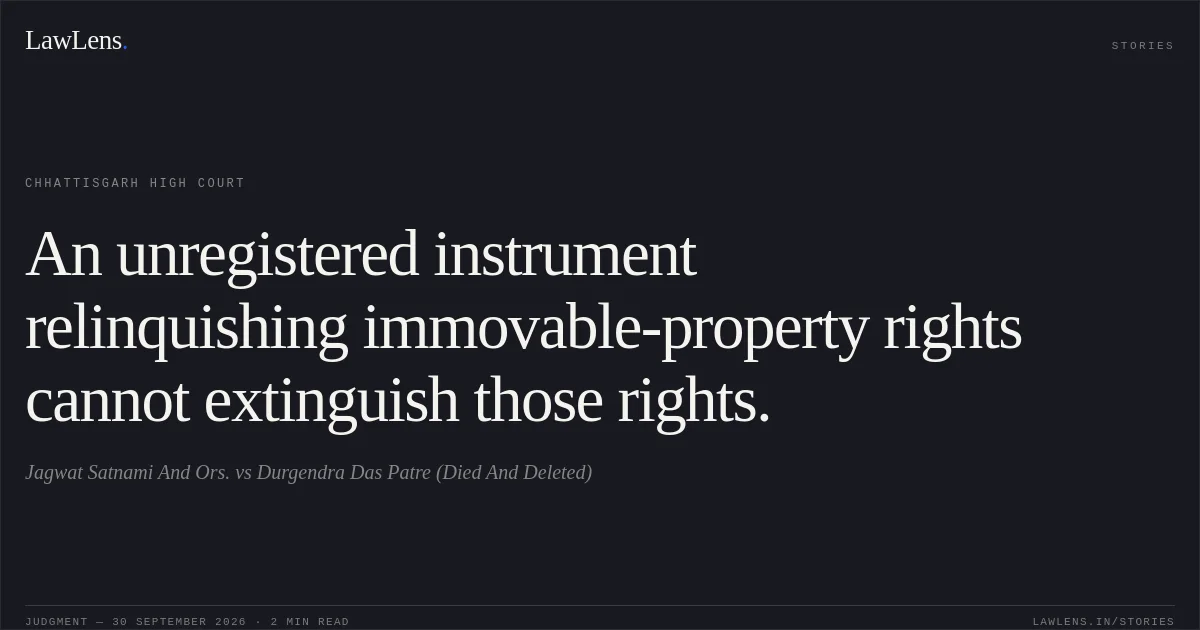
Section 17(1)(b) of the Registration Act, 1908 requires compulsory registration of a non-testamentary instrument that purports to extinguish a right in immovable property; under Section 49, an unregistered instrument cannot operate to affect that property right or prove the transaction itself.
Source reference: para. 22–25, 28The Court relied on Yellapu Uma Maheswari v. Buddha Jagadheeswararao, (2015) 16 SCC 787, for the principle that a document’s substance, not its label, determines whether registration is compulsory.
Source reference: para. 23–24Section 35 of the Indian Stamp Act bars admission in evidence of an instrument chargeable with duty but not duly stamped, subject to the procedure for payment of duty and penalty.
Source reference: para. 26The Court also applied the procedural safeguards in Order XXXII CPC, holding that a minor defendant must be duly represented before an adverse decree is passed against him.
Source reference: para. 33–37Reasoning
Exhibit P-6 was relied on to establish that Umed Das had relinquished his interest in the land, so its substance was an instrument extinguishing a right in immovable property.
Source reference: para. 21–29Because it was unregistered, it could not legally effect that relinquishment; the First Appellate Court therefore erred in treating it as the basis for a decree for possession.
Source reference: para. 21–29Separately, Rajendra Kumar’s minority was apparent from the record, yet the First Appellate Court proceeded to decide the appeal and pass a decree affecting his interests without ensuring proper representation.
Source reference: para. 32–37The Court treated that failure as a serious procedural defect, not a mere irregularity.
Source reference: para. 32–37Holding
The High Court answered both substantial questions of law in favour of the appellants.
It set aside the First Appellate Court’s judgment and decree dated 29 January 2014, affirmed the Trial Court’s dismissal of the suit dated 29 March 2005, and allowed the second appeal.
Source reference: para. 38–40Acts & Sections Cited
4 provisions across 3 statutes referred to in this judgment. Each provision opens on LawLens.
Code of Civil Procedure, 19081
Registration Act, 19082
Indian Stamp Act, 18991
Original Court PDF
Jagwat Satnami And Ors.vsDurgendra Das Patre (Died And Deleted)
Click to open original judgment
Original judgment, available to read, download and summarize on LawLens.in