Facts
The plaintiff and defendants were members of the family of Pachamuthu Pillai. Properties inherited from their common ancestor were allotted to Pachamuthu under a registered partition deed dated 10 June 1970. The plaintiff claimed that these properties remained joint family properties and sought partition, initially claiming a 1/6 share and subsequently a 9/18 share after Pachamuthu’s death and the impleadment of his wife and daughters.
Source reference: paras. 3–3.6, pp. 4–7The contesting defendants relied on an alleged oral partition dated 1 May 1984 among Pachamuthu and his sons, recorded in an unregistered and unstamped “Koor Chit” dated 22 May 1984. They further relied on a settlement deed executed by Pachamuthu in favour of the second defendant and a registered Will bequeathing a Grama Natham site to him.
Source reference: para. 5, pp. 7–9The Trial Court held that the suit properties were joint family properties, rejected the Koor Chit as inadmissible, invalidated the settlement deed, and granted the plaintiff a 9/48 share. The First Appellate Court reversed that decision, holding that the Koor Chit recorded an earlier partition, that the settlement deed was valid, and that the Grama Natham site was Pachamuthu’s separate property devolved under the Will.
Source reference: paras. 10–11, pp. 10–12The plaintiff therefore preferred the second appeal under Section 100 of the Code of Civil Procedure, 1908.
Source reference: no citationIssues
Whether the properties allotted to Pachamuthu under the 1970 partition deed were ancestral/joint family properties or his separate properties.
Source reference: paras. 17–18, pp. 16–18Whether the unregistered and unstamped Koor Chit was admissible as a memorandum recording an earlier oral partition.
Source reference: Substantial Question of Law (a), paras. 19–20, pp. 18–22Whether Pachamuthu could validly execute the settlement deed in favour of the second defendant after the alleged 1984 partition.
Source reference: Substantial Question of Law (b), para. 21, p. 22Whether the disputed signatures on the Koor Chit required the document to be sent for forensic or expert examination.
Source reference: Substantial Question of Law (c), para. 19, pp. 18–19Whether the Grama Natham property covered by the Will formed part of the family property or was Pachamuthu’s separate property.
Source reference: Substantial Question of Law (d), para. 22, pp. 22–23Whether the plaintiff was entitled to a share in Suit Item No. 4, which was admitted to be Pachamuthu’s separate property.
Source reference: para. 23, p. 24Law Applied
The Court applied the principles governing ancestral and separate property under Hindu law and the Hindu Succession Act, 1956, holding that property inherited before the commencement of the Act may retain its ancestral character, whereas property inherited after its commencement may constitute separate property as between the heirs, subject to the facts of the case; the Court referred to Arshnoor Singh v. Harpal Kaur and S. Sampoornam v. C.K. Shanmugam.
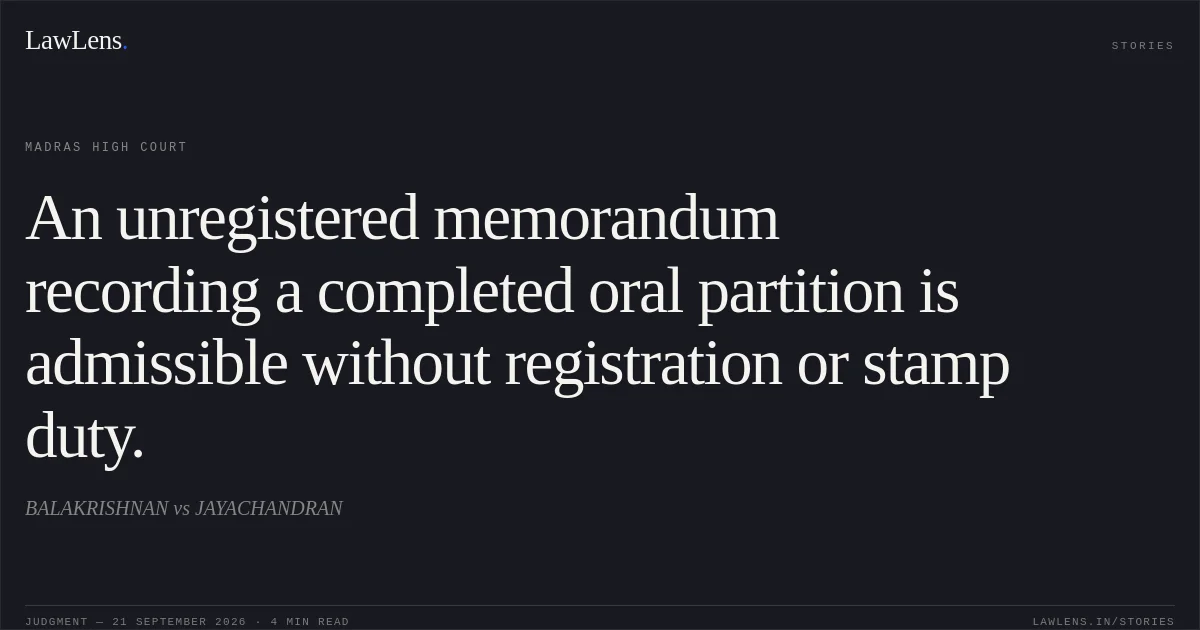
Source reference: para. 18, p. 17An unregistered document which merely records a completed oral partition is admissible as a memorandum and does not require registration or stamping; however, a document creating or declaring rights in praesenti would ordinarily attract registration requirements.
Source reference: paras. 19–20, pp. 18–22A co-owner who obtains a specific share through partition may deal with that share as separate property, including by settlement.
Source reference: para. 21, p. 22Disputed signatures do not automatically require expert examination, particularly where the party disputing them fails to seek forensic examination and the surrounding evidence supports execution.
Source reference: para. 19, pp. 18–19A Will must be proved in accordance with Section 63 of the Indian Succession Act, 1925, read with Section 68 of the Indian Evidence Act, 1872.
Source reference: para. 22, p. 23Property devolving intestate upon the death of a male Hindu is distributed among Class I heirs under Section 8 of the Hindu Succession Act, 1956.
Source reference: para. 23, p. 24Reasoning
The Court held that the properties allotted to Pachamuthu under the 1970 partition deed were joint family properties, principally because the defendants had expressly pleaded that they were ancestral and joint family properties, amounting to a judicial admission; the absence of evidence regarding the date of the common ancestor’s death did not justify disturbing the concurrent finding on the property’s character.
Source reference: para. 18, p. 17However, the Court found that the Koor Chit did not create rights for the first time but recorded the completed oral partition of 1984. Its execution was supported by the evidence of the scribe and an attesting witness, the property division was substantially equal and geographically coherent, and the plaintiff and another defendant challenged their signatures only after approximately sixteen years without seeking forensic examination.
Source reference: paras. 19–20, pp. 18–22Consequently, the Koor Chit was admissible without registration or stamp duty, and the first defendant’s allotted share became his separate property, which he could validly settle upon the second defendant.
Source reference: para. 21, p. 22The Grama Natham site was separately allotted by the Government under a rough patta and was therefore not property acquired by adverse possession or joint family property. The registered Will was duly proved through its attesting witnesses and was not surrounded by suspicious circumstances, particularly because it dealt only with a portion of Pachamuthu’s separate property and benefited the defendant whose adjoining property facilitated construction.
Source reference: para. 22, p. 23Suit Item No. 4, acquired by Pachamuthu under his own sale deeds, was separately admitted to be his self-acquired property and therefore devolved equally upon his eight surviving legal heirs under Section 8 of the Hindu Succession Act.
Source reference: para. 23, p. 24Holding
The Second Appeal was partly allowed.
The Court upheld the 1984 oral partition and the validity of the Koor Chit, settlement deed, and Will, thereby denying the plaintiff any share in Suit Item Nos. 1 to 3 and the Grama Natham site.
Source reference: paras. 20–22, pp. 21–23However, since Suit Item No. 4 was Pachamuthu’s separate property and devolved intestate upon his eight legal heirs, the plaintiff was granted a 1/8 share in Suit Item No. 4, namely the extent of 3 acres 3 cents in Survey No.148/2A.
Source reference: para. 23, p. 24; para. 25(a), p. 25The judgments of both the Trial Court and the First Appellate Court were set aside to that extent; no order as to costs was made, and the connected miscellaneous petition was closed.
Source reference: para. 25, p. 25Acts & Sections Cited
3 provisions across 3 statutes referred to in this judgment. Each provision opens on LawLens.
Code of Civil Procedure, 19081
Hindu Succession Act, 19561
Indian Succession Act, 19251
Original Court PDF
BALAKRISHNANvsJAYACHANDRAN
Click to open original judgment
Original judgment, available to read, download and summarize on LawLens.in