Facts
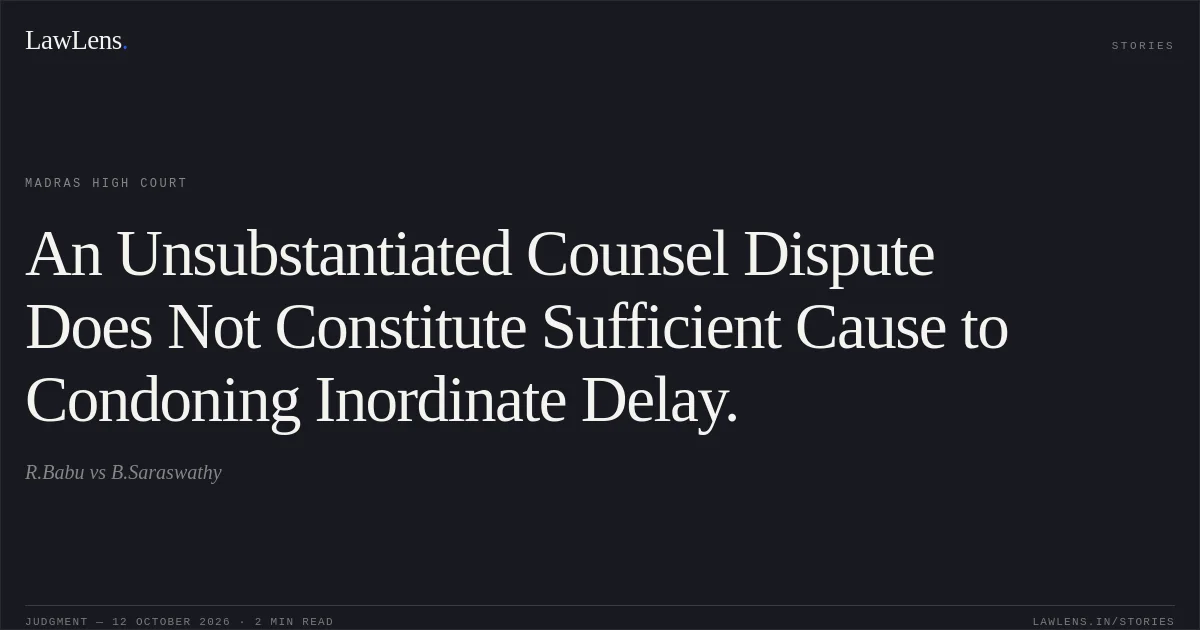
The petitioner-husband sought revision of the IV Additional Principal Family Court, Chennai’s order dated 12 September 2024 in M.C.No.79 of 2018, directing him to pay maintenance of ₹10,000 per month to his wife.
Source reference: para. 3, p. 2He filed the revision with a petition under Section 5 of the Limitation Act seeking condonation of a 578-day delay, attributing it to a dispute with his counsel.
Source reference: paras. 1, 5, pp. 1–3The respondent opposed condonation, contending that the delay was inadequately explained and that the revision was intended to avoid maintenance and prolong the proceedings.
Source reference: para. 6, p. 3Issues
Whether the petitioner established “sufficient cause” under Section 5 of the Limitation Act to condone the 578-day delay in filing the criminal revision.
Source reference: paras. 8–11, pp. 3–4Whether the delayed criminal revision could proceed against the maintenance order.
Source reference: paras. 2–3, p. 2; para. 4, p. 11Law Applied
The Court applied Section 5 of the Limitation Act, 1963, under which delay may be condoned upon a showing of sufficient cause; the judgment stated that the prescribed limitation period for the revision was 90 days under Article 131 of the Limitation Act.
Source reference: para. 9, p. 4It considered Collector, Land Acquisition v. Katiji, which favours substantial justice where delay is not deliberate; P.K. Ramachandran v. State of Kerala, which holds that limitation must be applied as prescribed and cannot be extended on equitable grounds; Shakuntala Devi Jain v. Kuntal Kumari, on liberal construction absent culpable lack of bona fides; Vedabai v. Shantaram Baburao Patil, requiring a more cautious approach to inordinate delay; Pundlik Jalam Patil v. Executive Engineer, on the consequences of sleeping over one’s rights; and Maniben Devraj Shah v. Municipal Corporation of Brihan Mumbai, on assessing bona fides and negligence when deciding whether sufficient cause exists.
Source reference: paras. 12–13, pp. 4–10The revision was presented under Sections 438 and 442 of the BNSS.
Source reference: para. 2, p. 2Reasoning
The Court found that the petitioner’s assertion of a dispute with his counsel did not satisfactorily explain the 578-day delay or establish a bona fide cause for the inaction.
Source reference: paras. 10–11, p. 4; pp. 10–11Applying the cited principles, it treated the delay as inordinate and effectively unexplained, and found the petitioner’s conduct careless and reckless; it also considered that the revision appeared intended to avoid maintenance and protract the proceedings.
Source reference: p. 10The Court further observed that the ₹10,000 monthly maintenance was not excessive or unreasonable, but its principal basis for refusing the application was the absence of sufficient cause for delay.
Source reference: p. 11Holding
The Court held that the petitioner had not established sufficient cause and dismissed the Section 5 application to condone the 578-day delay.
Consequently, it dismissed the criminal revision as well, without an order as to costs.
Source reference: pp. 11–12It directed the IV Additional Principal Family Court, Chennai, to recover the maintenance arrears from the petitioner within one month.
Source reference: p. 12Acts & Sections Cited
6 provisions across 3 statutes referred to in this judgment. Each provision opens on LawLens.
Limitation Act, 19632
Bharatiya Nagarik Suraksha Sanhita, 20233
Code of Criminal Procedure, 19731
Original Court PDF
R.BabuvsB.Saraswathy
Click to open original judgment
Original judgment, available to read, download and summarize on LawLens.in