Facts
The petitioner-tenant was impleaded as the defendant in Title Suit No. 378 of 2015, instituted by the husband of Opposite Party No. 1 for eviction on the grounds of default in payment of rent and reasonable requirement.
Source reference: para. 2(a), p. 1After entering appearance, the tenant filed applications under Sections 7(1) and 7(2) of the West Bengal Premises Tenancy Act, 1997, seeking permission to deposit current rent and determination of alleged rent arrears.
Source reference: para. 2(b), p. 1He disputed the arrears, claiming that, with the landlord’s permission, he had spent ₹2,00,000 on repairs and that the amount was to be adjusted against rent; he also alleged that the landlord had failed to issue rent receipts.
Source reference: para. 2(c), p. 2The Trial Court initially rejected the Section 7(2) application on 31 July 2018.
Source reference: para. 2(f), p. 2In revision, the High Court set aside that order and remanded the matter for evidence and cross-examination.
Source reference: para. 2(g), p. 2After rehearing, the Trial Court found that the alleged repair expenditure was unsupported, treated the dispute as sham, rejected the Section 7(2) application, and struck out the tenant’s defence under Section 7(3).
Source reference: para. 2(h), p. 2The tenant challenged that order under Article 227 of the Constitution.
Source reference: para. 2(i), p. 3Issues
Whether the tenant had raised a bona fide and genuine dispute regarding the rent arrears so as to attract Section 7(2) of the West Bengal Premises Tenancy Act, 1997?
Source reference: paras. 6–9, pp. 6–8Whether the Trial Court was required to determine the arrears under Section 7(2) before applying Section 7(3) and striking out the tenant’s defence?
Source reference: paras. 11–14, pp. 8–9Whether the tenant’s alleged expenditure on repairs could be adjusted against rent in the absence of proof of the expenditure and of an agreement with the landlord?
Source reference: paras. 15–20, pp. 9–10Law Applied
Section 7(1) of the West Bengal Premises Tenancy Act, 1997 requires the tenant to deposit admitted arrears and current rent within the prescribed period; Section 7(2) applies where there is a genuine dispute regarding the amount of rent payable and contemplates an application for determination, judicial determination of the amount, and deposit of the amount so determined; and Section 7(3) permits striking out the tenant’s defence upon failure to comply with the statutory deposit obligations.
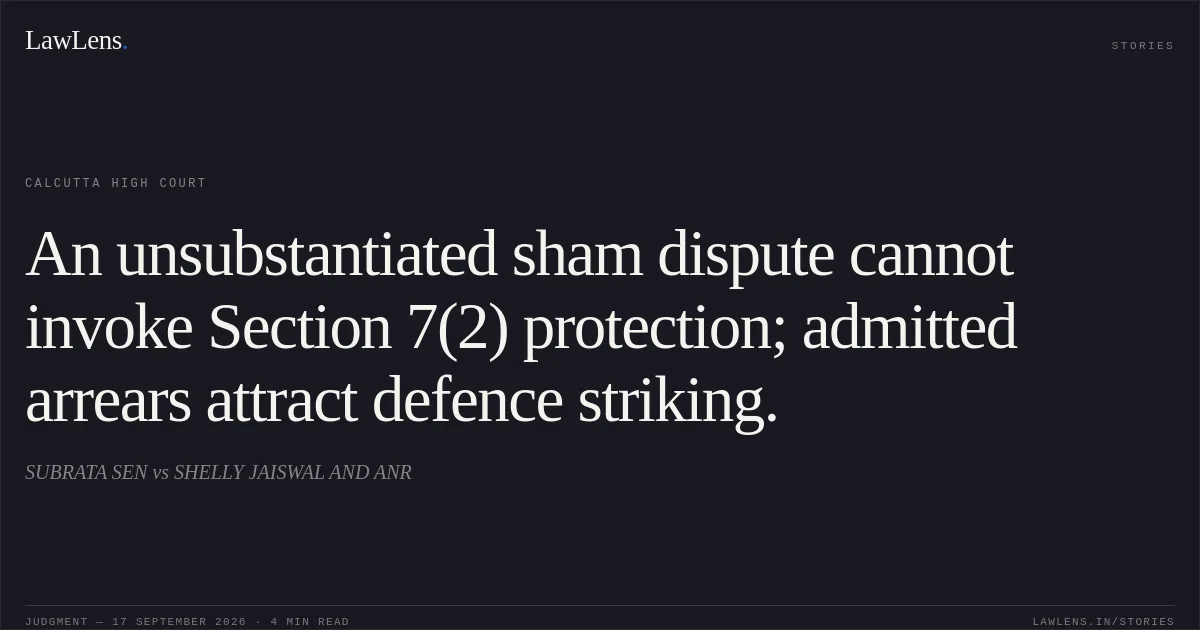
Source reference: paras. 6–8, pp. 6–8Relying on Gujrat Printing Press v. Naraindas Jewraj, Tarak Nath Gupta v. Lt. Col. Karuna Kumar Chatterjee, and Ruby Banerjee v. Mechanics Enterprises Pvt. Ltd., the Court held that a dispute under Section 7(2) must be bona fide and genuine; a sham or false dispute is treated as no dispute, leaving Section 7(1) fully applicable.
Source reference: paras. 7, 10, 13–14, pp. 6–9Bijay Kumar Singh v. Amit Kumar Chamariya, (2019) 10 SCC 660, establishes that admitted arrears must accompany the Section 7(2) application, while Debasish Paul v. Amal Boral, (2024) 2 SCC 169, reiterates the obligation to deposit arrears.
Source reference: paras. 19–22, pp. 10–11The principle in Makhan Lal Bose v. Charupama Debi, 1983 SCC OnLine Cal 97, concerning adjustment of lawfully incurred expenditure against rent applies only where the expenditure and the agreement for adjustment are proved.
Source reference: paras. 19–22, pp. 10–11Reasoning
The High Court held that the alleged dispute was not bona fide.
Source reference: para. 9, p. 8The tenant’s pleadings regarding expenditure of ₹2,00,000 were vague, lacked particulars as to the date and nature of repairs, and were unsupported by any documentary or other evidence.
Source reference: para. 9, p. 8His assertion that he was unable to pay rent arrears was also inconsistent with his claim that he had spent a substantial amount on repairs.
Source reference: no citationDuring cross-examination, he admitted that he had filed no document in Court proving the expenditure and could not establish that any such document had been delivered to or received by the landlord.
Source reference: paras. 15–16, pp. 9–10The Court treated this as a case of complete absence of evidence, rather than merely insufficient evidence, justifying the inference that the dispute was sham.
Source reference: para. 14, p. 9Consequently, the matter fell outside Section 7(2); the alleged arrears assumed the character of admitted arrears, and the tenant’s failure to deposit them attracted Section 7(1) and, ultimately, Section 7(3).
Source reference: paras. 19, 21–22, pp. 10–11The earlier remand order did not conclusively determine the existence of a genuine dispute and had expressly required the Trial Court to decide the matter afresh on evidence.
Source reference: paras. 11–12, p. 9Holding
The High Court answered the issues against the tenant.
It held that the tenant had raised a sham and unsupported dispute, had failed to prove the alleged repair expenditure or any agreement for adjustment against rent, and had not deposited the arrears required under Section 7(1).
Source reference: paras. 19–22, pp. 10–11The Trial Court was therefore not required to determine the arrears under Section 7(2), and was justified in rejecting the Section 7(2) application and striking out the tenant’s defence under Section 7(3).
Source reference: paras. 19–22, pp. 10–11Finding no jurisdictional error or perversity warranting interference under Article 227, the High Court dismissed C.O. 166 of 2026 without costs.
Source reference: para. 23, p. 11Acts & Sections Cited
1 provisions across 1 statute referred to in this judgment. Each provision opens on LawLens.
West Bengal Premises Tenancy Act, 19971
Original Court PDF
SUBRATA SENvsSHELLY JAISWAL AND ANR
Click to open original judgment
Original judgment, available to read, download and summarize on LawLens.in