Facts
The petitioner was elected as Mukhiya of Gram Panchayat Raj Sahuria in the 2021 Panchayat elections from a seat reserved for the Extremely Backward Class (“EBC”) category.
Source reference: paras. 22–25Respondent No. 9 challenged his election before the State Election Commission (“SEC”) under Section 136(2) of the Bihar Panchayat Raj Act, 2006, alleging that the petitioner actually belonged to the Sheikh community and had fraudulently obtained an EBC caste certificate.
Source reference: paras. 23–24Pursuant to an inquiry initiated through the Criminal Investigation Department, a three-member committee comprising police officials conducted local inquiries, examined villagers, relatives and public representatives, and verified the petitioner’s caste certificate with the Circle Officer.
Source reference: paras. 28–29Its report dated 31 December 2024 concluded that the petitioner belonged to the Teli (Muslim) caste.
Source reference: paras. 28–29The General Committee/Caste Scrutiny Committee issued a subsequent report dated 28 March 2025, communicated by Memo No. 6574 dated 11 April 2025, holding that the petitioner could not claim reservation in Bihar because his ancestors had migrated from Jaunpur, Uttar Pradesh, and he had not produced sufficient documentary material apart from a hibbanama.
Source reference: para. 33Relying on the subsequent report, the SEC, by order dated 25 June 2025 in Case No. 56 of 2023, set aside the petitioner’s election, holding that he was not an original resident of Bihar and had obtained the benefit of reservation on the basis of an incorrect caste certificate.
Source reference: paras. 34, 45Issues
Whether the subsequent report of the General Committee/Caste Scrutiny Committee, issued after the earlier inquiry had found the petitioner to belong to the Teli (Muslim) caste, was legally sustainable?
Source reference: paras. 30–38Whether the petitioner could be denied the benefit of reservation for the post of Mukhiya on the ground that his ancestors had migrated from Uttar Pradesh and that he was allegedly not an “original resident” of Bihar?
Source reference: paras. 39–46Whether the Bihar Reservation of Vacancies in Posts and Services Act, 1991, as amended by Bihar Act 15 of 2003, governed reservation for election to the post of Mukhiya under the Bihar Panchayat Raj Act, 2006?
Source reference: paras. 39–47Whether the SEC was justified in setting aside the petitioner’s election and recommending action against the officials who issued his caste certificate?
Source reference: paras. 45–47, 51–52Law Applied
The Court applied Section 15(5) of the Bihar Panchayat Raj Act, 2006, which governs reservation of seats for the posts of Mukhiya, read with Section 2(b), which adopts the list of Backward Classes specified in Annexure I to the Bihar Reservation of Vacancies in Posts and Services Act, 1991.
Source reference: paras. 41–42The Court held that the election reservation was governed by the Panchayat Raj Act and not directly by the residence-based restriction introduced into Section 4(2) of the 1991 Act through Bihar Act 15 of 2003, which provides that candidates residing outside Bihar cannot claim reservation under that Act.
Source reference: paras. 40–43Under Kumari Madhuri Patil v. Additional Commissioner, Tribal Development, (1994) 6 SCC 241, a genuine and favourable scrutiny report ordinarily requires no further action, while the scrutiny committee’s order is final subject only to judicial review under Article 226.
Source reference: paras. 26, 30–32Under the Full Bench decision in Rajani Kumari v. State Election Commission, 2019 (4) PLJR 673, the SEC may examine pre- or post-election disqualification on the basis of unimpeachable material, but disputed questions of fact must be referred to a competent fact-finding body.
Source reference: para. 27The Court also applied the principle that the SEC could not treat a caste certificate as incorrect without a supporting finding from the competent caste scrutiny authority.
Source reference: para. 47Reasoning
The Court found that the first inquiry was a substantive fact-finding exercise: the committee had conducted local inquiries, examined several witnesses, and verified the caste certificate with the competent revenue authority before concluding that the petitioner belonged to the Teli (Muslim) caste.
Source reference: paras. 29, 37The later report was not technically a review by the same committee, since it was prepared by a differently constituted departmental committee; however, it failed to properly consider the earlier categorical finding and reduced the issue to the petitioner’s production of a hibbanama.
Source reference: paras. 35–37Importantly, the later report did not find that the petitioner belonged to the Sheikh caste, did not declare the caste certificate false, and did not recommend its cancellation; it merely held that the petitioner was not entitled to reservation because of his ancestral migration from Uttar Pradesh.
Source reference: para. 44The Court held that this reasoning was legally erroneous.
Source reference: paras. 41–43Reservation for election to the post of Mukhiya flows from Section 15(5) of the Panchayat Raj Act, 2006.
Source reference: paras. 41–43The 1991 Act is relevant only for identifying the list of Backward Classes under Section 2(b) of the Panchayat Raj Act; its residence restriction under Bihar Act 15 of 2003 could not be applied to invalidate the petitioner’s election.
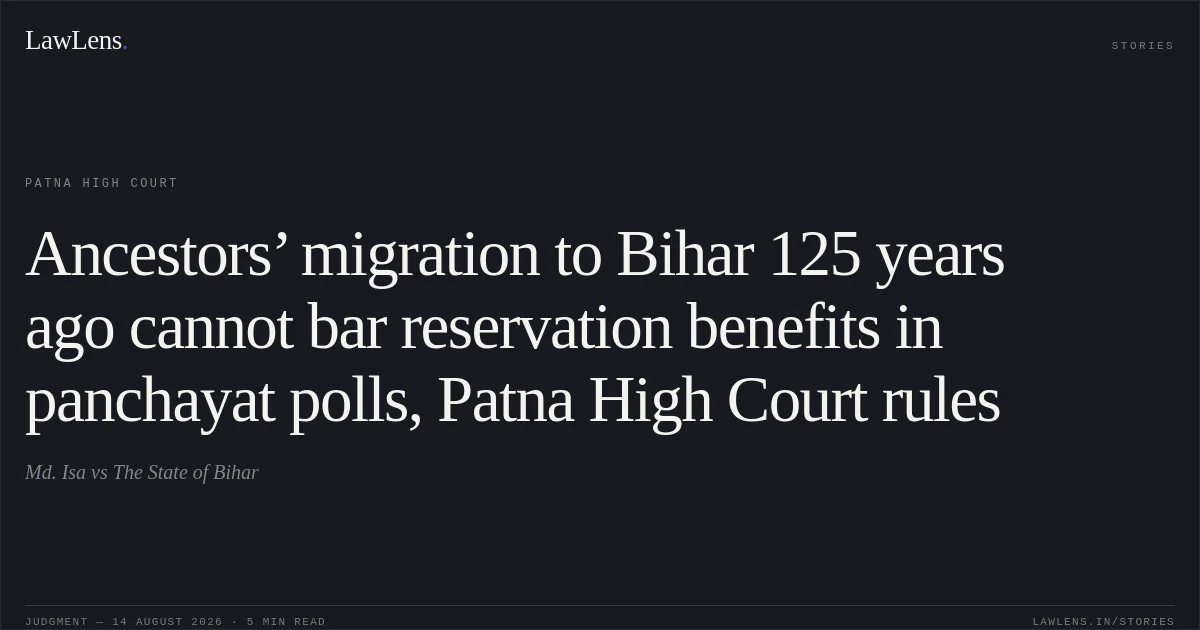
Source reference: paras. 41–43, 46Further, a person whose ancestors had migrated to Bihar three or four generations earlier and had resided there for approximately 125 years could not be treated as a person “residing out of the State of Bihar”.
Source reference: para. 43Since the caste scrutiny authorities had not found the petitioner to be a Sheikh or cancelled his Teli (Muslim) certificate, the SEC had no adequate basis to hold that the certificate was incorrect or to recommend action against the issuing officials.
Source reference: para. 47Holding
The Court held that the Caste Scrutiny Committee’s subsequent report dated 28 March 2025, communicated through Memo No. 6574 dated 11 April 2025, was unsustainable because it improperly applied the residence restriction under the 1991 Act, failed to properly consider the favourable earlier inquiry, and did not establish that the petitioner belonged to a caste other than Teli (Muslim).
The SEC’s order dated 25 June 2025 in Case No. 56 of 2023 was likewise quashed because it relied on the same erroneous legal basis and unsupportedly treated the petitioner’s caste certificate as incorrect.
Source reference: paras. 45–47, 51–52The writ petition was allowed, and both impugned proceedings were set aside.
Source reference: para. 53Acts & Sections Cited
4 provisions across 1 statute referred to in this judgment. Each provision opens on LawLens.
BIHAR PANCHAYAT RAJ ACT, 20064
Original Court PDF
Md. IsavsThe State of Bihar
Click to open original judgment
Original judgment, available to read, download and summarize on LawLens.in