Facts
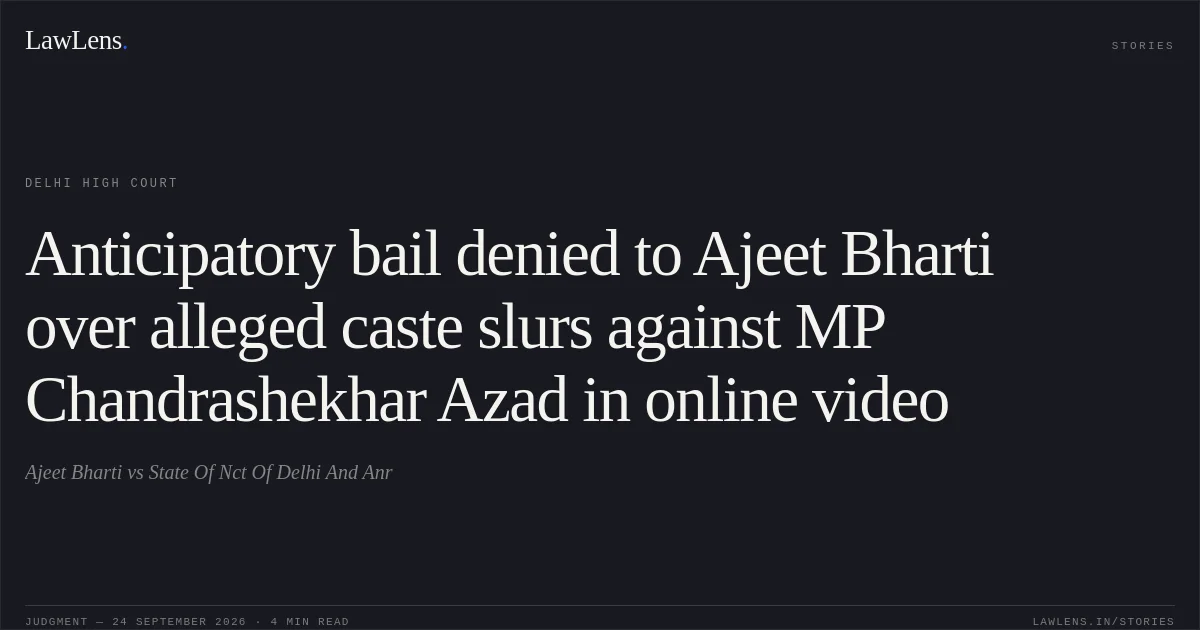
The applicant sought anticipatory bail under Section 482 of the Bharatiya Nagarik Suraksha Sanhita, 2023 (“BNSS”) in FIR No. 30/2026 registered at Police Station North Avenue under Sections 3(2)(va), 3(1)(r), 3(1)(s), 3(1)(u), 3(1)(v) and 3(1)(w) of the Scheduled Castes and the Scheduled Tribes (Prevention of Atrocities) Act, 1989 (“SC/ST Act”), Section 67 of the Information Technology Act, 2000, and Sections 196(1)(c) and 351(3) of the Bharatiya Nyaya Sanhita, 2023.
Source reference: p.2, para.1The FIR alleged that the applicant had uploaded and circulated an audio-visual programme containing caste-based abuses, caste slurs and derogatory remarks directed, inter alia, at Chandrashekhar Azad, a Member of Parliament belonging to a Scheduled Caste community, and at Scheduled Caste and Scheduled Tribe communities generally.
Source reference: pp.2–3, para.3The video had reportedly received approximately 23,100 views when the FIR was registered.
Source reference: p.2, para.3During the hearing, the applicant conceded that he was not a member of a Scheduled Caste or Scheduled Tribe and that the video, having been disseminated on a public social-media platform to a wide audience, was made available “within public view”.
Source reference: pp.10–11, para.14Issues
Whether the statutory bar under Sections 18 and 18A(2) of the SC/ST Act applies to an application for anticipatory bail under Section 482 BNSS where the FIR prima facie discloses offences under Sections 3(1)(r) and 3(1)(s) of the SC/ST Act.
Source reference: pp.3–9, paras.5–10Whether the allegations and the contents of the impugned video prima facie satisfy the ingredients of intentional caste-based insult or intimidation with intent to humiliate, and abuse by caste name in a place within public view under Sections 3(1)(r) and 3(1)(s) of the SC/ST Act.
Source reference: pp.9–15, paras.11–22Whether the applicant’s alleged online provocation constituted a ground for granting anticipatory bail.
Source reference: pp.15–16, para.23Law Applied
The Court applied Sections 18 and 18A(2) of the SC/ST Act, which exclude the availability of anticipatory bail in cases involving accusations under that statute; Section 482 BNSS was held to be pari materia with Section 438 of the Code of Criminal Procedure, 1973.
Source reference: pp.3–4, paras.5–6Relying principally on Shajan Skaria v. State of Kerala, 2024 SCC OnLine SC 2249, the Court held that the statutory bar does not operate where, on a bare reading of the FIR, no prima facie offence under the SC/ST Act is disclosed; however, once the necessary ingredients of the alleged offence are prima facie made out, anticipatory bail is unavailable.
Source reference: pp.4–5, paras.7–10The Court also relied on Kiran v. Rajkumar Jivraj Jain, 2025 SCC OnLine SC 1886, which reaffirmed that the bar is absolute where specific accusations under the SC/ST Act are prima facie established, subject only to the limited exception where the offence is not made out on the face of the FIR and without entering the evidentiary realm or conducting a mini-trial.
Source reference: pp.5–8, para.9Sections 3(1)(r) and 3(1)(s) criminalise intentional insult or intimidation of, and abuse of, a member of an SC/ST community by caste name, with intent to humiliate and in a place within public view.
Source reference: pp.9–10, para.11The Court further applied the principle from Shajan Skaria that the humiliation must be connected to caste identity and caste-based notions of superiority, rather than being a merely general insult.
Source reference: pp.14–15, para.20Reasoning
The Court found that the applicant’s public dissemination of the video satisfied the “place within public view” requirement, particularly because the content was openly accessible online and had been viewed by thousands of persons.
Source reference: pp.10–11, paras.14–15On examining the transcript and video, the Court held that the repeated use of caste names/slurs immediately before and after direct references to Chandrashekhar Azad prima facie identified him with those caste expressions.
Source reference: pp.11–13, paras.16–17The further statement that he would have to become worthy of seeking the hand of a “savarna” woman was treated as an invocation of caste hierarchy and superiority, rather than a stray or general insult.
Source reference: pp.13–15, paras.18–21Accordingly, the allegations prima facie disclosed both caste-based humiliation under Section 3(1)(r) and abuse by caste name under Section 3(1)(s).
Source reference: pp.14–16, paras.21–25Since the prima facie threshold was met, the exception recognised in Shajan Skaria and Kiran was unavailable, and the bar under Sections 18 and 18A(2) operated fully.
Source reference: pp.14–16, paras.21–25The Court also held that alleged online provocation did not excuse the applicant’s conduct, particularly as the provocation was not attributed to the named individual and there was no subsequent clarification, retraction or apology.
Source reference: p.15, para.23Holding
The Court held that the FIR prima facie disclosed offences under Sections 3(1)(r) and 3(1)(s) of the SC/ST Act.
Consequently, Sections 18 and 18A(2) barred the grant of anticipatory bail under Section 482 BNSS, rendering the application not maintainable.
Source reference: p.16, para.25The application for anticipatory bail was therefore dismissed.
Source reference: p.16, para.25The Court clarified that its observations were confined to adjudication of the bail application and would not affect the merits of the proceedings.
Source reference: p.16, para.26Acts & Sections Cited
8 provisions across 5 statutes referred to in this judgment. Each provision opens on LawLens.
Bharatiya Nagarik Suraksha Sanhita, 20231
Scheduled Castes and the Scheduled Tribes (Prevention of Atrocities) Act, 19892
Information Technology Act, 20001
Bharatiya Nyaya Sanhita, 20232
Code of Criminal Procedure, 19732
Original Court PDF
Ajeet BhartivsState Of Nct Of Delhi And Anr
Click to open original judgment
Original judgment, available to read, download and summarize on LawLens.in