Facts
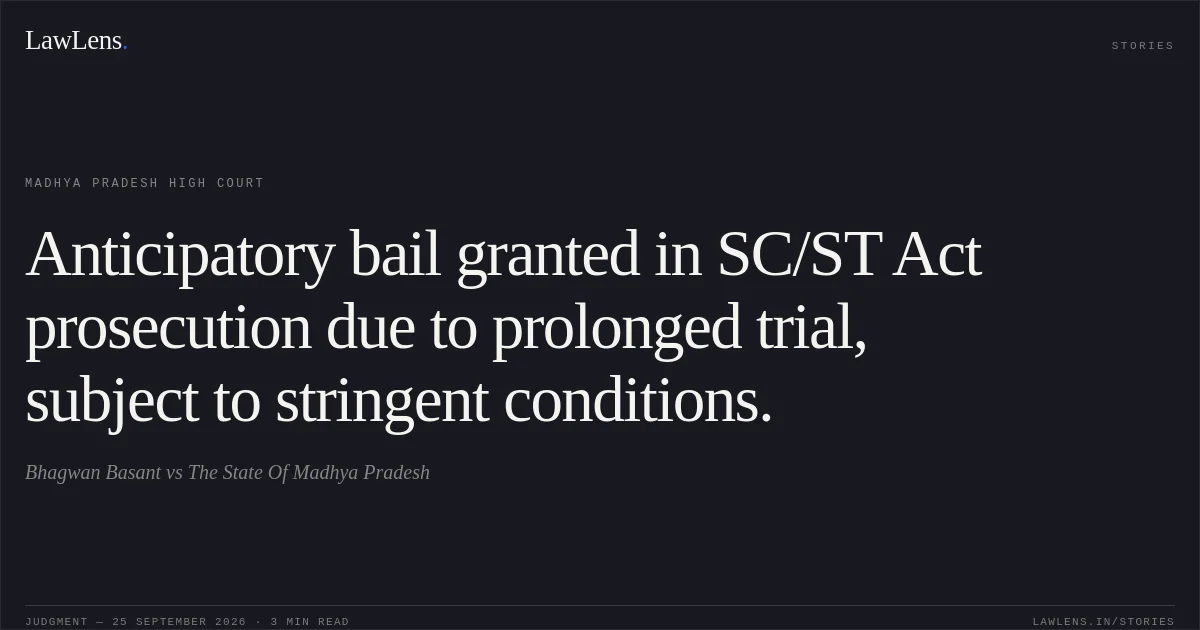
The appellant challenged the order dated 3 August 2026 passed by the Special Judge, SC/ST Act, Gwalior, dismissing his application for anticipatory bail under Section 482 of the Bharatiya Nagarik Suraksha Sanhita, 2023 (“BNSS”).
Source reference: para. 1The appellant apprehended arrest in Crime No. 517/2019 registered at Police Station Indarganj, District Gwalior, for offences under Sections 323, 294, 506 and 34 of the Indian Penal Code and Sections 3(1)(da), 3(1)(dha) and 3(2)(va) of the Scheduled Castes and Scheduled Tribes (Prevention of Atrocities) Act, 1989 (“SC/ST Act”).
Source reference: para. 1The appellant contended that he had been falsely implicated, that no caste-based abuse had been made, that he was not informed about filing of the charge-sheet, and that he had consequently not appeared before the trial court when the charge-sheet was filed.
Source reference: para. 3The Court recorded that the victim had been informed of the appeal in compliance with Section 15-A of the SC/ST Act.
Source reference: para. 2Issues
Whether the appellant was entitled to anticipatory bail under Section 482 of the BNSS in connection with the offences alleged under the IPC and the SC/ST Act?
Source reference: paras. 1, 3–6Whether anticipatory bail could be granted subject to the appellant appearing before the Investigating Officer or trial court within a prescribed period and complying with specified conditions?
Source reference: paras. 6–10Law Applied
The Court applied Section 14(2) of the SC/ST Act, governing an appeal against an order of the Special Court, and Section 482 of the BNSS, which empowers the High Court to grant anticipatory bail.
Source reference: para. 1The Court also considered the victim-notification requirement under Section 15-A of the SC/ST Act.
Source reference: para. 2Anticipatory bail was granted on the usual principles that the accused’s appearance, cooperation with investigation, non-interference with witnesses or evidence, and continued compliance with the process of the court may be secured through appropriate conditions.
Source reference: paras. 6–10Reasoning
After hearing the parties and perusing the case diary, the Court considered the overall facts and circumstances, particularly that the trial was likely to take time, while expressly declining to make any observation on the merits of the prosecution case.
Source reference: paras. 5–6The appellant’s undertaking to cooperate and the absence of any stated likelihood of his fleeing from justice supported conditional protection from arrest.
Source reference: para. 3The Court therefore set aside the Special Judge’s order and directed that the appellant be released on anticipatory bail if he appeared before the Investigating Officer or trial court within fifteen days and furnished a personal bond of ₹50,000 with one solvent surety in the like amount.
Source reference: para. 6The protection was secured by conditions requiring availability for investigation, abstention from similar offences, non-inducement or intimidation of witnesses, non-tampering with evidence, furnishing of fresh bonds after submission of the final report if directed, and regular appearance during trial.
Source reference: para. 8The Court further provided that failure to appear within fifteen days would automatically cancel the order, and that breach of the bail conditions could justify cancellation of bail on merits.
Source reference: paras. 7, 9Holding
The appeal was allowed.
The order dated 3 August 2026 rejecting anticipatory bail was set aside.
Source reference: no citationThe appellant was granted anticipatory bail subject to appearing before the Investigating Officer or trial court within fifteen days from the date of the order and furnishing a personal bond of ₹50,000 with one solvent surety for the same amount.
Source reference: para. 6The bail protection was made effective until the conclusion of trial, subject to the stipulated conditions and the possibility of cancellation in case of breach.
Source reference: paras. 7–9Acts & Sections Cited
11 provisions across 4 statutes referred to in this judgment. Each provision opens on LawLens.
Scheduled Castes and the Scheduled Tribes (Prevention of Atrocities) Act, 19892
Bharatiya Nagarik Suraksha Sanhita, 20233
Indian Penal Code, 18604
Code of Criminal Procedure, 19732
Original Court PDF
Bhagwan BasantvsThe State Of Madhya Pradesh
Click to open original judgment
Original judgment, available to read, download and summarize on LawLens.in