01Facts
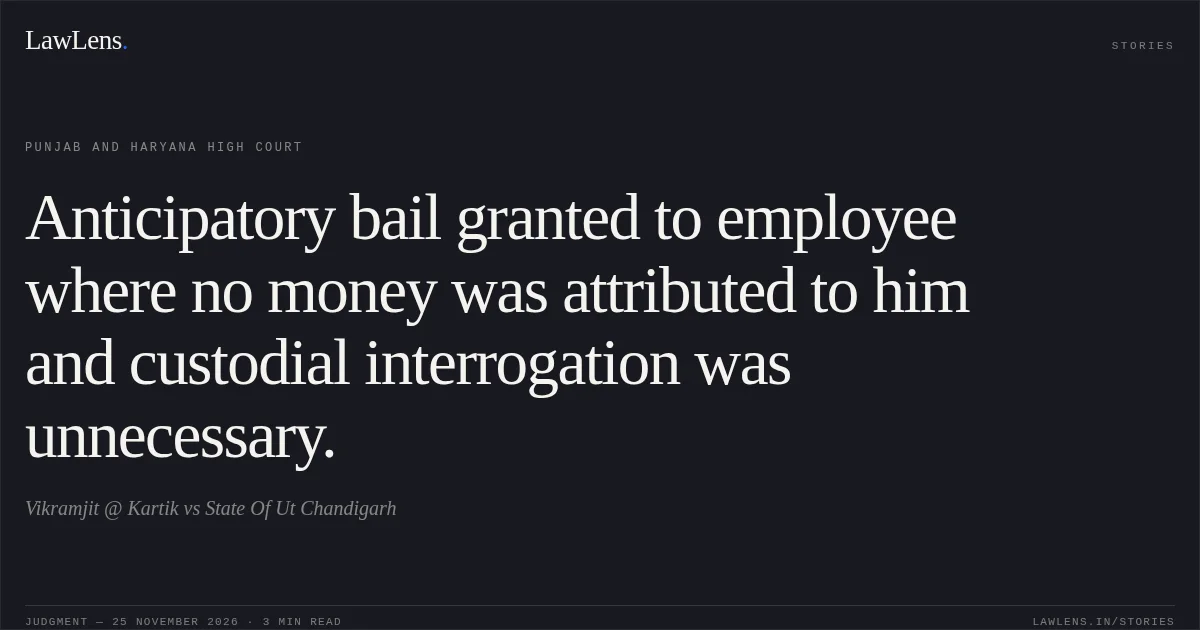
The petitioner sought anticipatory bail under Section 482 of the Bharatiya Nagarik Suraksha Sanhita (BNSS), 2023, in FIR No. 44 dated 16.05.2026, registered at Police Station North, Chandigarh, under Sections 318(4) and 61(2) of the Bharatiya Nyaya Sanhita (BNS), 2023 (corresponding to IPC Sections 420 and 120-B).
¶ 1The prosecution alleged that the petitioner, with a co-accused, induced the complainant to pay Rs. 12,00,000 on the pretext of sending him abroad. Neither the travel nor the refund occurred.
order dated 05.10.2026 · ¶ 2The petitioner contended that he was only an employee of the consultancy, tasked with checking applicant documents, while the owners handled finances. He further contended that no demand or receipt of money was attributed to him and that he had clean antecedents.
order dated 05.10.2026 · ¶ 3The State relied on CCTV footage showing his presence and interaction in the office and sought to investigate his role, nexus, money trail and the documents handed over.
order dated 05.10.2026 · ¶ 4On 05.10.2026, the Court held that custodial interrogation was not warranted, directed the petitioner to join investigation, and provided for interim bail on arrest subject to Section 482(2) BNSS conditions.
order dated 05.10.2026 · ¶ 6–8, 10The petitioner subsequently joined investigation, and the State, on instructions from the Investigating Officer, confirmed that custodial interrogation was not required.
¶ 3–402Issues
i.1. Whether the petitioner, an employee whose role was confined to document verification, is entitled to anticipatory bail where no money was handed to or demanded by him and no specific material links him to the alleged amount.
order dated 05.10.2026 · ¶ 6–7ii.2. Whether the interests of investigation can be adequately protected by directing the petitioner to join and cooperate with investigation, without custodial interrogation.
order dated 05.10.2026 · ¶ 7–8 · ¶ 503Law Applied
Section 482 BNSS, which empowers the High Court to grant anticipatory bail.
order dated 05.10.2026 · ¶ 10 · ¶ 5Section 482(2) BNSS, which permits conditions on such relief.
order dated 05.10.2026 · ¶ 10 · ¶ 5The principle that custodial interrogation is justified only where it is necessary for the investigation, and that the State is entitled to probe an accused's role, nexus, money trail and documentary evidence.
order dated 05.10.2026 · ¶ 7The principle that mere employment with a concern, absent attributable demand, receipt or retention of money, does not by itself establish criminal liability at the bail stage.
order dated 05.10.2026 · ¶ 6The Court cited no precedents.
Provisions in the judgment · 4 · Linked ones open on LawLens
Bharatiya Nagarik Suraksha Sanhita, 2023 Section 482
Bharatiya Nyaya Sanhita, 2023 Section 318Section 61
Indian Penal Code, 1860 Section 420
04Reasoning
The Court accepted that the CCTV footage established the petitioner's presence and interaction at the office, which warranted investigation into his role.
order dated 05.10.2026 · ¶ 6However, no material showed that money was handed to him, that any part of Rs. 12,00,000 was received or retained by him, or that any specific demand was attributed to him. On that record, custodial interrogation did not appear necessary.
order dated 05.10.2026 · ¶ 6–7The Court addressed the State's legitimate investigative concerns (his nexus with the co-accused, the money trail and the whereabouts of the documents) by directing the petitioner to join investigation and face the CCTV footage, statements and financial records. This conditional protection was held sufficient to preserve the integrity of the investigation.
order dated 05.10.2026 · ¶ 7–8The petitioner's subsequent compliance, together with the State's concession that custodial interrogation was unnecessary, removed any residual basis for withholding relief.
¶ 3–505Holding
The Court held that the petitioner's presence in the office and his employment do not, on the present record, justify custodial interrogation, as no material attributes receipt, retention or demand of the alleged amount to him.
order dated 05.10.2026 · ¶ 6–8Investigation could be adequately protected by requiring cooperation.
order dated 05.10.2026 · ¶ 8The petition was allowed, and the interim order dated 05.10.2026 was made absolute, subject to compliance with Section 482(2) BNSS. The petitioner is thus granted anticipatory bail on conditions, including joining and cooperating with investigation.
¶ 5Original Court PDF
Vikramjit @ KartikvsState Of Ut Chandigarh
Click to open original judgment
Original judgment, available to read, download and summarize on LawLens.in