01Facts
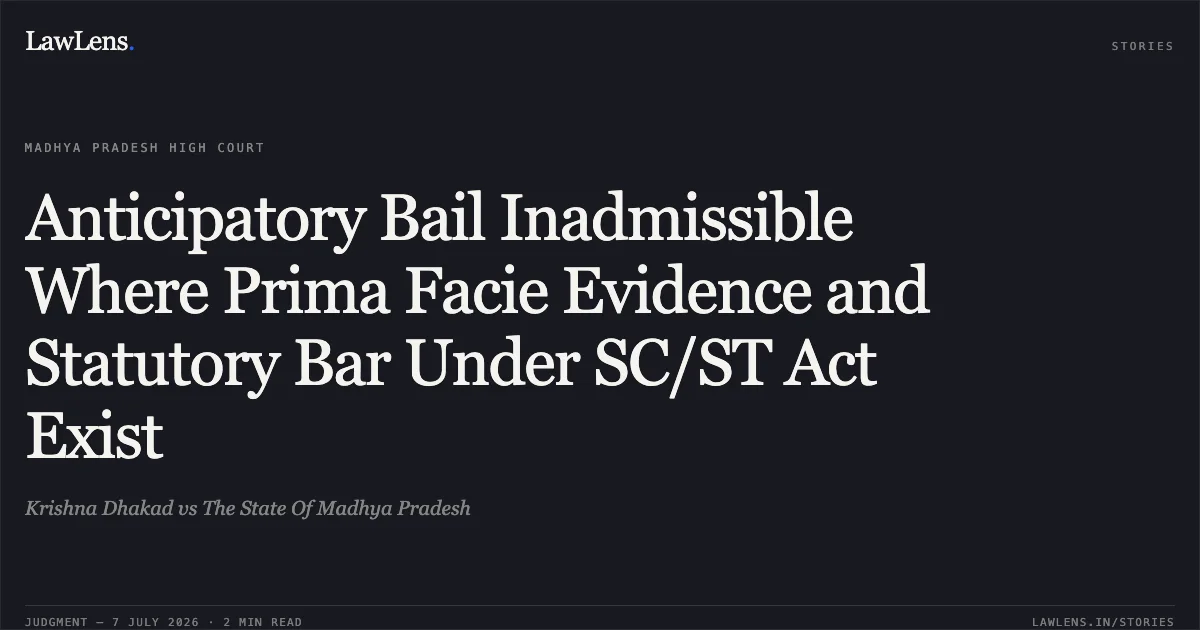
The appellants, Rahul Kumar and Krishna Dhakad, were implicated in FIR No. 240/2025 at Police Station Betul Bazar for various offences under the Bharatiya Nyaya Sanhita (BNS), 2023, and the SC/ST (Prevention of Atrocities) Act, 1989.
¶ 2The appellants moved the Special Judge, Betul, for anticipatory bail under Section 482 of the Bharatiya Nagarik Suraksha Sanhita (BNSS), 2023, which was rejected on 28.02.2026.
¶ 1They subsequently filed these second criminal appeals under Section 14-A of the SC/ST Act, claiming a plea of alibi and arguing that Call Detail Records (CDRs) and location data proved their absence from the crime scene.
¶ 3The State and the victim opposed the appeals, asserting that CDR data placed the appellants in the vicinity and that custodial interrogation was necessary.
¶ 402Issues
i.1. Whether the appellants are entitled to the grant of anticipatory bail despite the statutory bar under the SC/ST (Prevention of Atrocities) Act and the nature of the allegations.
¶ 5-6ii.2. Whether disputed questions of fact, such as pleas of alibi and electronic evidence (CDR/CCTV), can be adjudicated at the stage of considering an anticipatory bail application.
¶ 503Law Applied
The court's decision was governed by Section 14-A of the Scheduled Castes and Scheduled Tribes (Prevention of Atrocities) Act, 1989, which provides the mechanism for appeals against bail orders.
¶ 1It strictly applied the statutory bar contained in Section 18 of the SC/ST Act, 1989, which precludes the grant of anticipatory bail where a prima facie case is established under the Act.
¶ 5The court considered the procedural framework of Section 482 of the BNSS, 2023, regarding anticipatory bail, alongside substantive provisions of the BNS, 2023, including Sections 74 (assault/criminal force to woman with intent to outrage modesty), 70(1) (rape), and 115(2) (voluntarily causing hurt).
¶ 2, 5Provisions in the judgment · 11 · Linked ones open on LawLens
Bharatiya Nagarik Suraksha Sanhita, 2023 Section 482
Bharatiya Nyaya Sanhita, 2023 Section 3Section 70Section 74Section 115Section 118Section 296Section 324Section 351
Scheduled Castes and the Scheduled Tribes (Prevention of Atrocities) Act, 1989 Section 3Section 18
04Reasoning
The court observed that the material collected during the investigation prima facie supported the prosecution's case.
¶ 5It rejected the appellants' reliance on CDRs, location data, and CCTV footage as grounds for bail, reasoning that these constitute "disputed questions of fact" and "matters of defense" that are more appropriately examined during the trial rather than the preliminary stage of bail.
¶ 5The court noted that even if mobile locations did not match the exact spot, the proximity to the vicinity remained a factor for investigation.
¶ 4Applying the statutory mandate, the court held that the gravity of the offences and the specific bar under Section 18 of the SC/ST Act outweighed the appellants' arguments for liberty at this stage.
¶ 505Holding
The High Court dismissed the second criminal appeals, refusing to grant anticipatory bail to the appellants.
¶ 6The court held that no case for bail was made out given the gravity of the allegations, the role attributed to the appellants, and the legal prohibition under Section 18 of the SC/ST (Prevention of Atrocities) Act.
¶ 5Any observations made were clarified as not being a comment on the merits of the case.
¶ 6Original Court PDF
Krishna DhakadvsThe State Of Madhya Pradesh
Click to open original judgment
Original judgment, available to read, download and summarize on LawLens.in