Facts
The applicant, an authorized signatory for M/s Om Kiran Ispat Udyog, filed for anticipatory bail under Section 482 of the Bharatiya Nagarik Suraksha Sanhita (BNSS), 2023, apprehending arrest for alleged offenses under Sections 69 and 132 of the CGST/CGGST Act, 2017.
Source reference: para. 1The applicant alleged that despite cooperating with summons, he was coerced and threatened with arrest following searches in January 2025 and January 2026.
Source reference: para. 2The applicant further claimed that the investigation assumed a coercive character after the arrest of business associates.
Source reference: para. 3Conversely, the respondents argued that the total Input Tax Credit (ITC) involved was Rs. 1.16 crore, which falls below the Rs. 5 crore threshold that renders an offense cognizable and non-bailable under the Act.
Source reference: para. 4They maintained that the offense was bailable and non-cognizable, and therefore, the apprehension of arrest was unfounded.
Source reference: para. 4Issues
Whether the applicant is entitled to the protection of anticipatory bail under Section 482 of the BNSS for offenses alleged under the CGST Act where the tax liability is below the statutory threshold for non-bailable offenses.
Source reference: para. 6Law Applied
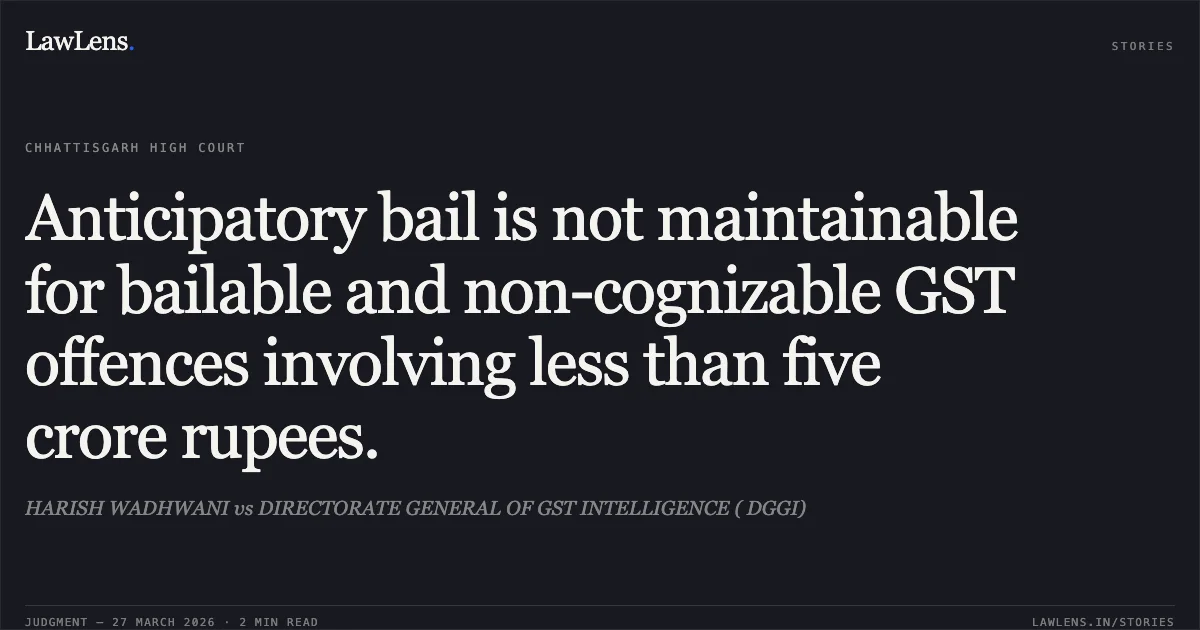
The court primarily applied Section 132 of the Central Goods and Services Tax (CGST) Act, 2017, which classifies offenses involving an amount less than Rs. 5 crore as non-cognizable and bailable.
Source reference: para. 6It further considered Section 69 of the CGST Act regarding the power to arrest and Section 482 of the Bharatiya Nagarik Suraksha Sanhita (BNSS), 2023, which governs the grant of bail to persons apprehending arrest.
Source reference: para. 1, 6Reasoning
The court examined the financial scope of the allegations, noting that the matter pertained to a total GST liability of Rs. 1,16,22,215, with a recoverable amount of Rs. 74,89,846.
Source reference: para. 6Applying the statutory framework of Section 132 of the CGST Act, the court observed that since the liability was less than Rs. 5 crore, the alleged offenses are inherently non-cognizable and bailable.
Source reference: para. 6The court reasoned that an application for anticipatory bail is not maintainable or meritorious when the offense for which arrest is apprehended is already bailable by law, as the applicant's right to bail is secured upon any potential detention.
Source reference: para. 6Holding
The Court concluded that the anticipatory bail application was devoid of merit because the alleged offenses are bailable in nature.
Accordingly, the application filed by the applicant under Section 482 of the BNSS was rejected.
Source reference: para. 7Original Court PDF
HARISH WADHWANIvsDIRECTORATE GENERAL OF GST INTELLIGENCE ( DGGI)
Click to open original judgment
Original judgment, available to read, download and summarize on LawLens.in


