01Facts
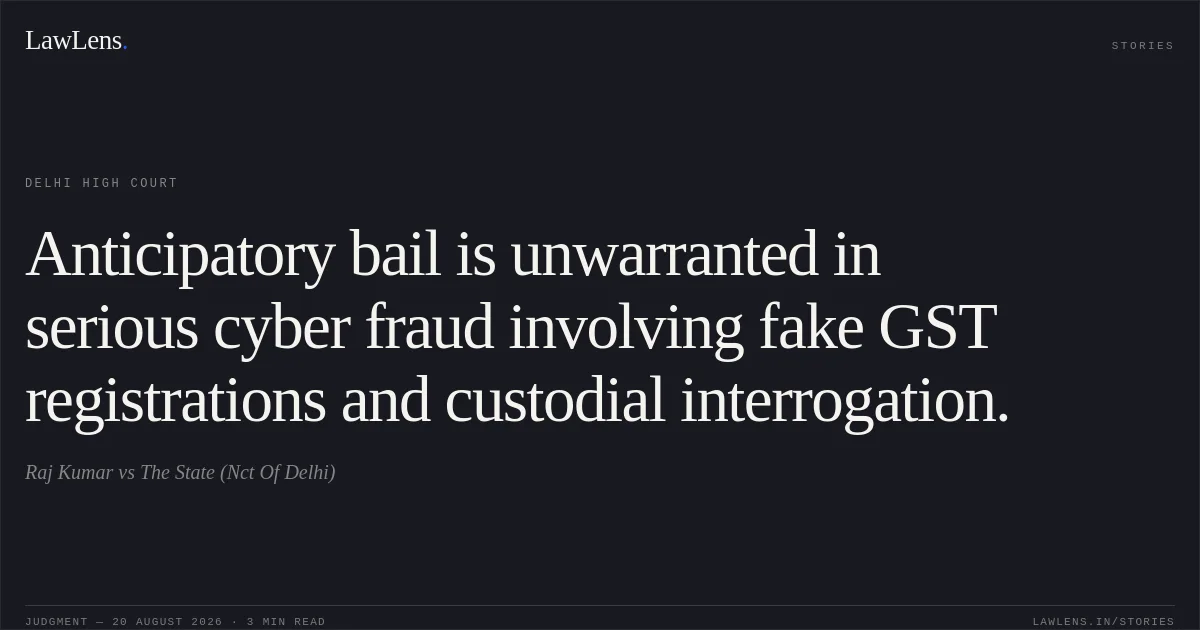
The applicant sought anticipatory bail in FIR No. 108/2025 registered at Police Station Cyber, Outer North District, Delhi, for offences under Sections 420, 419, 468, 471 and 120B IPC.
¶ 1The prosecution alleged that the complainant’s PAN and Aadhaar details had been misused to create fake GST firms and conduct illicit financial transactions without her knowledge.
¶ 3.1–3.2During investigation, the police traced mobile numbers, email IDs, recovery email IDs, IP addresses and GST-related activity to the applicant.
¶ 3.3–3.5The prosecution alleged that the applicant generated GST numbers for fictitious entities, supplied them with associated mobile numbers and email IDs to co-accused Aman Bisht, generated fake invoices and e-way bills, and received payments directly from clients.
¶ 3.3–3.5The applicant contended that the case against him rested only on the disclosure statement of a co-accused, that the incriminating mobile phones did not belong to him, and that the investigation was biased.
¶ 4The State relied on technical evidence, the Customer Application Form of an incriminating mobile number, the applicant’s failure to join investigation, the need for custodial interrogation, and his involvement in three other financial-fraud cases, including one under the Prevention of Money Laundering Act.
¶ 5The Investigating Officer reported that the investigation remained ongoing.
¶ 6, 802Issues
i.Whether the applicant was entitled to anticipatory bail in view of the allegations concerning creation and use of fake GST registrations through misuse of the identity documents of innocent persons.
¶ 7–10ii.Whether the applicant’s custodial interrogation was justified when the investigation involved ongoing technical analysis, alleged non-cooperation, and the need to determine the full extent of the fraud.
¶ 8iii.Whether the seriousness of the alleged economic offences and the applicant’s involvement in other financial-fraud cases militated against grant of anticipatory bail.
¶ 903Law Applied
The Court considered the offences alleged under Sections 420, 419, 468, 471 and 120B IPC, relating respectively to cheating, personation, forgery for the purpose of cheating, use of forged documents as genuine, and criminal conspiracy.
¶ 1It applied the established parameters governing anticipatory bail, including the seriousness and nature of the accusation, the stage and requirements of investigation, the possibility of custodial interrogation, and the applicant’s conduct in joining the investigation.
¶ 7–8The Court also treated the economic and systemic consequences of fraudulent GST registrations as relevant to the discretionary relief of anticipatory bail, and considered the applicant’s antecedents involving other financial-fraud cases as an adverse factor.
¶ 7, 9The Court further noted the statutory proceedings under Section 84 BNSS concerning the applicant’s alleged evasion and possible declaration as a proclaimed offender.
¶ 5Provisions in the judgment · 5 · Linked ones open on LawLens
Indian Penal Code, 1860 Section 420Section 419Section 468Section 471
Bharatiya Nagarik Suraksha Sanhita, 2023 Section 84
04Reasoning
The Court found that the prosecution case was supported not merely by a co-accused’s disclosure statement but by detailed technical investigation linking mobile numbers, email IDs, recovery email IDs and GST-related activity to the applicant.
¶ 3.3–3.5, 5–6The allegations involved systematic creation of fake GST entities by misusing the identity documents of innocent persons, with potentially serious consequences for individuals and the national economy.
¶ 7Since the technical investigation was still examining the extent of the alleged fraud and the applicant had not joined the investigation, the Investigating Officer’s request for custodial interrogation was held to be justified.
¶ 8The applicant’s alleged involvement in three other financial-fraud cases, including a PMLA matter, further weighed against the grant of discretionary pre-arrest protection.
¶ 9On these facts, the Court concluded that anticipatory bail would be inappropriate.
05Holding
The Court answered the issues against the applicant and held that this was not a fit case for anticipatory bail.
¶ 7–10Considering the gravity of the alleged GST and financial fraud, the ongoing technical investigation, the applicant’s non-cooperation, the justified requirement of custodial interrogation, and his other financial-fraud cases, the Court dismissed BAIL APPLN. 1632/2026.
¶ 7–10Original Court PDF
Raj KumarvsThe State (Nct Of Delhi)
Click to open original judgment
Original judgment, available to read, download and summarize on LawLens.in