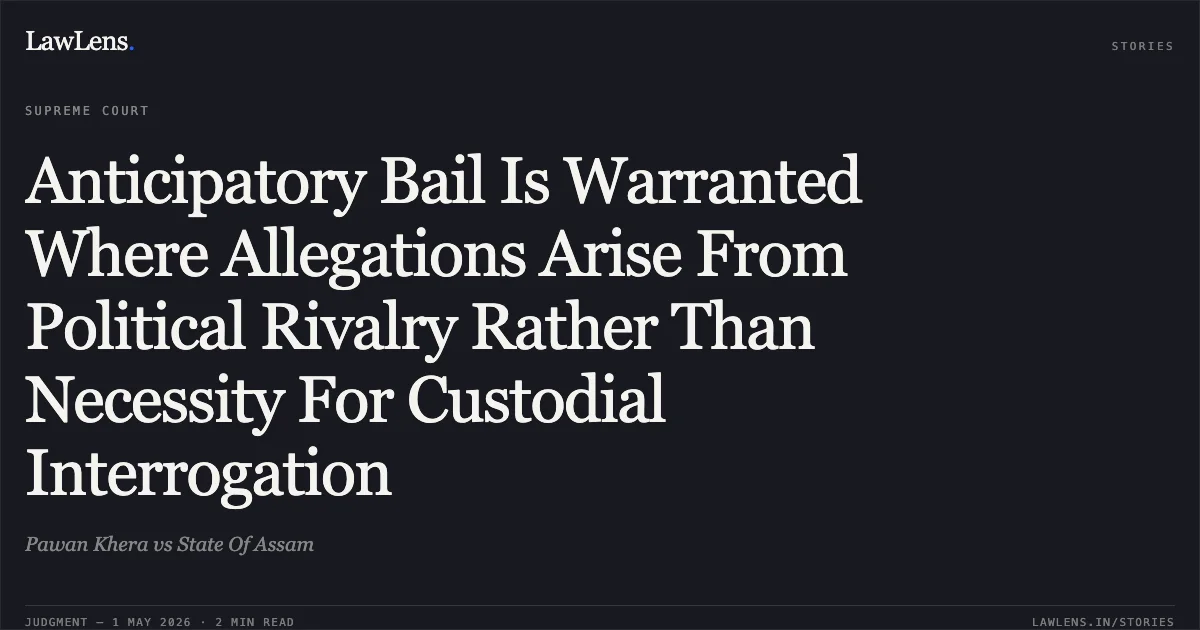
Facts
The Appellant, a national political party office bearer, held press conferences on April 5, 2026, alleging that the wife of the Chief Minister of Assam possessed three foreign passports and undisclosed overseas assets
Source reference: para 5The State registered an FIR on April 6, 2026, under various sections of the Bharatiya Nyaya Sanhita, 2023 (BNS), asserting the documents shown were forged
Source reference: para 4, 6Following the rejection of a non-bailable warrant by a Magistrate and a stay on a transit bail order, the Appellant moved the Gauhati High Court for anticipatory bail
Source reference: para 7, 8The High Court denied the application on April 24, 2026, on the grounds that the documents were prima facie forged and custodial interrogation was necessary
Source reference: para 3, 12, 13The Appellant approached the Supreme Court citing political vendetta and lack of flight risk
Source reference: para 10Issues
1. Whether the High Court was justified in refusing anticipatory bail by placing the burden of proof on the accused at the pre-trial stage
Source reference: para 19, 272. Whether custodial interrogation is essential in a case primarily based on documentary evidence where allegations and counter-allegations suggest political rivalry
Source reference: para 25Law Applied
The Court primarily applied Section 438 of the CrPC/Section 482 of BNSS principles regarding anticipatory bail as interpreted in Shri Gurbaksh Singh Sibbia v. State of Punjab, which establishes that judicial discretion must balance individual liberty against the state's interest and consider if an accusation is motivated by a desire to humiliate the applicant
Source reference: para 14, 15It further relied on Pradip N. Sharma v. State of Gujarat, holding that custodial interrogation is generally unnecessary when an offence is based on documentary evidence and the accused is not a flight risk
Source reference: para 16Additionally, it distinguished Maruti Nivrutti Navale v. State of Maharashtra, where custodial interrogation was required to recover physical documents from the accused
Source reference: para 17, 18Reasoning
The Court observed that the High Court erred by shifting the burden of proof to the Appellant to "prove beyond doubt" that his claims were true at the bail stage
Source reference: para 13, 27The Court highlights that the underlying documents are already with the prosecution, negating the need for custodial recovery
Source reference: para 21Crucially, the Court scrutinized press statements made by the Chief Minister (the complainant's husband) threatening to "knock out" the Appellant and keep him in jail, which indicated that the criminal process might be "coloured by political rivalry"
Source reference: para 22, 25The Court reasoned that since the Appellant is a resident of India with no flight risk and the issues involve election-time rhetoric, the apprehension of arrest appeared to stem from motives other than the mere ends of justice
Source reference: para 25, 26Holding
The Court answered the issues in the negative, holding that the High Court's refusal was based on an erroneous appreciation of material
The Supreme Court allowed the appeal and directed that in the event of arrest, the Appellant be released on anticipatory bail subject to reasonable conditions
Source reference: para 27(a)The Appellant was ordered to cooperate with the investigation, refrain from tampering with evidence, and seek permission before leaving India
Source reference: para 27(b)-(d)The Court clarified that these observations are limited to the bail application and shall not influence the trial on merits
Source reference: para 28Acts & Sections Cited
19 provisions across 3 statutes referred to in this judgment. Each provision opens on LawLens.
Bharatiya Nyaya Sanhita, 2023
Bharatiya Nagarik Suraksha Sanhita, 20231
Code of Criminal Procedure, 19733
Original Court PDF
Pawan KheravsState Of Assam
Click to open original judgment
Original judgment, available to read, download and summarize on LawLens.in


![Subsequent exoneration does not retrospectively invalidate a finalized promotion select list.. UNNIKRISHNAN M vs M/o Environment And Forests. CAT - ['Ernakulam']. LawLens](/stories/thumbnails/subsequent-exoneration-does-not-retrospectively-invalidate-a-finalized-promotion-select-li-ce80a0e84f2f4887857271e8b4341c42.webp)