Facts
An FIR was registered against an unknown person after the second respondent reported being induced to transfer ₹10,99,426 to various accounts in connection with an online part-time task scheme.
Source reference: p. 3–4, para. 4During investigation, ₹6,34,625 was traced to the bank account of Surya Gold Loan, a business of which the petitioner was proprietor.
Source reference: p. 4–5, paras. 5–6The petitioner said that the money had been deposited on the representation of a customer, Mufasir M.K., and that a complaint had been filed against Mufasir in Kerala; material was produced indicating that the Kerala police investigation identified Mufasir as having used the account.
Source reference: p. 4–5, paras. 5–6The petitioner, who had no other criminal antecedents, sought anticipatory bail after the Sessions Court dismissed his application.
Source reference: p. 3, paras. 3, 6Issues
Whether the petitioner should be granted anticipatory bail in Crime No. 90 of 2025, registered for offences under Section 66(D) of the Information Technology Act, 2000 and Section 318(4) of the Bharatiya Nyaya Sanhita, 2023.
Source reference: p. 2–3, paras. 1, 3Whether anticipatory bail should be made subject to conditions securing the petitioner’s cooperation with the investigation and attendance before the Trial Court.
Source reference: p. 5–7, para. 7 and orderLaw Applied
Section 482 of the Bharatiya Nagarik Suraksha Sanhita, 2023 provides for a person apprehending arrest to seek a direction for release on bail in the event of arrest.
Source reference: p. 2–3, para. 1The alleged offences were under Section 66(D) of the Information Technology Act, 2000 and Section 318(4) of the Bharatiya Nyaya Sanhita, 2023.
Source reference: p. 2–3, para. 1The Court applied its discretion to grant anticipatory bail subject to appropriate conditions, having regard to the nature of the allegations and the material placed before it; it cited no precedent.
Source reference: p. 5–6, para. 7Reasoning
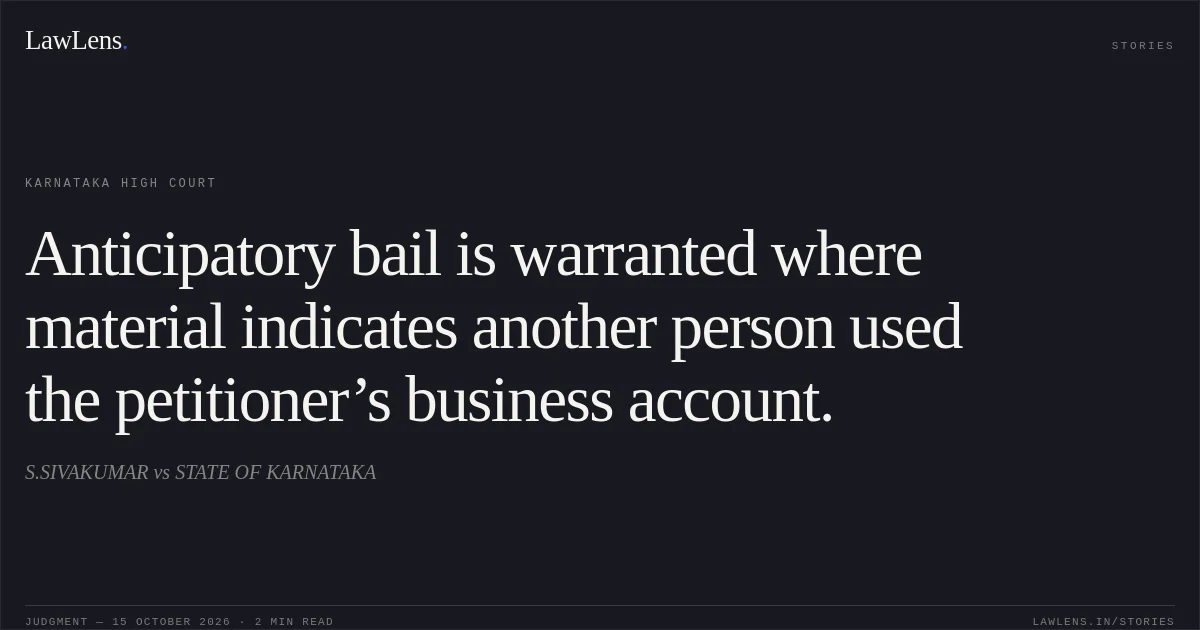
The Court considered that the money had entered the account of the petitioner’s business, but noted the petitioner’s explanation that a customer had arranged the transfer and the material indicating that the customer had used the account.
Source reference: p. 4–5, paras. 5–6It also took into account the petitioner’s lack of criminal antecedents and undertaking to cooperate with the investigation.
Source reference: p. 5, para. 6On those grounds, and having regard to the nature of the allegations, the Court found anticipatory bail appropriate, subject to conditions.
Source reference: p. 5–6, para. 7Holding
The petition was allowed.
The police were directed to release the petitioner on bail in the event of his arrest in Crime No. 90 of 2025, subject to conditions including appearance before the Investigating Officer within 15 days, execution of a personal bond of ₹1,00,000 with two sureties for the like amount, attendance before the Trial Court, cooperation with the investigation, non-tampering with prosecution witnesses, and refraining from similar offences.
Source reference: p. 6–7, orderActs & Sections Cited
3 provisions across 3 statutes referred to in this judgment. Each provision opens on LawLens.
Code of Criminal Procedure, 19731
Bharatiya Nagarik Suraksha Sanhita, 20231
Bharatiya Nyaya Sanhita, 20231
Original Court PDF
S.SIVAKUMARvsSTATE OF KARNATAKA
Click to open original judgment
Original judgment, available to read, download and summarize on LawLens.in


