Facts
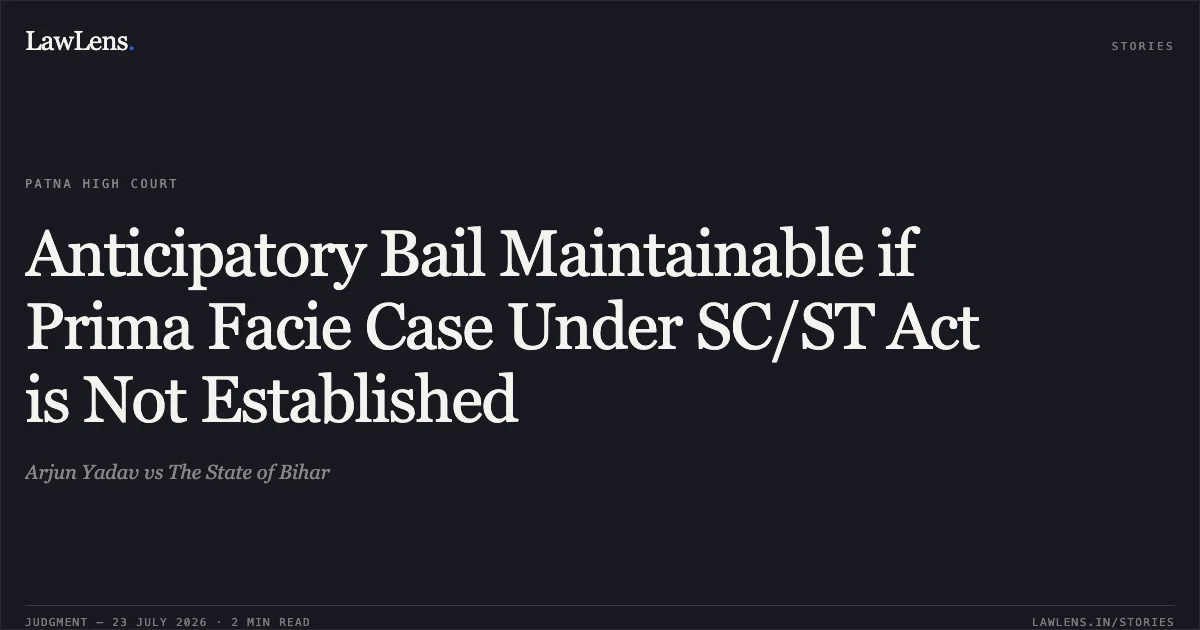
Eight appellants challenged the order dated 02.02.2026 passed by the Exclusive Special Judge, SC/ST Act, Gaya, which denied them anticipatory bail in a case involving alleged offenses under Sections 341, 323, 379, 354, 447, 504, 506/34 of the IPC and Sections 3(1)(r), 3(1)(s), and 3(1)(w) of the SC/ST Act.
Source reference: p. 1-2The prosecution alleged the appellants abused and assaulted the informant (Respondent No. 2) and her family, and snatched jewelry.
Source reference: p. 2The appellants contended that the case was a false implication arising from a land encroachment dispute where they opposed the informant's family's construction on a main road.
Source reference: p. 2They highlighted a three-day delay in filing the FIR (incident: 11.05.2024; FIR: 14.05.2024) and argued that the alleged caste-based slurs occurred within a private house rather than a place of public view.
Source reference: p. 2-3Issues
1. Whether the appellants are entitled to anticipatory bail despite the statutory bar under the SC/ST Act?
Source reference: p. 3-42. Whether a prima facie case under the SC/ST Act is established to justify the denial of pre-arrest bail?
Source reference: p. 3Law Applied
The court primarily applied Section 14(A)(2) of the Scheduled Castes and Scheduled Tribes (Prevention of Atrocities) Act, 1989, regarding appeals against bail orders.
Source reference: p. 1-2It further considered the principles of anticipatory bail now governed by Section 482 of the Bharatiya Nagarik Suraksha Sanhita (BNSS), 2023 (referenced as Section 482(2) for bail conditions).
Source reference: p. 4The court also relied on the judicial principle that the statutory bar on anticipatory bail under the SC/ST Act does not apply if there is a lack of materials to make out a prima facie case or if the accusation appears to be malicious.
Source reference: p. 3Reasoning
The court evaluated the competing claims and noted a "possibility of false accusation" rooted in an underlying land dispute.
Source reference: p. 3The court observed that while caste-based abusive language was alleged, the FIR indicated these events purportedly occurred inside the informant's house, which often fails the "public view" requirement for specific SC/ST Act offenses.
Source reference: p. 3Furthermore, the court emphasized the unexplained three-day delay in lodging the FIR and the fact that the appellants had clean criminal antecedents.
Source reference: p. 3By connecting these factual gaps—specifically the lack of evidence of humiliation because of caste in a legal sense—the court determined that there were insufficient materials to maintain a prima facie case under the SC/ST Act, thereby overcoming the bar to anticipatory bail.
Source reference: p. 3Holding
The court concluded that lack of prima facie materials under the SC/ST Act justified the grant of pre-arrest bail despite the nature of the charges.
The Court allowed the appeal and set aside the impugned order dated 02.02.2026. It directed that in the event of arrest or surrender within eight weeks, the appellants be released on bail upon furnishing bonds of Rs. 10,000/- each with two sureties, subject to conditions under Section 482(2) of the BNSS, including regular court appearance and a requirement that one bailor be a close relative.
Source reference: p. 4Acts & Sections Cited
11 provisions across 3 statutes referred to in this judgment. Each provision opens on LawLens.
Scheduled Castes and the Scheduled Tribes (Prevention of Atrocities) Act, 19892
Indian Penal Code, 18608
Bharatiya Nagarik Suraksha Sanhita, 20231
Original Court PDF
Arjun YadavvsThe State of Bihar
Click to open original judgment
Original judgment, available to read, download and summarize on LawLens.in