Facts
The petitioner, complainant Pawan Kumar, alleged that Mukesh Kumar Verma purchased books worth approximately ₹24,97,166 on credit, issued cheques that were dishonoured, and failed to discharge his liability.
Source reference: paras. 2–4The petitioner instituted Complaint Case No. 46 of 2022 for offences under Sections 406 and 420 of the IPC and Section 138 of the Negotiable Instruments Act; cognizance was taken under Section 406 IPC and Section 138 NI Act.
Source reference: paras. 2–4During the proceedings, the dispute was referred to mediation, resulting in a mediated settlement dated 26 June 2023, under which the accused agreed to pay ₹10,50,000 to the complainant within nine months commencing from July 2023, through the complainant’s designated bank account.
Source reference: para. 5Relying exclusively on the settlement, the High Court granted the accused anticipatory bail on 21 August 2023, recording that the dispute had been resolved.
Source reference: para. 6The accused did not pay the settled amount within the stipulated period, and admittedly made no payment through the designated bank account.
Source reference: paras. 7–9, 21During the proceedings, the accused claimed that he had subsequently paid ₹10,00,000 in cash and executed a compromise deed dated 18 March 2026.
Source reference: paras. 13–17Issues
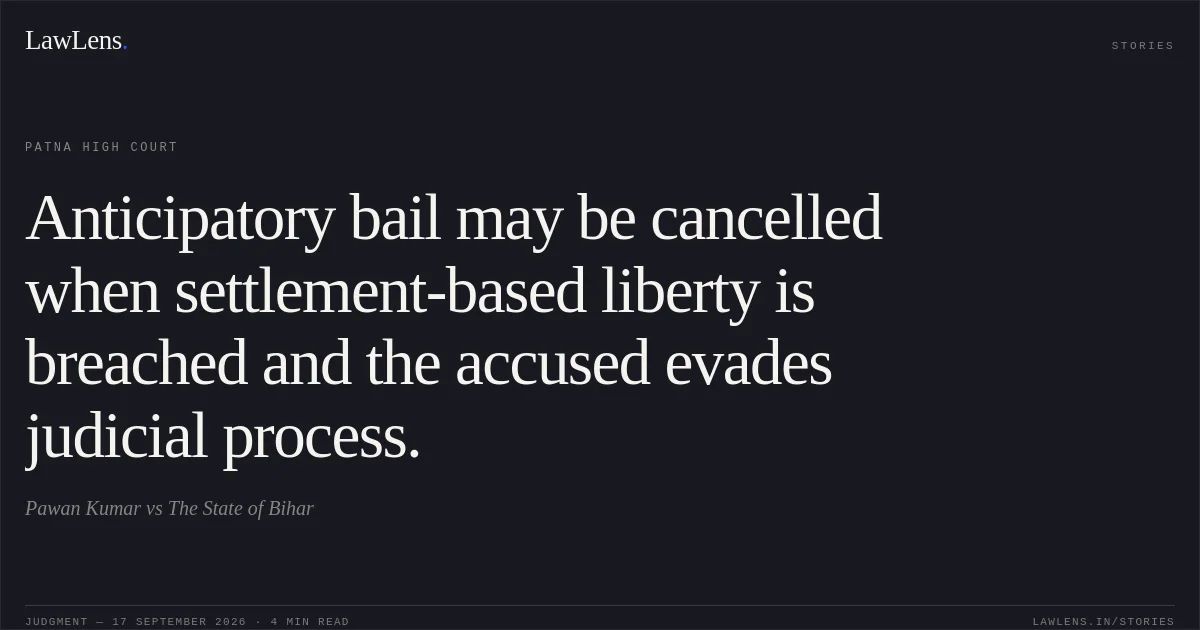
Whether the accused’s complete failure to honour the mediated settlement, which constituted the sole basis for grant of anticipatory bail, amounted to a cogent and overwhelming supervening circumstance warranting cancellation of bail under Section 439(2) CrPC?
Source reference: para. 19Whether the accused’s alleged abscondence and evasion of the process of the Court constituted abuse of the concession of anticipatory bail and justified its cancellation?
Source reference: paras. 19–22Whether the disputed compromise deed, alleged cash payment, and related documents could be conclusively adjudicated upon in the summary proceedings for cancellation of bail?
Source reference: paras. 29–30Law Applied
The Court applied Section 439(2) CrPC, under which bail may be cancelled where post-grant conduct discloses abuse of liberty or circumstances affecting the due administration of justice.
Source reference: para. 20Relying on Dolat Ram v. State of Haryana, Puran v. Rambilas, Neeru Yadav v. State of U.P., Deepak Yadav v. State of U.P., Ajwar v. Waseem, and State of Karnataka v. Sri Darshan, the Court held that cancellation requires cogent and overwhelming circumstances, including interference with or evasion of the process of justice, abuse of the concession of bail, or a real possibility of abscondence.
Source reference: para. 20Bail may also be cancelled where it was procured through misrepresentation or fraud, as recognised in Himanshu Sharma v. State of Madhya Pradesh.
Source reference: para. 20The Court distinguished Biman Chatterjee v. Sanchita Chatterjee, observing that mere non-compliance with a proposed compromise ordinarily does not justify cancellation, but the position is different where a written settlement was actually executed and constituted the recorded basis for bail.
Source reference: paras. 24, 27The Court also relied on Gajanan Dattatray Gore v. State of Maharashtra, Satinder Singh Bhasin v. Government of NCT of Delhi, and M/s Netsity Systems Pvt. Ltd. v. State, recognising that breach of a settlement or undertaking that formed the foundation of bail may amount to abuse of the process of the Court.
Source reference: paras. 23, 25–26Reasoning
The Court found that the anticipatory bail order was not based on an assessment of the accused’s case on merits; it was granted solely because the parties had entered into the written mediated settlement.
Source reference: para. 21The accused admittedly failed to pay the agreed ₹10,50,000 within the stipulated nine-month period and made no payment through the contractually specified bank account. Thus, the foundation of the bail order had been destroyed by the accused’s own conduct.
Source reference: para. 21The Court held that the default could not be viewed in isolation because it was accompanied by the accused’s alleged evasion of the Court’s process and appearance only after coercive steps were initiated.
Source reference: para. 22The Court further held that it was not appropriate, in a Section 439(2) proceeding, to conclusively determine whether the alleged 2026 compromise deed, cash payment, and related documents were genuine; those factual issues required examination by the trial court through evidence, signature comparison, and examination of witnesses.
Source reference: paras. 29–30The disputed later compromise therefore did not negate the established circumstances showing breach of the original settlement and abuse of the bail concession.
Source reference: paras. 28–31Holding
The High Court allowed the application and cancelled the anticipatory bail granted to Mukesh Kumar Verma by order dated 21 August 2023 in Criminal Miscellaneous No. 4721 of 2023.
The bail bonds, if any, were cancelled, and the accused was directed to surrender before the trial court within two weeks; failing surrender, the Senior Superintendent of Police, Gayaji, was directed to secure his custody.
Source reference: para. 33The accused was left at liberty to seek regular bail, which was to be considered independently on merits.
Source reference: para. 33The trial court was directed to proceed expeditiously with the complaint case and decide the pending applications under Section 340 CrPC/Section 379 BNSS and Section 143A of the Negotiable Instruments Act in accordance with law.
Source reference: para. 34The High Court clarified that it had expressed no final opinion on the merits of the complaint or the genuineness of the disputed compromise documents.
Source reference: para. 35Acts & Sections Cited
9 provisions across 4 statutes referred to in this judgment. Each provision opens on LawLens.
Code of Criminal Procedure, 19734
Indian Penal Code, 18602
Negotiable Instruments Act, 18812
Bharatiya Nagarik Suraksha Sanhita, 20231
Original Court PDF
Pawan KumarvsThe State of Bihar
Click to open original judgment
Original judgment, available to read, download and summarize on LawLens.in