Facts
The Petitioner sought anticipatory bail regarding FIR No. RC2212025E0005, registered by the CBI for a nation-wide investment fraud involving a fake trading app named ‘Anisha’
Source reference: p. 1-2The syndicate allegedly defrauded investors of approximately Rs. 150 crores using over 650 SIM cards and 41 bank accounts managed via common IP addresses
Source reference: p. 2Investigation revealed that Rs. 2.77 crores was credited to a 'Falcon Resealing Enterprises' account, which, though in another's name, was allegedly managed by the Petitioner using fake documents
Source reference: p. 2Technical analysis geo-located the account's access to the Petitioner’s residence and linked his personal mobile number to the same IMEI used to operate the suspect account
Source reference: p. 3-4Sessions Court dismissed his bail application on July 14, 2025
Source reference: p. 3Issues
1. Whether the Petitioner is entitled to the protection of anticipatory bail given the allegations of a large-scale organized cyber-financial fraud and his technical nexus to the crime
Source reference: p. 5-62. Whether custodial interrogation is necessary to unearth the conspiracy and the source of crypto-currency transactions
Source reference: p. 3, 6Law Applied
The court applied Sections 61(2), 318(4), 340(2), and 336(3) of the Bharatiya Nyaya Sanhita (BNS), 2023, along with Sections 66C and 66D of the Information Technology Act, 2000
Source reference: p. 1It relied on the principle from State of Rajasthan v. Balchand regarding bail
Source reference: p. 5Crucially, the court cited State (Represented by CBI) v. Anil Sharma, emphasizing that custodial interrogation is "qualitatively more elicitation oriented" than questioning a suspect protected by a pre-arrest bail order
Source reference: p. 5It further applied P. Chidambaram v. Directorate of Enforcement, holding that the court must balance individual liberty under Article 21 with the state's right to effective interrogation in economic offences impacting society
Source reference: p. 5Reasoning
The court reasoned that the gravity of the organized cyber-crime and its massive societal impact outweighed the Petitioner's plea for liberty
Source reference: p. 5The analysis of CDRs and IMEIs established a "technological and physical nexus" between the Petitioner and the fraudulent bank accounts
Source reference: p. 4Furthermore, the court noted that the Petitioner had received 6,984 USDT in crypto-currency and was suspected of communicating with perpetrators in China and destroying his actual mobile handsets
Source reference: p. 3The court found that because the Petitioner might have eluded the investigation if shielded by a bail order, his custodial interrogation was imperative to scrutinize his international connections and unearth the conspiracy
Source reference: p. 3, 5-6Holding
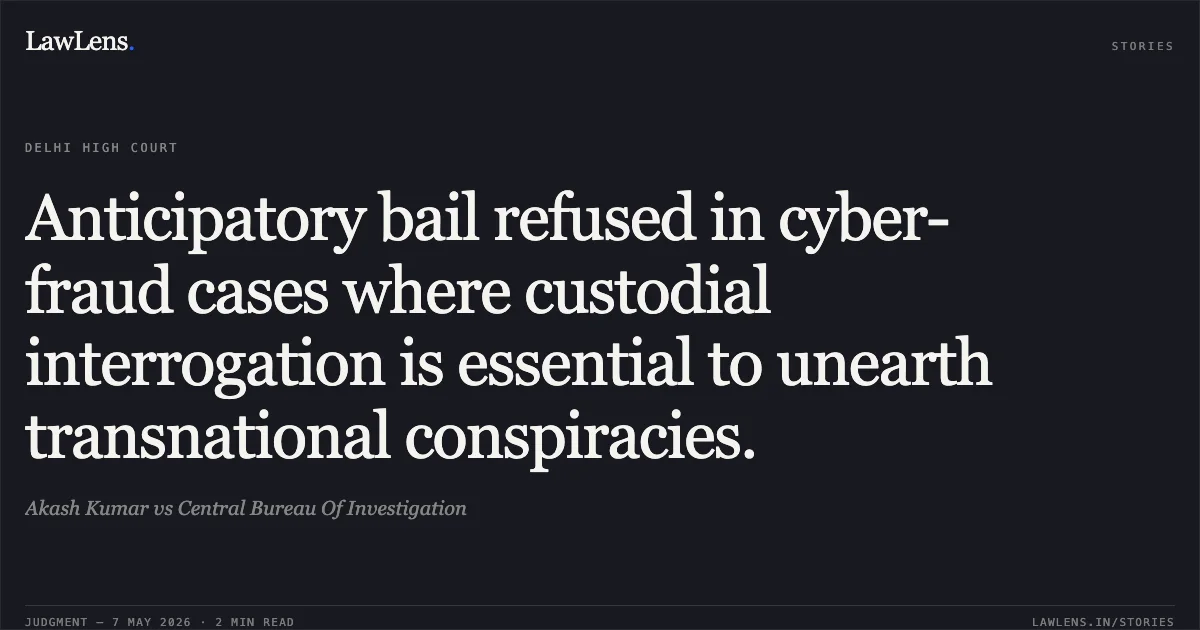
The Court dismissed the anticipatory bail application
It held that in serious economic offences and cyber-crimes, pre-arrest protection cannot be granted when custodial interrogation is essential to reach the truth
Source reference: p. 6The court found no compelling reason to enlarge the Petitioner on bail, citing the need to investigate the crypto-currency trail and foreign links
Source reference: p. 6All pending applications were disposed of accordingly
Source reference: p. 6Acts & Sections Cited
4 provisions across 1 statute referred to in this judgment. Each provision opens on LawLens.
Bharatiya Nyaya Sanhita, 20234
Original Court PDF
Akash KumarvsCentral Bureau Of Investigation
Click to open original judgment
Original judgment, available to read, download and summarize on LawLens.in