01Facts
The State of Gujarat initiated proceedings against the respondent-accused under Sections 17 and 18(a)(ii), read with Section 27, of the Drugs and Cosmetics Act, 1940.
¶ 1–2 · p. 1Following investigation, the police filed a charge-sheet before the Judicial Magistrate First Class, Upleta. The accused pleaded not guilty, and the matter proceeded to trial. By judgment and order dated 29 September 2009, the Trial Court acquitted the accused.
¶ 1–2 · p. 1The State filed the present appeal before the Gujarat High Court under Section 378(4) of the Code of Criminal Procedure, 1973 (“CrPC”).
¶ 1–2 · p. 1During hearing, the parties addressed the maintainability and proper forum of the appeal in light of conflicting authorities concerning appeals against acquittal by a Magistrate and the victim’s right of appeal under the proviso to Section 372 CrPC.
¶ 3–8 · pp. 2–502Issues
i.Whether an appeal against the acquittal recorded by the Judicial Magistrate First Class was properly maintainable before the High Court under Section 378(4) CrPC, or whether it was required to be presented before the concerned Sessions Court
¶ 4–5 · pp. 2–3ii.Whether the appeal could be treated as an appeal under the proviso to Section 372 CrPC, corresponding to Section 413 of the Bharatiya Nagarik Suraksha Sanhita, 2023 (“BNSS”), and transferred to the Sessions Court
¶ 6–9 · pp. 3–5iii.Whether the appeal should be transferred without adjudication on the merits pending authoritative clarification of the legal position by a larger Bench of the Supreme Court
¶ 7–9 · pp. 4–503Law Applied
The Court considered Section 378 CrPC, particularly Sections 378(1)(a), 378(1)(b), and 378(4), governing appeals against acquittal; the proviso to Section 372 CrPC, which confers upon a victim a right to appeal against acquittal, conviction for a lesser offence, or inadequate compensation; and Section 413 BNSS, corresponding to the victim’s appellate remedy under the new procedural code.
¶ 4, 6, and 9 · pp. 2–5Relying on Subhash Chand v. State (Delhi Administration), (2013) 2 SCC 17, the Court noted that an appeal against a Magistrate’s acquittal in a cognizable and non-bailable offence is to be filed before the Sessions Court at the instance of the Public Prosecutor as directed by the District Magistrate, whereas other appeals against acquittal may lie before the High Court as directed by the State Government.
¶ 4 · p. 2The Court also considered Celestium Financial v. A. Gnanasekaran, which held that a victim may appeal under the proviso to Section 372 CrPC without seeking special leave under Section 378(4).
¶ 5–6 · pp. 3–4However, it noted that M/s. Everest Automobiles v. M/s. Rajit Enterprises, Special Leave to Appeal (Crl.) No. 12350 of 2024, questioned the correctness of Celestium Financial for not considering earlier decisions such as Satya Pal Singh v. State of M.P. and Subhash Chand, and indicated the desirability of a larger Bench ruling.
¶ 7 · p. 4Provisions in the judgment · 11 · Linked ones open on LawLens
Drugs and Cosmetics Act, 1940 Section 17Section 18Section 27
Code of Criminal Procedure, 1973 Section 2Section 200Section 372Section 374Section 378
Negotiable Instruments Act, 1881 Section 138Section 143
Bharatiya Nagarik Suraksha Sanhita, 2023 Section 413
04Reasoning
The High Court did not examine the evidentiary merits of the acquittal. It focused on the appropriate appellate forum and the interaction between Section 378 CrPC and the victim’s statutory right of appeal under the proviso to Section 372 CrPC.
¶ 4–9 · pp. 2–5In view of the principles discussed in Subhash Chand, the subsequent reasoning in Celestium Financial, and the Supreme Court’s reservations in Everest Automobiles regarding the unresolved conflict, the Court considered it appropriate not to retain the matter for merits adjudication.
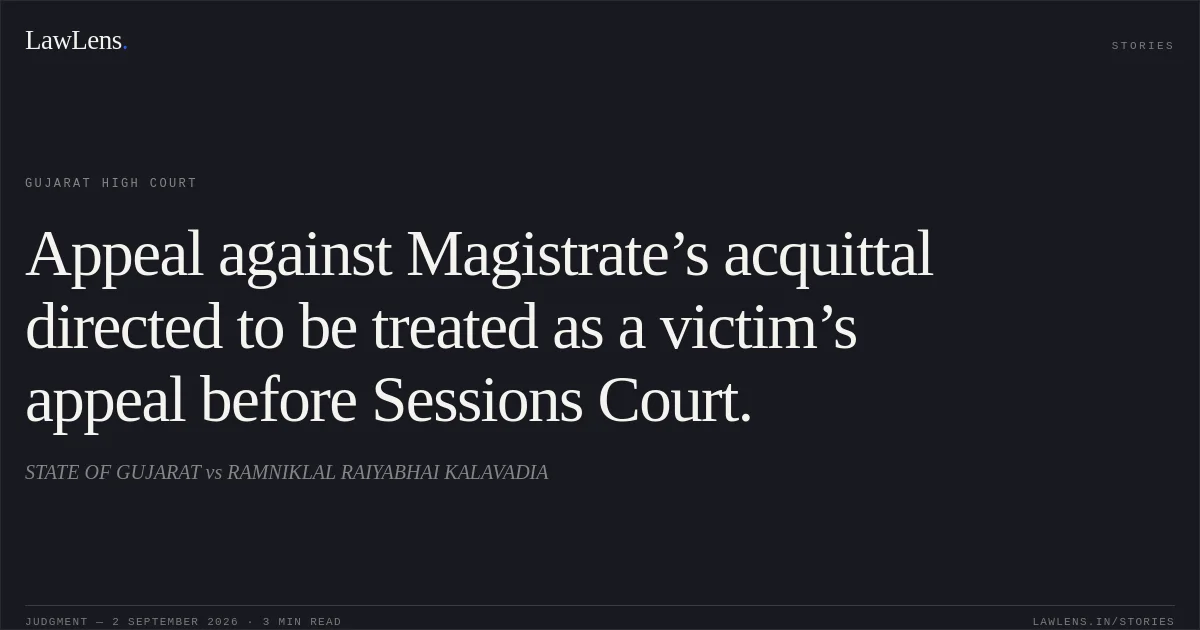
¶ 4–9 · pp. 2–5Instead, it directed that the appeal be transferred to the concerned Sessions Court, where it could be treated and numbered as an appeal under the proviso to Section 372 CrPC or Section 413 BNSS.
¶ 4–9 · pp. 2–505Holding
The High Court disposed of the appeal by directing the Registry to transfer it, along with the complete record, the certified copy of the impugned judgment, and the record and proceedings, to the concerned Sessions Court.
¶ 9 · p. 5The Sessions Court was directed to treat and number the matter as an appeal under the proviso to Section 372 CrPC or Section 413 BNSS and issue notice to the parties.
¶ 9 · p. 5The Court further directed the lower appellate court to endeavour to dispose of the matter expeditiously, given its prolonged pendency.
¶ 10 · p. 6It expressly clarified that it had not considered or decided the merits of the acquittal.
¶ 10 · p. 6Original Court PDF
STATE OF GUJARATvsRAMNIKLAL RAIYABHAI KALAVADIA
Click to open original judgment
Original judgment, available to read, download and summarize on LawLens.in