Facts
The appellants (plaintiffs) filed suits for declaration and permanent injunction regarding certain properties. Along with the plaints, they moved applications (I.A. Nos. 1 and 2) under Order XXXIX Rules 1 and 2 of the Code of Civil Procedure (CPC) seeking ad-interim ex-parte temporary injunctions to restrain the defendants from alienating the property and from carrying out further construction
Source reference: para 4The Trial Court (XXX Addl. City Civil Judge, Bengaluru), upon perusing the documents, observed that appropriate orders could only be passed after hearing both parties and consequently issued notice on the I.As and suit summons
Source reference: para 4.1The plaintiffs challenged these orders via Miscellaneous First Appeals (MFA), contending that the Trial Court failed to exercise its jurisdiction to grant ex-parte relief and acted arbitrarily
Source reference: para 5.1Issues
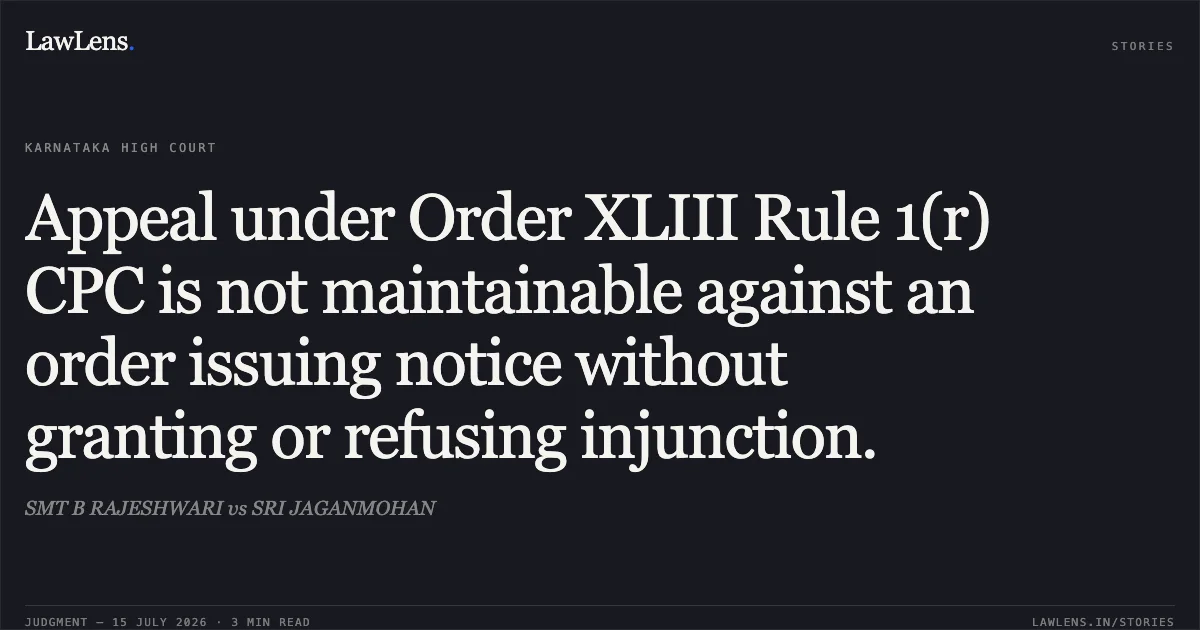
1. Whether the present appeals are maintainable under Order XLIII Rule 1(r) of the CPC against a Trial Court order that merely issues notice on an injunction application without expressly granting or rejecting the prayer for ad-interim relief?
Source reference: para 8Law Applied
Section 104 and Order XLIII Rule 1(r) of the CPC, which restrict the right of appeal only to specific orders passed under Rules 1, 2, 2A, 4, or 10 of Order XXXIX
Source reference: para 14, 19distinction between Rule 1/Rule 2 (grant/refusal of injunction) and Rule 3 of Order XXXIX (procedure for directing notice before granting injunction)
Source reference: para 15A. Venkatasubbaiah Naidu v. S. Challappan, which establishes that while an appeal lies against an ex-parte order remaining in force beyond 30 days, the normal remedy under Order XLIII Rule 1 does not extend to mere procedural directions
Source reference: para 16Rule 3 is consciously excluded from the list of appealable orders to prevent challenges to innocuous notices [Perpetual Vision LLP v. Vaibhav S. Pingale]
Source reference: para 12Reasoning
The Court reasoned that under Order XXXIX, a Trial Judge has two distinct options upon receiving an injunction application: (i) issue notice under Rule 3 to hear the opponent, or (ii) grant an ex-parte ad-interim injunction under the proviso to Rule 3 if delay would defeat the object of the injunction
Source reference: para 17The Court observed that Order XLIII Rule 1(r) specifically enumerates the rules under which an order is appealable and "conspicuously" omits Rule 3
Source reference: para 20Therefore, an order that neither grants nor rejects an injunction but simply defers the decision until the defendants are heard is an exercise of discretion under Rule 3, which is not amenable to the appellate jurisdiction of the High Court
Source reference: para 21The Court noted that the "species" of order issuing notice is distinct from the "genus" of orders granting or refusing injunctions under Rules 1 and 2
Source reference: para 13Holding
The Court held that the appeals are not maintainable because an order merely issuing notice under Order XXXIX Rule 3 does not constitute an appealable order under Order XLIII Rule 1(r) of the CPC
The appeals were dismissed; however, the Court reserved liberty for the appellants to move the Trial Court for an early hearing, directing the Trial Judge to consider such a motion and pass suitable orders within 15 days of the request
Source reference: para 25(i), 25(iii)The Court clarified that it expressed no opinion on the merits of the underlying injunction applications
Source reference: para 25(v)Acts & Sections Cited
7 provisions across 3 statutes referred to in this judgment. Each provision opens on LawLens.
Code of Civil Procedure, 19085
Transfer of Property Act, 18821
Delhi High Court Act, 19661
Original Court PDF
SMT B RAJESHWARIvsSRI JAGANMOHAN
Click to open original judgment
Original judgment, available to read, download and summarize on LawLens.in