Facts
The State of Gujarat filed an appeal against the judgment of the Chief Judicial Magistrate, Rajkot, dated 29.09.2007, which acquitted two police constables (Accused Nos. 3 and 4) of charges involving the facilitation of a prisoner's escape from lawful custody
Source reference: p. 1-2While the trial court convicted the other co-accused for offences under Sections 224, 225A, and 202 of the IPC, it acquitted the respondents by granting them the benefit of doubt
Source reference: p. 2The State preferred this appeal directly to the High Court under Section 378(1)(3) of the Cr.P.C.
Source reference: p. 1Issues
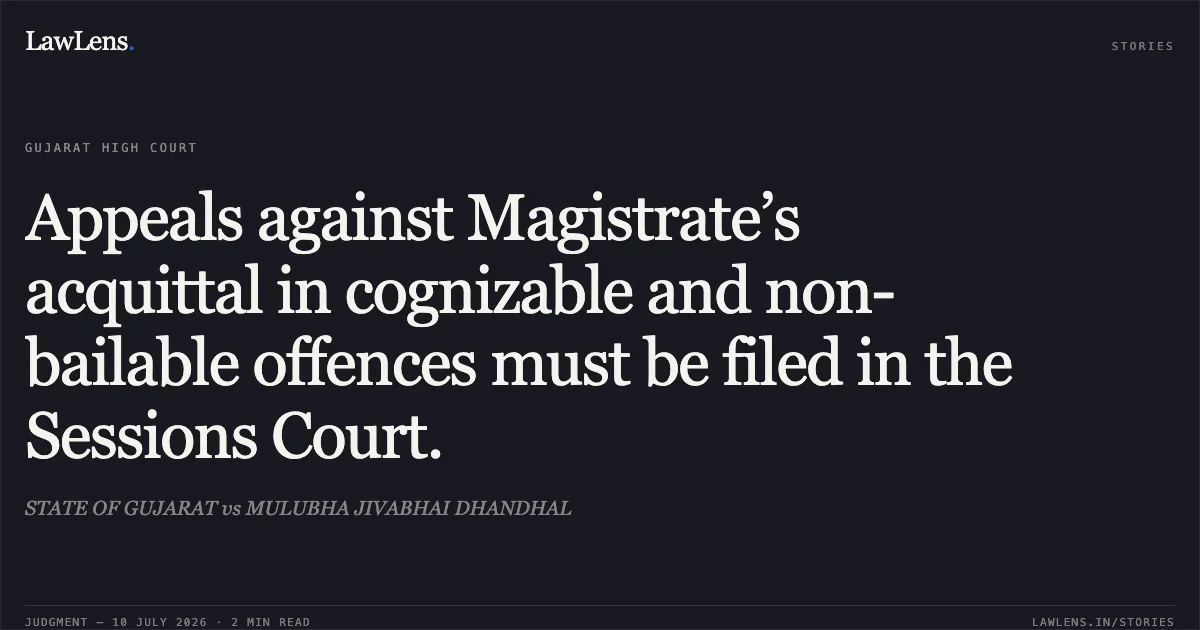
Whether the High Court is the appropriate forum for an appeal against an order of acquittal passed by a Magistrate in respect of cognizable and non-bailable offences
Source reference: p. 3 / para. 5-6Whether the appeal must be transferred to the Sessions Court in light of the statutory bar under Section 378(1) of the Cr.P.C. and recent judicial precedents
Source reference: p. 4-6 / para. 10Law Applied
Section 378(1) of the Code of Criminal Procedure, 1973, which mandates that appeals against acquittal orders passed by a Magistrate in cognizable and non-bailable cases must be filed in the Sessions Court, not the High Court
Source reference: para. 5-6Supreme Court’s interpretation in Subhash Chand vs. State (Delhi Administration), which established that Section 378(1)(b) creates a categorical bar against the State filing such appeals directly in the High Court
Source reference: para. 6Procedural rights of victims and complainants under Section 372 of the Cr.P.C. and Section 413 of the BNSS as referenced in Celestium Financial vs. A. Gnanasekaran and Mohanlal vs. Gaurav Kumar
Source reference: para. 7-8Reasoning
The Court examined the nature of the offences charged (Sections 224, 225A, 202, and 120B of the IPC) and the status of the adjudicating court (Chief Judicial Magistrate)
Source reference: para. 5Applying the rule from Subhash Chand, the Court reasoned that because the acquittal was rendered by a Magistrate for cognizable/non-bailable offences, the State's appeal is statutorily required to be heard by the immediate higher court, i.e., the Sessions Court
Source reference: para. 6The Court noted that even if the State Government directs a Public Prosecutor to file an appeal, Section 378(1)(b) restricts the venue for such "Magisterial acquittals" to the Court of Sessions to ensure procedural hierarchy
Source reference: para. 6Holding
The High Court held that it lacked the immediate jurisdiction to entertain the appeal and directed the Registry to transfer the entire record and proceedings to the concerned Sessions Court
The Sessions Court was directed to treat the matter as an appeal under the proviso to Section 372 of the Cr.P.C. (now Section 413 of the BNSS), register it accordingly, and endeavor to dispose of the long-pending matter expeditiously. The appeal was disposed of for the purpose of transfer without an adjudication on merits
Source reference: para. 10-11Acts & Sections Cited
13 provisions across 4 statutes referred to in this judgment. Each provision opens on LawLens.
Code of Criminal Procedure, 19735
Indian Penal Code, 18605
Negotiable Instruments Act, 18812
Bharatiya Nagarik Suraksha Sanhita, 20231
Original Court PDF
STATE OF GUJARATvsMULUBHA JIVABHAI DHANDHAL
Click to open original judgment
Original judgment, available to read, download and summarize on LawLens.in