Facts
The petitioner, a PDS licensee, challenged the order dated 12 June 2019 passed by the Sub-Divisional Magistrate, Teghra, cancelling her licence under the Bihar Targeted Distribution System Control Order, 2016, allegedly without providing an opportunity of hearing.
Source reference: p.1, para.1During the pendency of the writ petition, she filed P.D.S. Appeal No. 8 of 2021 before the District Magistrate, Begusarai, which was dismissed on 5 October 2021 as barred by limitation.
Source reference: pp.2–5, paras.2–3Her revision before the Divisional Commissioner, Munger, being Supply Revision Case No. 159 of 2022, was also dismissed on 30 September 2022 on limitation grounds.
Source reference: pp.3–5, paras.2, 4The petitioner contended that the delay was attributable to the COVID-19 pandemic and that the authorities had failed to consider the Supreme Court’s limitation-relaxation directions.
Source reference: pp.3–4, para.2; p.5, para.6Issues
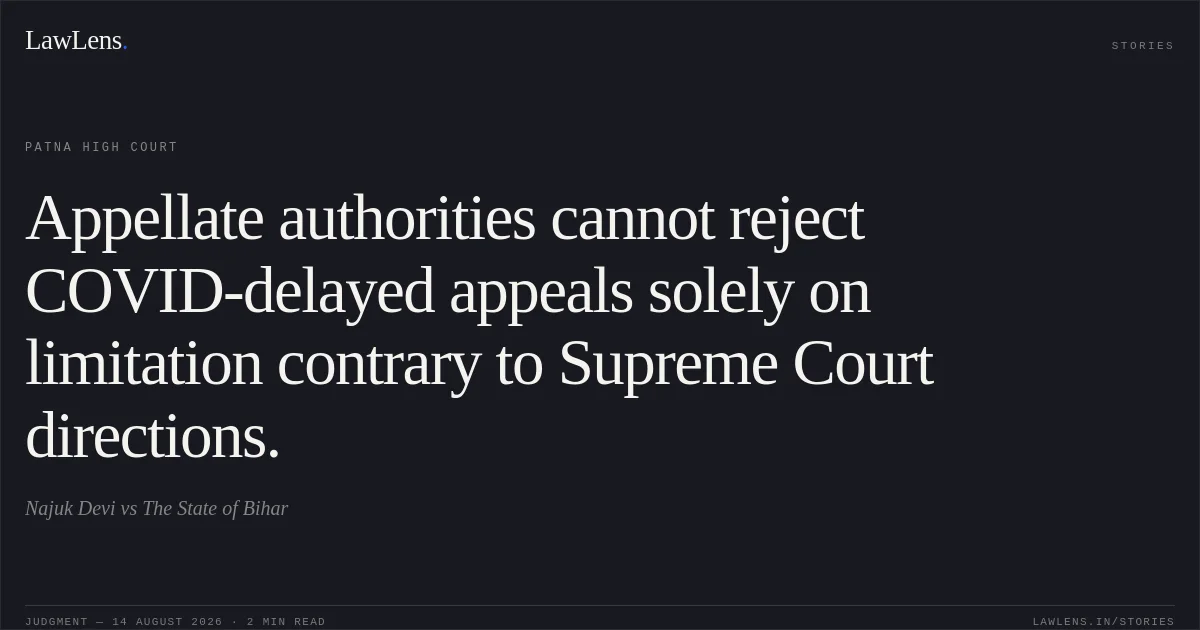
Whether the Appellate Authority and the Divisional Commissioner acted unlawfully in rejecting the petitioner’s appeal and revision solely on the ground of limitation without considering the Supreme Court’s COVID-19 limitation-relaxation directions?
Source reference: p.5, para.3; p.6, para.6Whether the matter should be remitted to the Appellate Authority for adjudication of the petitioner’s challenge to the cancellation of her PDS licence on merits?
Source reference: p.6, para.7Law Applied
The Court applied the Bihar Targeted Distribution System Control Order, 2016, under which the licensing authority exercised power to cancel the petitioner’s PDS licence.
Source reference: p.1, para.1It further applied the principles of natural justice, particularly the requirement of a fair opportunity of hearing before adverse administrative action, as raised in relation to the original cancellation order.
Source reference: pp.2–4, para.2The Court also relied on the Supreme Court’s directions issued during the COVID-19 pandemic extending or relaxing limitation periods for proceedings before courts and authorities, recognising that restrictions prevented persons from approaching legal forums within the ordinary limitation period.
Source reference: p.6, para.6Reasoning
The Court found that the Appellate Authority and the Divisional Commissioner had rejected the petitioner’s statutory remedies exclusively on limitation grounds, without adequately considering the exceptional circumstances created by the COVID-19 pandemic and the Supreme Court’s limitation-related directions.
Source reference: p.6, para.6Since the petitioner’s challenge to the cancellation order had not been examined on merits, the limitation-based orders were held to be arbitrary and illegal.
Source reference: p.6, para.7The Court therefore set aside both orders and considered it appropriate to remit the matter to the Appellate Authority for a fresh decision after hearing the parties.
Source reference: p.6, para.7Holding
The writ petition was disposed of by setting aside the Appellate Authority’s order dated 5 October 2021 in P.D.S. Appeal No. 8 of 2021 and the Divisional Commissioner’s order dated 30 September 2022 in Supply Revision Case No. 159 of 2022.
The petitioner was directed to file a fresh appeal within one month of receiving the High Court’s order, and the Appellate Authority was directed to decide it on merits by a reasoned and speaking order, after granting a fair hearing to both parties, within three months from the date of filing.
Source reference: p.6, para.8The original cancellation order was not finally adjudicated on merits and remained subject to the fresh appellate proceedings.
Source reference: p.6, para.8Original Court PDF
Najuk DevivsThe State of Bihar
Click to open original judgment
Original judgment, available to read, download and summarize on LawLens.in